
Pulp Fiction, 1865 · page 79 of 400
The Argosy — page 79: what you’re looking at
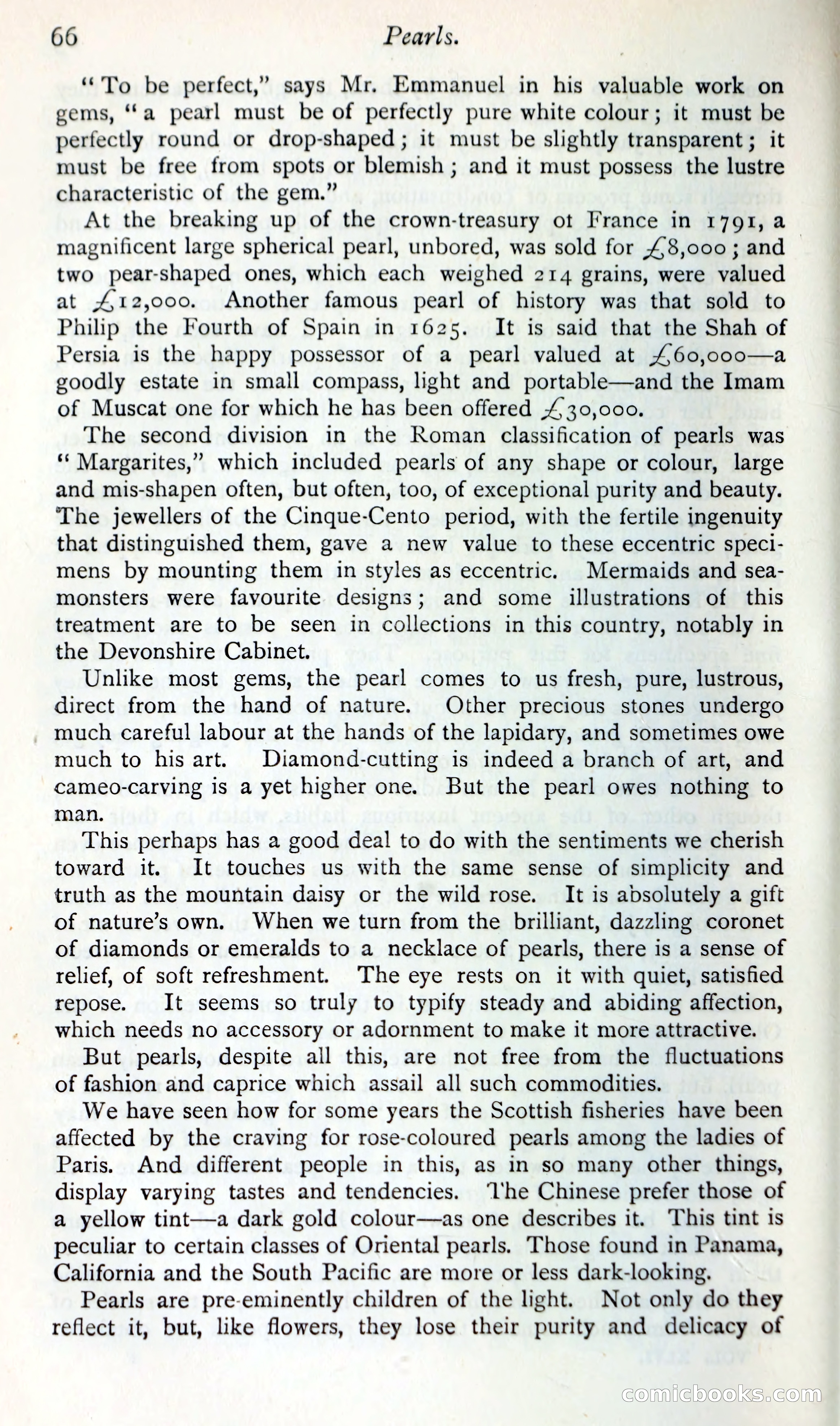
A restored page from Pulp Fiction, 1865. Page through the whole issue in the reader above.
📄 Transcribed text from this page (OCR, searchable)
Machine-transcribed from the original scan — historical spelling and the odd misread are preserved.
66 Pearls. “To be perfect,” says Mr. Emmanuel in his valuable work on gems, ‘fa pearl must be of perfectly pure white colour; it must be perfectly round or drop-shaped ; it must be slightly transparent; it must be free from spots or blemish ; and it must possess the lustre characteristic of the gem.” At the breaking up of the crown-treasury ot France in 1791, a magnificent large spherical pearl, unbored, was sold for 48,000 ; and two pear-shaped ones, which each weighed 214 grains, were valued at £12,000. Another famous pearl of history was that sold to Philip the Fourth of Spain in 1625. It is said that the Shah of Persia is the happy possessor of a pearl valued at 4£,60,0o00—a goodly estate in small compass, light and portable—and the Imam of Muscat one for which he has been offered 4 30,000. The second division in the Roman classification of pearls was ** Margarites,” which included pearls of any shape or colour, large and mis-shapen often, but often, too, of exceptional purity and beauty. The jewellers of the Cinque-Cento period, with the fertile ingenuity that distinguished them, gave a new value to these eccentric speci- mens by mounting them in styles as eccentric. Mermaids and sea- monsters were favourite designs; and some illustrations of this treatment are to be seen in collections in this country, notably in the Devonshire Cabinet. Unlike most gems, the pearl comes to us fresh, pure, lustrous, direct from the hand of nature. Other precious stones undergo much careful labour at the hands of the lapidary, and sometimes owe much to his art. Diamond-cutting is indeed a branch of art, and cameo-carving 1s a yet higher one. But the pearl owes nothing to man. This perhaps has a good deal to do with the sentiments we cherish toward it. It touches us with the same sense of simplicity and truth as the mountain daisy or the wild rose. It is absolutely a gift of nature’s own. When we turn from the brilliant, dazzling coronet of diamonds or emeralds to a necklace of pearls, there is a sense of relief, of soft refreshment. The eye rests on it with quiet, satisfied repose. It seems so truly to typify steady and abiding affection, which needs no accessory or adornment to make it more attractive. But pearls, despite all this, are not free from the fluctuations of fashion and caprice which assail all such commodities. We have seen how for some years the Scottish fisheries have been affected by the craving for rose-coloured pearls among the ladies of Paris. And different people in this, as in so many other things, display varying tastes and tendencies. ‘lhe Chinese prefer those of a yellow tint—a dark gold colour—as one describes it. This tint is peculiar to certain classes of Oriental pearls. Those found in Panama, California and the South Pacific are more or less dark-looking. Pearls are pre-eminently children of the light. Not only do they reflect it, but, like flowers, they lose their purity and delicacy of COMMIECOOOKS. EO