
Pulp Fiction, 1865 · page 58 of 400
The Argosy — page 58: what you’re looking at
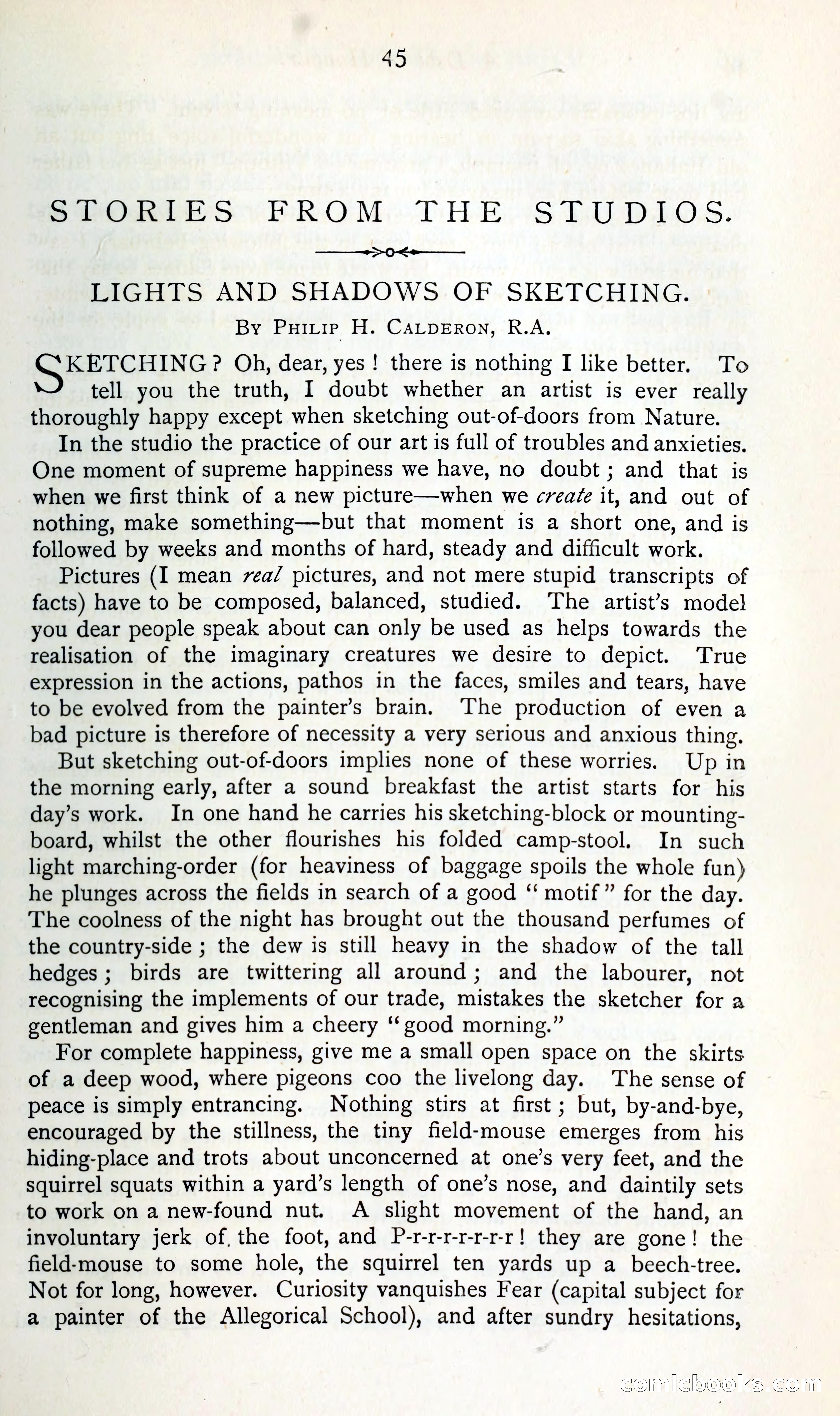
A restored page from Pulp Fiction, 1865. Page through the whole issue in the reader above.
📄 Transcribed text from this page (OCR, searchable)
Machine-transcribed from the original scan — historical spelling and the odd misread are preserved.
45 STORIES FROM THE STUDIOS. —__—->0<»—__ LIGHTS AND SHADOWS OF SKETCHING. By Puitip H. CALDERON, R.A. KETCHING? Oh, dear, yes! there is nothing I like better. To tell you the truth, I doubt whether an artist is ever really thoroughly happy except when sketching out-of-doors from Nature. In the studio the practice of our art is full of troubles and anxieties. One moment of supreme happiness we have, no doubt; and that is when we first think of a new picture—when we creaze it, and out of nothing, make something—but that moment is a short one, and is followed by weeks and months of hard, steady and difficult work. Pictures (I mean vea/ pictures, and not mere stupid transcripts of facts) have to be composed, balanced, studied. The artist’s model you dear people speak about can only be used as helps towards the realisation of the imaginary creatures we desire to depict. True expression in the actions, pathos in the faces, smiles and tears, have to be evolved from the painter’s brain. ‘The production of even a bad picture is therefore of necessity a very serious and anxious thing. But sketching out-of-doors implies none of these worries. Up in the morning early, after a sound breakfast the artist starts for his day’s work. In one hand he carries his sketching-block or mounting- board, whilst the other flourishes his folded camp-stool. In such light marching-order (for heaviness of baggage spoils the whole fun) he plunges across the fields in search of a good “ motif” for the day. The coolness of the night has brought out the thousand perfumes of the country-side ; the dew is still heavy in the shadow of the tall hedges; birds are twittering all around; and the labourer, not recognising the implements of our trade, mistakes the sketcher for a gentleman and gives him a cheery ‘good morning.” For complete happiness, give me a small open space on the skirts of a deep wood, where pigeons coo the livelong day. The sense of peace is simply entrancing. Nothing stirs at first ; but, by-and-bye, encouraged by the stillness, the tiny field-mouse emerges from his hiding-place and trots about unconcerned at one’s very feet, and the squirrel squats within a yard’s length of one’s nose, and daintily sets to work on a new-found nut. A slight movement of the hand, an involuntary jerk of, the foot, and P-r-r-r-r-r-r-r! they are gone! the field-mouse to some hole, the squirrel ten yards up a_beech-tree. Not for long, however. Curiosity vanquishes Fear (capital subject for a painter of the Allegorical School), and after sundry hesitations, SS (C(O) COMICLOOO©