
Pulp Fiction, 1865 · page 57 of 400
The Argosy — page 57: what you’re looking at
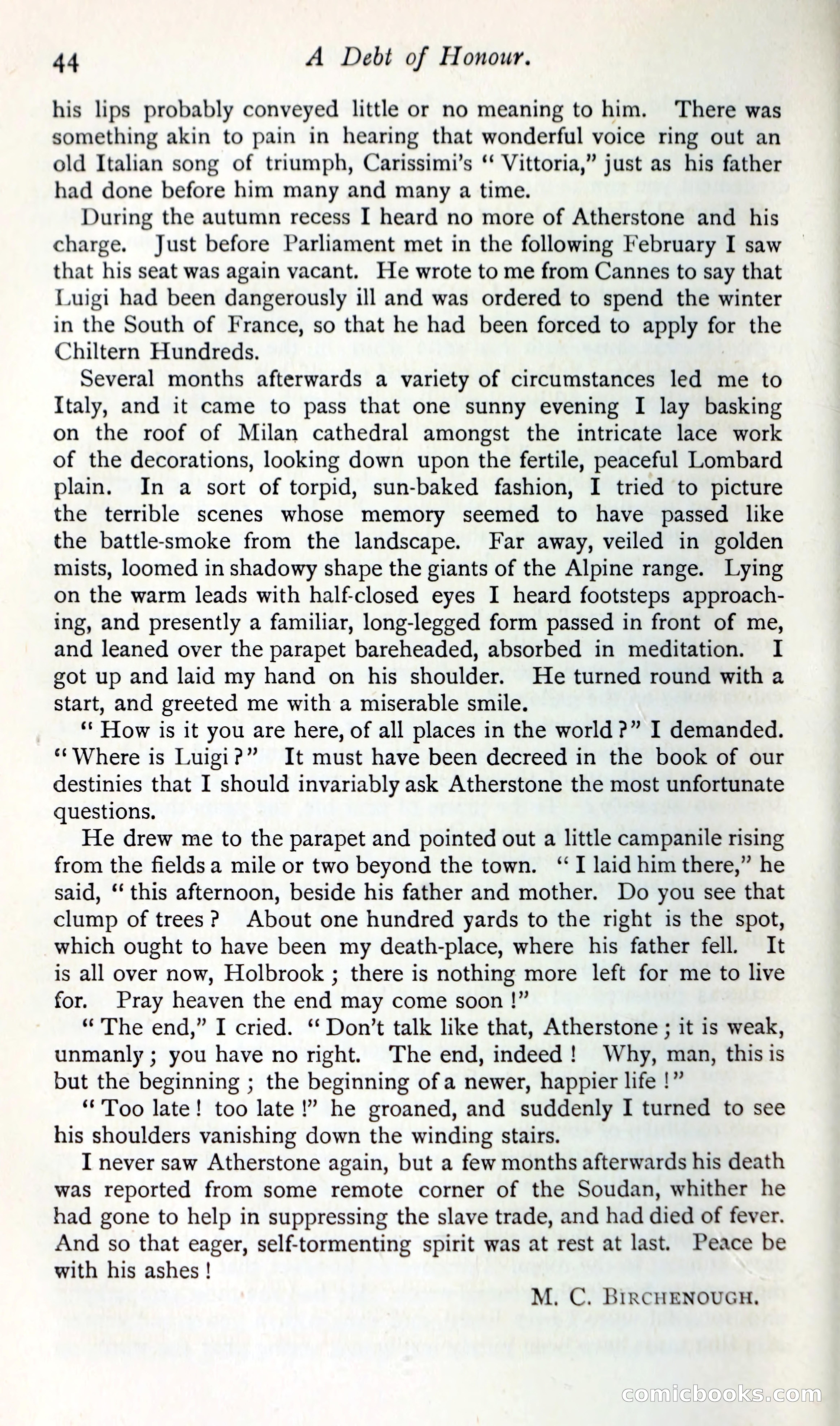
A restored page from Pulp Fiction, 1865. Page through the whole issue in the reader above.
📄 Transcribed text from this page (OCR, searchable)
Machine-transcribed from the original scan — historical spelling and the odd misread are preserved.
44 A Debt of Honour. his lips probably conveyed little or no meaning to him. There was something akin to pain in hearing that wonderful voice ring out an old Italian song of triumph, Carissimi’s “‘ Vittoria,” just as his father had done before him many and many a time. During the autumn recess I heard no more of Atherstone and his charge. Just before Parliament met in the following February I saw that his seat was again vacant. He wrote to me from Cannes to say that Luigi had been dangerously ill and was ordered to spend the winter in the South of France, so that he had been forced to apply for the Chiltern Hundreds. Several months afterwards a variety of circumstances led me to Italy, and it came to pass that one sunny evening I lay basking on the roof of Milan cathedral amongst the intricate lace work of the decorations, looking down upon the fertile, peaceful Lombard plain. In a sort of torpid, sun-baked fashion, I tried to picture the terrible scenes whose memory seemed to have passed like the battlessmoke from the landscape. Far away, veiled in golden mists, loomed in shadowy shape the giants of the Alpine range. Lying on the warm leads with half-closed eyes I heard footsteps approach- ing, and presently a familiar, long-legged form passed in front of me, and leaned over the parapet bareheaded, absorbed in meditation. I got up and laid my hand on his shoulder. He turned round with a start, and greeted me with a miserable smile. ‘* How is it you are here, of all places in the world ?” I demanded. ‘Where is Luigi?” It must have been decreed in the book of our destinies that I should invariably ask Atherstone the most unfortunate questions. He drew me to the parapet and pointed out a little campanile rising from the fieldsa mile or two beyond the town. ‘I laid him there,” he said, ‘‘ this afternoon, beside his father and mother. Do you see that clump of trees? About one hundred yards to the right is the spot, which ought to have been my death-place, where his father fell. It is all over now, Holbrook ; there is nothing more left for me to live for. Pray heaven the end may come soon !” “The end,” I cried. ‘‘ Don’t talk like that, Atherstone ; it is weak, unmanly ; you have no right. The end, indeed! Why, man, this is but the beginning ; the beginning ofa newer, happier life !” “Too late! too late!” he groaned, and suddenly I turned to see his shoulders vanishing down the winding stairs. I never saw Atherstone again, but a few months afterwards his death was reported from some remote corner of the Soudan, whither he had gone to help in suppressing the slave trade, and had died of fever. And so that eager, self-tormenting spirit was at rest at last. Peace be with his ashes ! M. C. BIRCHENOUGH. ECOPMICDOOKS. EO