
Pulp Fiction, 1865 · page 330 of 400
The Argosy — page 330: what you’re looking at
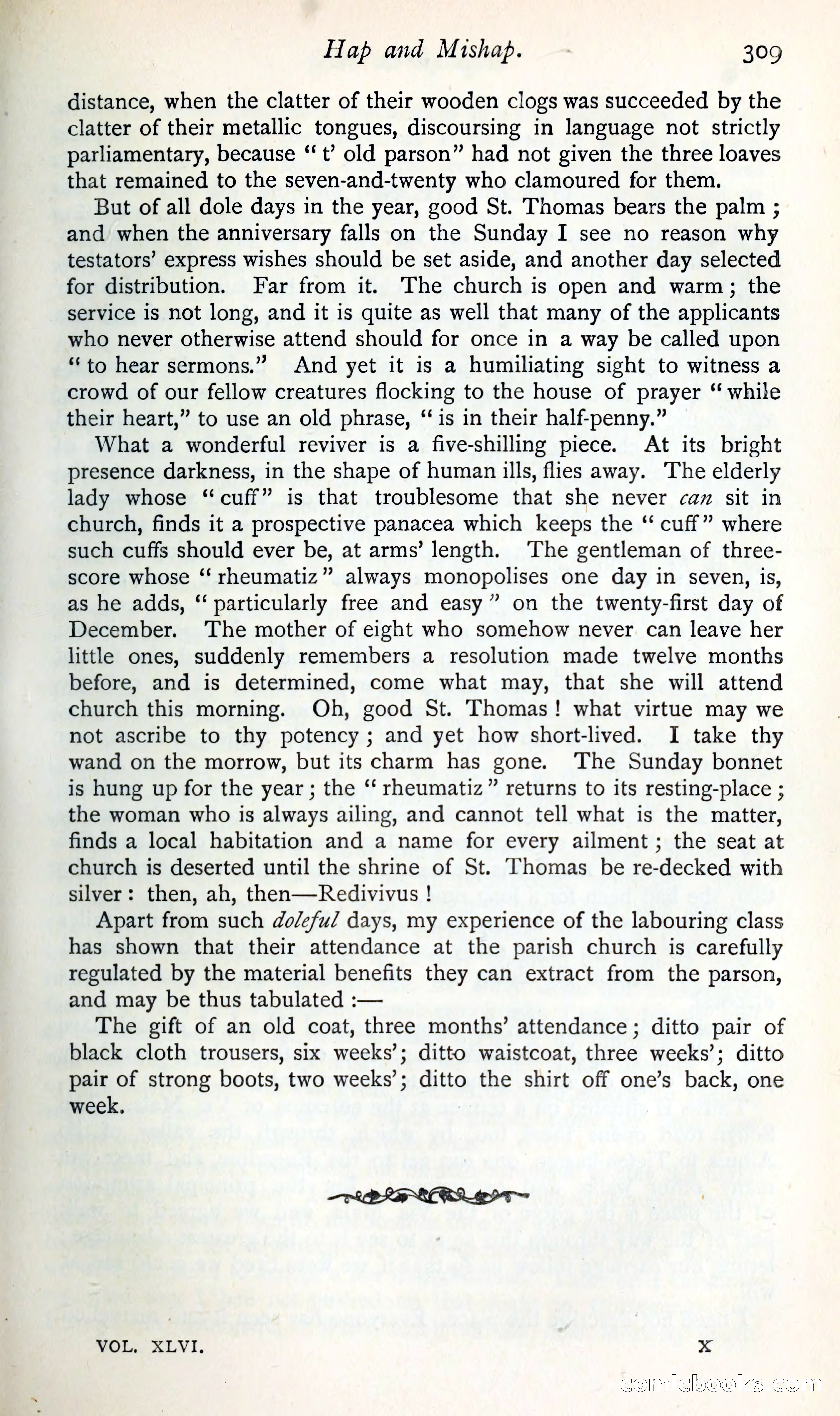
A restored page from Pulp Fiction, 1865. Page through the whole issue in the reader above.
📄 Transcribed text from this page (OCR, searchable)
Machine-transcribed from the original scan — historical spelling and the odd misread are preserved.
Hap and Mishap. - 309 distance, when the clatter of their wooden clogs was succeeded by the clatter of their metallic tongues, discoursing in language not strictly parliamentary, because “‘t’ old parson” had not given the three loaves that remained to the seven-and-twenty who clamoured for them. But of all dole days in the year, good St. Thomas bears the palm ; and when the anniversary falls on the Sunday I see no reason why testators’ express wishes should be set aside, and another day selected for distribution. Far from it. The church is open and warm; the service is not long, and it is quite as well that many of the applicants who never otherwise attend should for once in a way be called upon ‘to hear sermons.” And yet it is a humiliating sight to witness a crowd of our fellow creatures flocking to the house of prayer ‘‘ while their heart,” to use an old phrase, ‘‘ is in their half-penny.” What a wonderful reviver is a five-shilling piece. At its bright presence darkness, in the shape of human ills, flies away. The elderly lady whose “cuff” is that troublesome that she never caz sit in church, finds it a prospective panacea which keeps the ‘‘ cuff” where such cuffs should ever be, at arms’ length. ‘The gentleman of three- score whose “ rheumatiz” always monopolises one day in seven, is, as he adds, ‘‘ particularly free and easy” on the twenty-first day of December. ‘The mother of eight who somehow never can leave her little ones, suddenly remembers a resolution made twelve months before, and is determined, come what may, that she will attend church this morning. Oh, good St. Thomas! what virtue may we not ascribe to thy potency ; and yet how short-lived. I take thy wand on the morrow, but its charm has gone. The Sunday bonnet is hung up for the year ; the ‘‘ rheumatiz” returns to its resting-place ; the woman who is always ailing, and cannot tell what is the matter, finds a local habitation and a name for every ailment; the seat at church is deserted until the shrine of St. ‘Thomas be re-decked with silver: then, ah, then—Redivivus ! Apart from such doleful days, my experience of the labouring class has shown that their attendance at the parish church is carefully regulated by the material benefits they can extract from the parson, and may be thus tabulated :— The gift of an old coat, three months’ attendance; ditto pair of black cloth trousers, six weeks’; ditto waistcoat, three weeks’; ditto pair of strong boots, two weeks’; ditto the shirt off one’s back, one week. VOL. XLVI. x COMICOOOKS EO im