
Pulp Fiction, 1865 · page 325 of 400
The Argosy — page 325: what you’re looking at
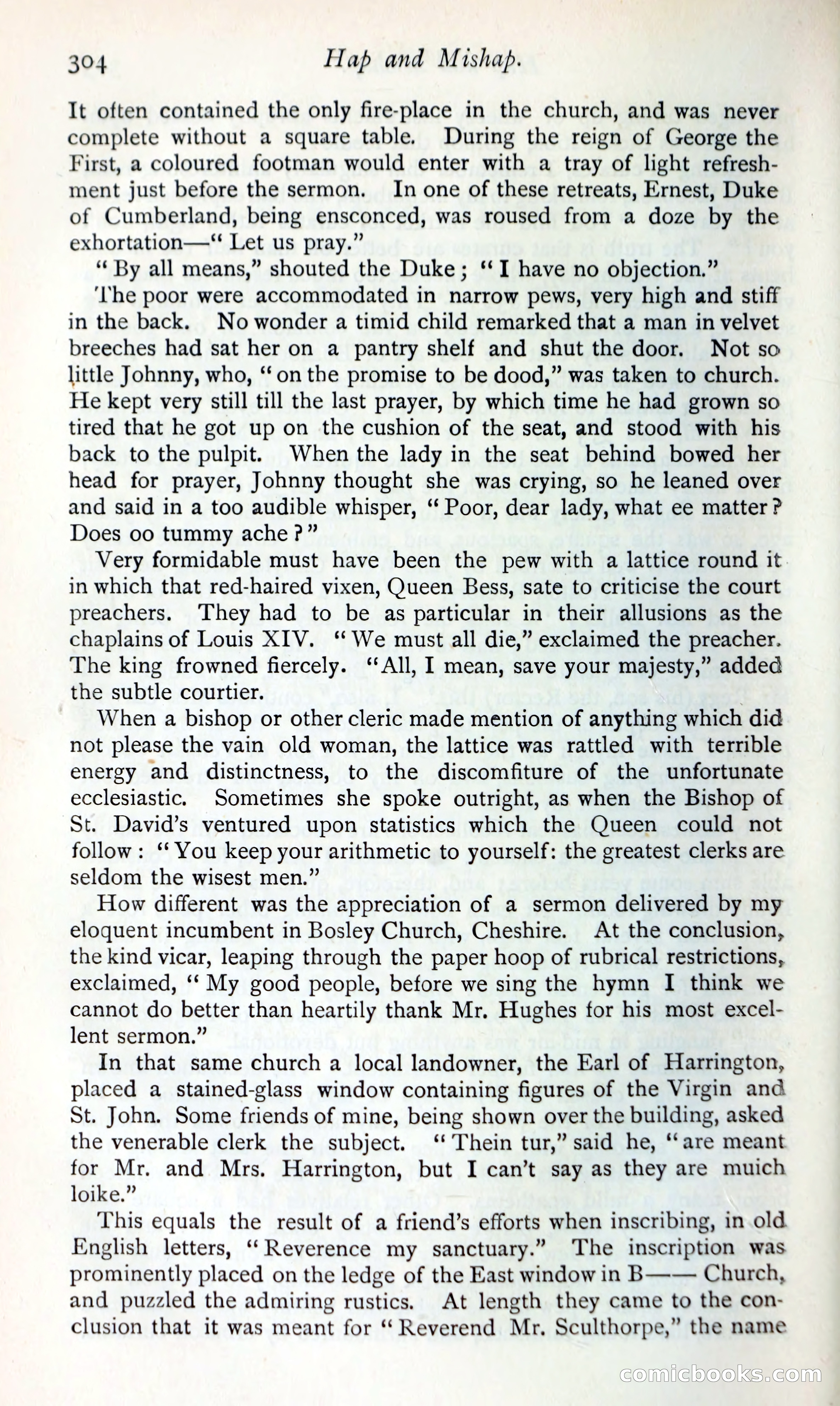
A restored page from Pulp Fiction, 1865. Page through the whole issue in the reader above.
📄 Transcribed text from this page (OCR, searchable)
Machine-transcribed from the original scan — historical spelling and the odd misread are preserved.
304 Hap and Mishap. It often contained the only fire-place in the church, and was never complete without a square table. During the reign of George the First, a coloured footman would enter with a tray of light refresh- ment just before the sermon. In one of these retreats, Ernest, Duke of Cumberland, being ensconced, was roused from a doze by the exhortation—‘ Let us pray.” ‘‘ By all means,” shouted the Duke; ‘‘I have no objection.” ‘he poor were accommodated in narrow pews, very high and stiff in the back. No wonder a timid child remarked that a man in velvet breeches had sat her on a pantry shelf and shut the door. Not so little Johnny, who, ‘‘on the promise to be dood,” was taken to church. He kept very still till the last prayer, by which time he had grown so tired that he got up on the cushion of the seat, and stood with his back to the pulpit. When the lady in the seat behind bowed her head for prayer, Johnny thought she was crying, so he leaned over and said in a too audible whisper, ‘‘ Poor, dear lady, what ee matter P Does oo tummy ache ?” Very formidable must have been the pew with a lattice round it in which that red-haired vixen, Queen Bess, sate to criticise the court preachers. ‘They had to be as particular in their allusions as the chaplains of Louis XIV. ‘‘ We must all die,” exclaimed the preacher. The king frowned fiercely. ‘All, I mean, save your majesty,” added the subtle courtier. | When a bishop or other cleric made mention of anything which did not please the vain old woman, the lattice was rattled with terrible energy and distinctness, to the discomfiture of the unfortunate ecclesiastic. Sometimes she spoke outright, as when the Bishop of St. David’s ventured upon statistics which the Queen could not follow: ‘‘ You keep your arithmetic to yourself: the greatest clerks are seldom the wisest men.” How different was the appreciation of a sermon delivered by my eloquent incumbent in Bosley Church, Cheshire. At the conclusion, the kind vicar, leaping through the paper hoop of rubrical restrictions, exclaimed, ‘‘ My good people, before we sing the hymn I think we cannot do better than heartily thank Mr. Hughes for his most excel- lent sermon.” In that same church a local landowner, the Earl of Harrington, placed a stained-glass window containing figures of the Virgin and St. John. Some friends of mine, being shown over the building, asked the venerable clerk the subject. ‘‘ Thein tur,” said he, ‘are meant for Mr. and Mrs, Harrington, but I can’t say as they are muich loike.” This equals the result of a friend’s efforts when inscribing, in old English letters, ‘‘Reverence my sanctuary.” ‘The inscription was prominently placed on the ledge of the East window in B—— Church, and puzzled the admiring rustics. At length they came to the con- clusion that it was meant for ‘Reverend Mr. Sculthorpe,” the name ECORNIECLIOOKS EO m