
Pulp Fiction, 1865 · page 316 of 400
The Argosy — page 316: what you’re looking at
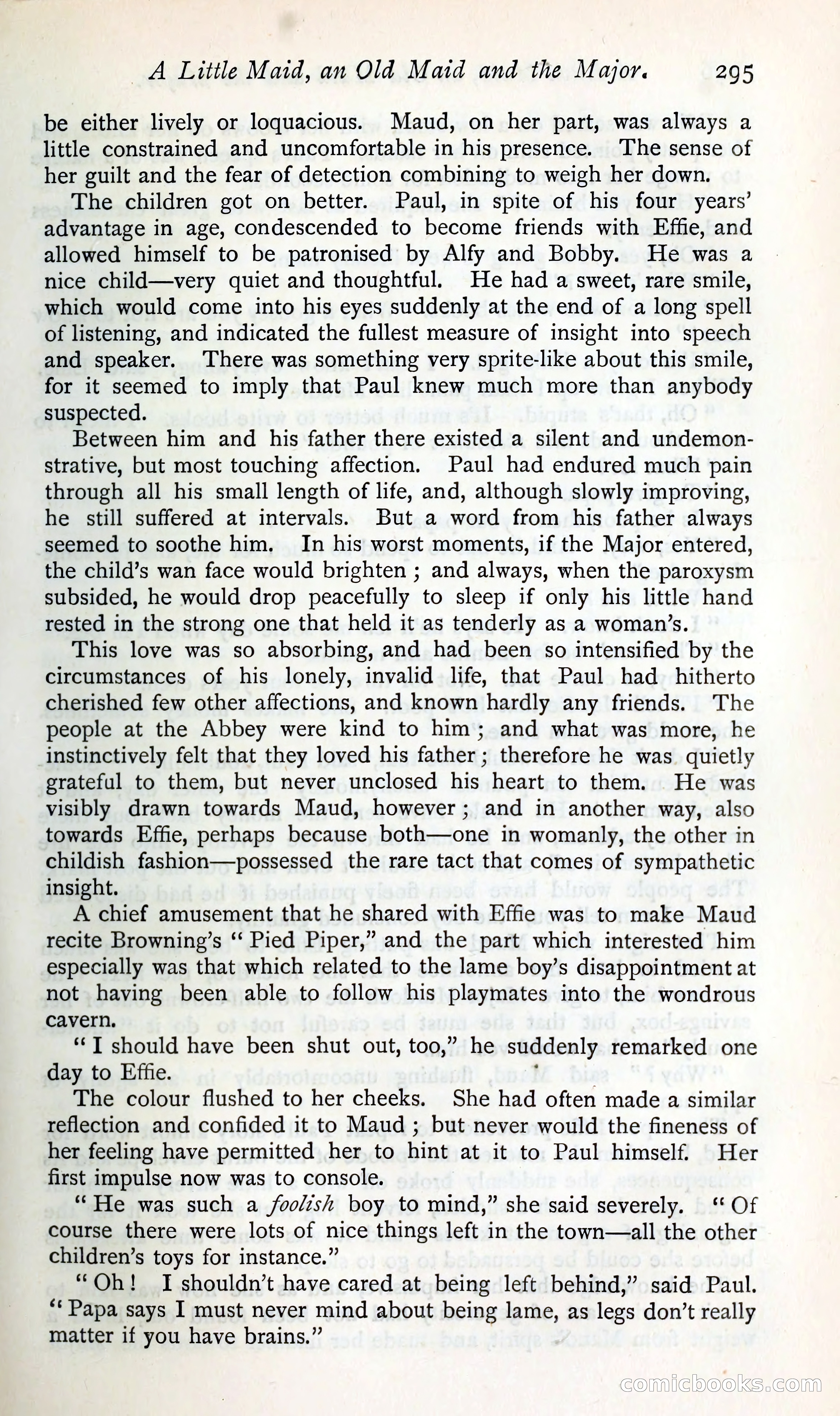
A restored page from Pulp Fiction, 1865. Page through the whole issue in the reader above.
📄 Transcribed text from this page (OCR, searchable)
Machine-transcribed from the original scan — historical spelling and the odd misread are preserved.
A Little Maid, an Old Matd and the Major. 295 be either lively or loquacious. Maud, on her part, was always a little constrained and uncomfortable in his presence. ‘The sense of her guilt and the fear of detection combining to weigh her down. The children got on better. Paul, in spite of his four years’ advantage in age, condescended to become friends with Effie, and allowed himself to be patronised by Alfy and Bobby. He was a nice child—very quiet and thoughtful. He had a sweet, rare smile, which would come into his eyes suddenly at the end of a long spell of listening, and indicated the fullest measure of insight into speech and speaker. ‘There was something very sprite-like about this smile, for it seemed to imply that Paul knew much more than anybody suspected. Between him and his father there existed a silent and undemon- strative, but most touching affection. Paul had endured much pain through all his small length of life, and, although slowly improving, he still suffered at intervals. But a word from his father always seemed to soothe him. In his worst moments, if the Major entered, the child’s wan face would brighten ; and always, when the paroxysm subsided, he would drop peacefully to sleep if only his little hand rested in the strong one that held it as tenderly as a woman’s. This love was so absorbing, and had been so intensified by the circumstances of his lonely, invalid life, that Paul had hitherto cherished few other affections, and known hardly any friends. The people at the Abbey were kind to him; and what was more, he instinctively felt that they loved his father; therefore he was quietly grateful to them, but never unclosed his heart to them. He was visibly drawn towards Maud, however; and in another way, also towards Effie, perhaps because both—one in womanly, the other in childish fashion—possessed the rare tact that comes of sympathetic insight. A chief amusement that he shared with Effie was to make Maud recite Browning’s ‘‘ Pied Piper,” and the part which interested him especially was that which related to the lame boy’s disappointment at not having been able to follow his playmates into the wondrous cavern. ‘IT should have been shut out, too,” he suddenly remarked one day to Effie. ; | The colour flushed to her cheeks. She had often made a similar reflection and confided it to Maud; but never would the fineness of her feeling have permitted her to hint at it to Paul himself. Her first impulse now was to console. ‘““He was such a foolzsh boy to mind,” she said severely. ‘‘ Of course there were lots of nice things left in the town—all the other children’s toys for instance.” “Oh! I shouldn’t have cared at being left behind,” said Paul. ‘‘ Papa says I must never mind about being lame, as legs don’t really matter if you have brains.” connicloooks (C(O)