
Pulp Fiction, 1865 · page 315 of 400
The Argosy — page 315: what you’re looking at
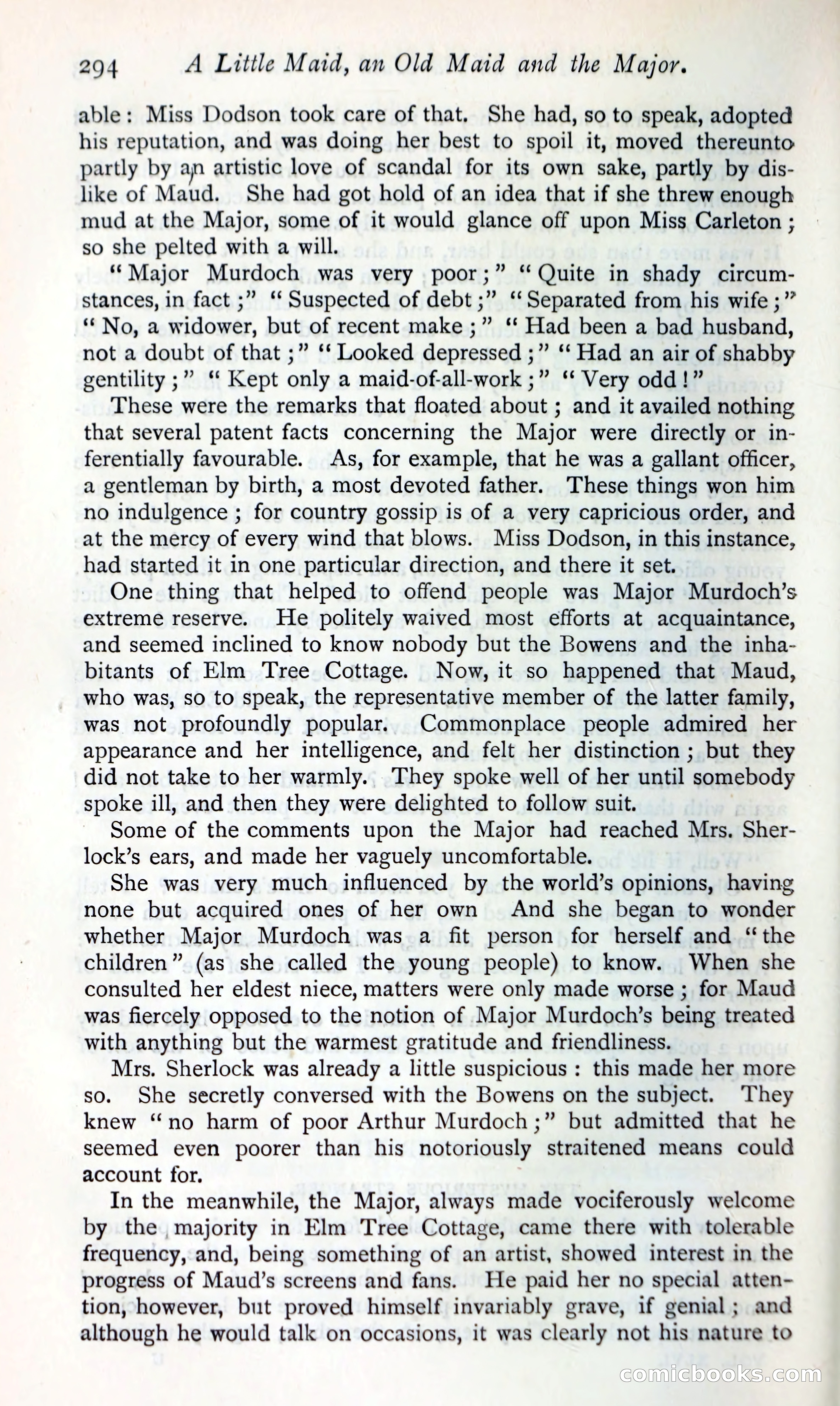
A restored page from Pulp Fiction, 1865. Page through the whole issue in the reader above.
📄 Transcribed text from this page (OCR, searchable)
Machine-transcribed from the original scan — historical spelling and the odd misread are preserved.
294 A Little Maid, an Old Maid and the Major. able: Miss Dodson took care of that. She had, so to speak, adopted his reputation, and was doing her best to spoil it, moved thereunto partly by an artistic love of scandal for its own sake, partly by dis- like of Maud. She had got hold of an idea that if she threw enough mud at the Major, some of it would glance off upon Miss Carleton ; so she pelted with a will. Major Murdoch was very poor;” ‘Quite in shady circum- stances, in fact ;” ‘‘ Suspected of debt ;” ‘‘ Separated from his wife ;” ‘* No, a widower, but of recent make ;” ‘‘ Had been a bad husband, not a doubt of that ;” ‘‘ Looked depressed ;” ‘‘ Had an air of shabby gentility ;” ‘‘ Kept only a maid-of-all-work ;” ‘‘ Very odd!” These were the remarks that floated about ; and it availed nothing that several patent facts concerning the Major were directly or in- ferentially favourable. As, for example, that he was a gallant officer, a gentleman by birth, a most devoted father. These things won him no indulgence ; for country gossip is of a very capricious order, and at the mercy of every wind that blows. Miss Dodson, in this instance, had started it in one particular direction, and there it set. One thing that helped to offend people was Major Murdoch’s extreme reserve. He politely waived most efforts at acquaintance, and seemed inclined to know nobody but the Bowens and the inha- bitants of Elm Tree Cottage. Now, it so happened that Maud, who was, so to speak, the representative member of the latter family, was not profoundly popular. Commonplace people admired her appearance and her intelligence, and felt her distinction ; but they did not take to her warmly. They spoke well of her until somebody spoke ill, and then they were delighted to follow suit. Some of the comments upon the Major had reached Mrs. Sher- lock’s ears, and made her vaguely uncomfortable. She was very much influenced by the world’s opinions, having none but acquired ones of her own And she began to wonder whether Major Murdoch was a fit person for herself and “the children” (as she called the young people) to know. When she consulted her eldest niece, matters were only made worse ; for Maud was fiercely opposed to the notion of Major Murdoch’s being treated with anything but the warmest gratitude and friendliness. Mrs. Sherlock was already a little suspicious: this made her more so. She secretly conversed with the Bowens on the subject. They knew ‘no harm of poor Arthur Murdoch ;” but admitted that he seemed even poorer than his notoriously straitened means could account for. In the meanwhile, the Major, always made vociferously welcome by the majority in Elm Tree Cottage, came there with tolerable frequency, and, being something of an artist, showed interest in the progress of Maud’s screens and fans. He paid her no special atten- tion, however, but proved himself invariably grave, if genial; and although he would talk on occasions, it was clearly not his nature to ECORNIECLIOOKS EO m