
Pulp Fiction, 1865 · page 279 of 400
The Argosy — page 279: what you’re looking at
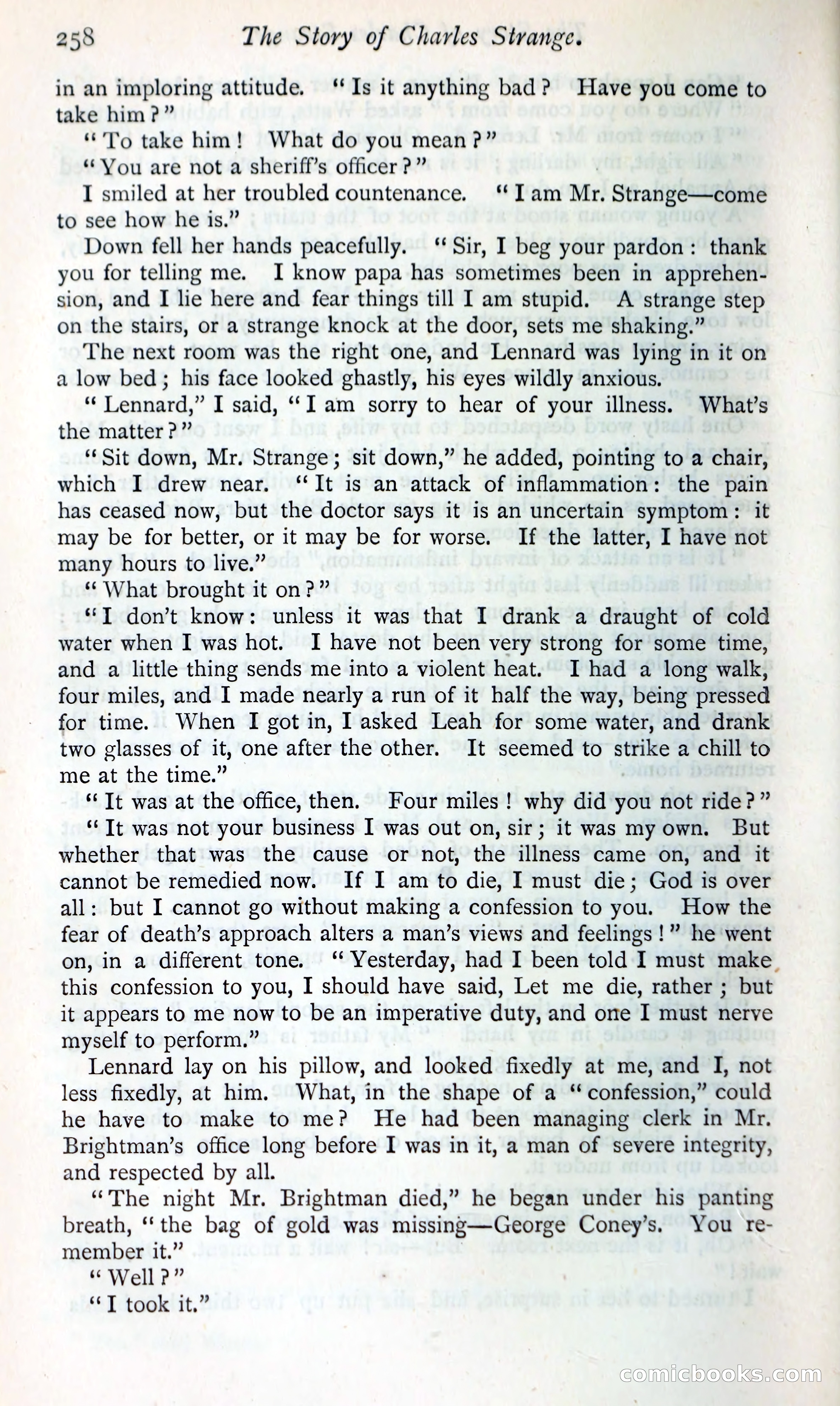
A restored page from Pulp Fiction, 1865. Page through the whole issue in the reader above.
📄 Transcribed text from this page (OCR, searchable)
Machine-transcribed from the original scan — historical spelling and the odd misread are preserved.
258 The Story of Charles Strange. in an imploring attitude. ‘Is it anything bad? Have you come to take him ?” “To take him! What do you mean P” ‘You are not a sheriff’s officer P” I smiled at her troubled countenance. ‘Iam Mr. Strange—come to see how he is.” Down fell her hands peacefully. ‘Sir, I beg your pardon: thank you for telling me. I know papa has sometimes been in apprehen- sion, and I lie here and fear things till 1 am stupid. A strange step on the stairs, or a strange knock at the door, sets me shaking.” The next room was the right one, and Lennard was lying in it on a low bed; his face looked ghastly, his eyes wildly anxious. ‘ Lennard,” I said, ‘‘I am sorry to hear of your illness. What’s the matter?” Sit down, Mr. Strange; sit down,” he added, pointing to a chair, which I drew near. ‘It is an attack of inflammation: the pain has ceased now, but the doctor says it is an uncertain symptom: it may be for better, or it may be for worse. If the latter, I have not many hours to live.” “What brought it on?” “TI don’t know: unless it was that I drank a draught of cold water when I was hot. I have not been very strong for some time, and a little thing sends me into a violent heat. I had a long walk, four miles, and I made nearly a run of it half the way, being pressed for time. When I got in, I asked Leah for some water, and drank two glasses of it, one after the other. It seemed to strike a chill to me at the time.” ‘Tt was at the office, then. Four miles! why did you not ride?” ‘Tt was not your business I was out on, sir; it was my own. But whether that was the cause or not, the illness came on, and it cannot be remedied now. If I am to die, I must die; God is over all: but I cannot go without making a confession to you. How the fear of death’s approach alters a man’s views and feelings!” he went on, in a different tone. ‘‘ Yesterday, had I been told I must make this confession to you, I should have said, Let me die, rather ; but it appears to me now to be an imperative duty, and one I must nerve myself to perform.” Lennard lay on his pillow, and looked fixedly at me, and I, not less fixedly, at him. What, in the shape of a “confession,” could he have to make to me? He had been managing clerk in Mr. Brightman’s office long before I was in it, a man of severe integrity, and respected by all. “The night Mr. Brightman died,” he began under his panting breath, “the bag of gold was missing—George Coney’s. You re- member it.” Well ?” T took it.” ECORNIELIOOKS.E© m