
Pulp Fiction, 1865 · page 278 of 400
The Argosy — page 278: what you’re looking at
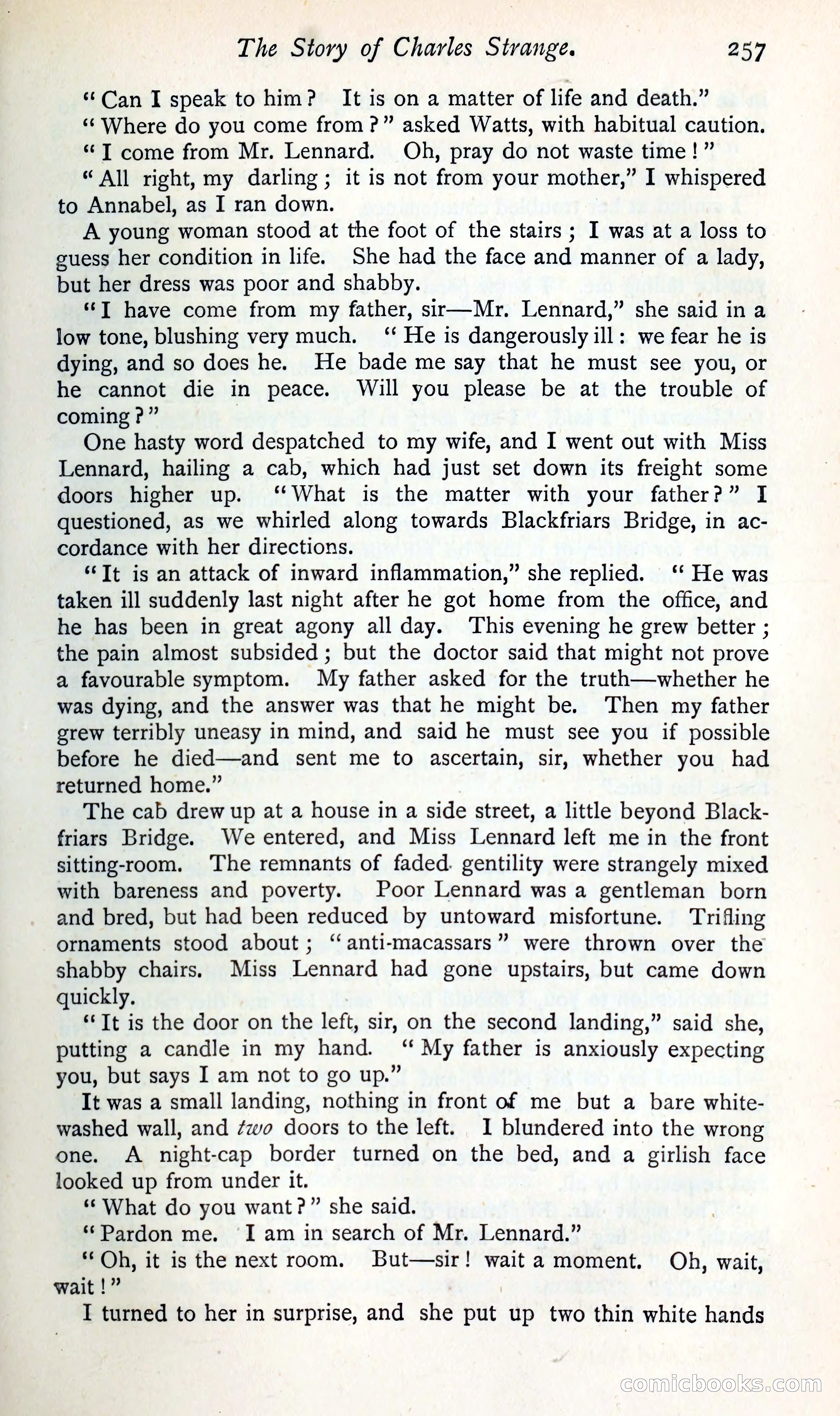
A restored page from Pulp Fiction, 1865. Page through the whole issue in the reader above.
📄 Transcribed text from this page (OCR, searchable)
Machine-transcribed from the original scan — historical spelling and the odd misread are preserved.
The Story of Charles Strange. 257 ‘Can I speak to him? It is on a matter of life and death.” ‘¢ Where do you come from ?” asked Watts, with habitual caution. ‘“ T come from Mr. Lennard. Oh, pray do not waste time!” “ All right, my darling; it is not from your mother,” I whispered to Annabel, as I ran down. A young woman stood at the foot of the stairs ; I was at a loss to guess her condition in life. She had the face and manner of a lady, but her dress was poor and shabby. ‘T have come from my father, sir—Mr. Lennard,” she said in a low tone, blushing very much. ‘‘ He is dangerously ill: we fear he is dying, and so does he. He bade me say that he must see you, or he cannot die in peace. Will you please be at the trouble of coming ?” | One hasty word despatched to my wife, and I went out with Miss Lennard, hailing a cab, which had just set down its freight some doors higher up. ‘‘What is the matter with your father?” I questioned, as we whirled along towards Blackfriars Bridge, in ac- cordance with her directions. ‘‘Tt is an attack of inward inflammation,” she replied. ‘‘ He was taken ill suddenly last night after he got home from the office, and he has been in great agony all day. ‘This evening he grew better ; the pain almost subsided; but the doctor said that might not prove a favourable symptom. My father asked for the truth—whether he was dying, and the answer was that he might be. Then my father grew terribly uneasy in mind, and said he must see you if possible before he died—and sent me to ascertain, sir, whether you had returned home.” | The cab drew up at a house in a side street, a little beyond Black- friars Bridge. We entered, and Miss Lennard left me in the front sitting-room. The remnants of faded. gentility were strangely mixed with bareness and poverty. Poor Lennard was a gentleman born and bred, but had been reduced by untoward misfortune. Trifling ornaments stood about; ‘“‘anti-macassars” were thrown over the shabby chairs. Miss Lennard had gone upstairs, but came down quickly. ‘Tt is the door on the left, sir, on the second landing,” said she, putting a candle in my hand. ‘“ My father is anxiously expecting you, but says I am not to go up.” It was a small landing, nothing in front of me but a bare white- washed wall, and ¢wo doors to the left. 1 blundered into the wrong one. A night-cap border turned on the bed, and a girlish face looked up from under it. ‘‘ What do you want?” she said. ‘Pardon me. I am in search of Mr. Lennard.” ‘Oh, it is the next room. But—sir! waita moment. Oh, wait, wait !” . I turned to her in surprise, and she put up two thin white hands conniclooolkks (CO)