
Pulp Fiction, 1865 · page 247 of 400
The Argosy — page 247: what you’re looking at
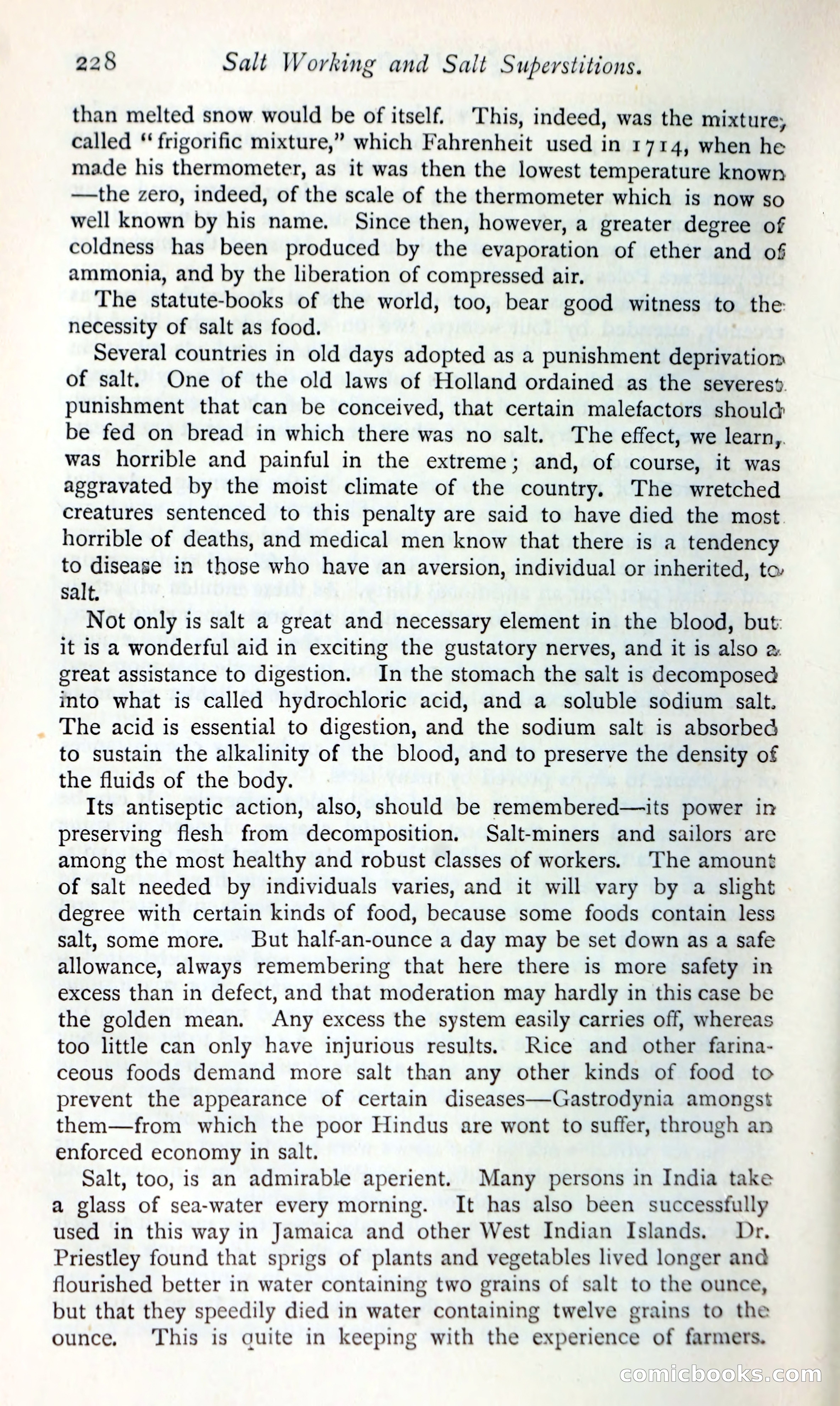
A restored page from Pulp Fiction, 1865. Page through the whole issue in the reader above.
📄 Transcribed text from this page (OCR, searchable)
Machine-transcribed from the original scan — historical spelling and the odd misread are preserved.
228 Salt Working and Salt Superstitions. than melted snow would be of itself. This, indeed, was the mixture; called “ frigorific mixture,” which Fahrenheit used in 1714, when he made his thermometer, as it was then the lowest temperature known —the zero, indeed, of the scale of the thermometer which is now so well known by his name. Since then, however, a greater degree of coldness has been produced by the evaporation of ether and of ammonia, and by the liberation of compressed air. The statute-books of the world, too, bear good witness to the necessity of salt as food. Several countries in old days adopted as a punishment deprivation of salt. One of the old laws of Holland ordained as the severes>. punishment that can be conceived, that certain malefactors should be fed on bread in which there was no salt. The effect, we learn,. was horrible and painful in the extreme; and, of course, it was aggravated by the moist climate of the country. The wretched creatures sentenced to this penalty are said to have died the most horrible of deaths, and medical men know that there is a tendency to disease in those who have an aversion, individual or inherited, to. salt. Not only is salt a great and necessary element in the blood, but: it is a wonderful aid in exciting the gustatory nerves, and it is also a. great assistance to digestion. In the stomach the salt is decomposed into what is called hydrochloric acid, and a soluble sodium salt. _ The acid is essential to digestion, and the sodium salt is absorbed to sustain the alkalinity of the blood, and to preserve the density of the fluids of the body. Its antiseptic action, also, should be remembered—its power in preserving flesh from decomposition. Salt-miners and sailors are among the most healthy and robust classes of workers. ‘The amount of salt needed by individuals varies, and it will vary by a slight degree with certain kinds of food, because some foods contain less salt, some more. But half-an-ounce a day may be set down as a safe allowance, always remembering that here there is more safety in excess than in defect, and that moderation may hardly in this case be the golden mean. Any excess the system easily carries off, whereas too little can only have injurious results. Rice and other farina- ceous foods demand more salt than any other kinds of food to prevent the appearance of certain diseases—Gastrodynia amongst them—from which the poor Hindus are wont to suffer, through an enforced economy in salt. Salt, too, is an admirable aperient. Many persons in India take a glass of sea-water every morning. It has also been successfully used in this way in Jamaica and other West Indian Islands. Dr. Priestley found that sprigs of plants and vegetables lived longer and flourished better in water containing two grains of salt to the ounce, but that they speedily died in water containing twelve grains to the ounce. This is guite in keeping with the experience of farmers. CORNIELOOLKS (E€©) m