
Pulp Fiction, 1865 · page 50 of 400
The Argosy — page 50: what you’re looking at
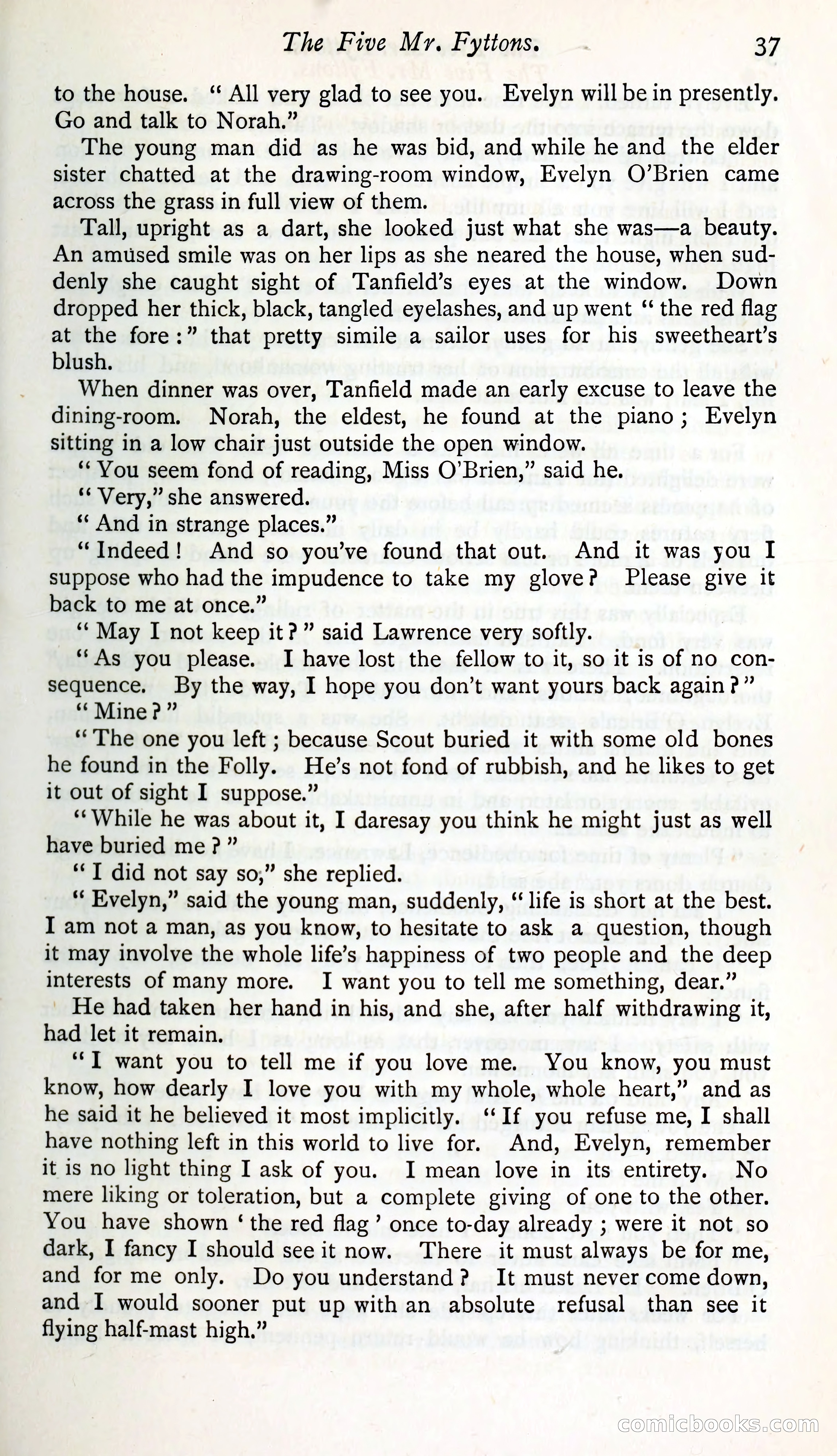
A restored page from Pulp Fiction, 1865. Page through the whole issue in the reader above.
📄 Transcribed text from this page (OCR, searchable)
Machine-transcribed from the original scan — historical spelling and the odd misread are preserved.
The Five Mr. Fyttons. 37 to the house. “ All very glad to see you. Evelyn will bein presently. Go and talk to Norah.” The young man did as he was bid, and while he and the elder sister chatted at the drawing-room window, Evelyn O’Brien came across the grass in full view of them. Tall, upright as a dart, she looked just what she was—a beauty. An amused smile was on her lips as she neared the house, when sud- denly she caught sight of Tanfield’s eyes at the window. Down dropped her thick, black, tangled eyelashes, and up went ‘‘ the red flag at the fore:” that pretty simile a sailor uses for his sweetheart’s blush. When dinner was over, Tanfield made an early excuse to leave the dining-room. Norah, the eldest, he found at the piano; Evelyn sitting in a low chair just outside the open window. “You seem fond of reading, Miss O’Brien,” said he. ** Very,” she answered. ** And in strange places.” “Indeed! And so you’ve found that out. And it was you I suppose who had the impudence to take my glove? Please give it back to me at once.” ‘* May I not keep it?” said Lawrence very softly. ‘“As you please. I have lost the fellow to it, so it is of no con- sequence, By the way, I hope you don’t want yours back again ?” “ Mine?” “The one you left ; because Scout buried it with some old bones he found in the Folly. He’s not fond of rubbish, and he likes to get it out of sight I suppose.” ‘While he was about it, I daresay you think he might just as well have buried me?” ‘*T did not say so,” she replied. Evelyn,” said the young man, suddenly, “life is short at the best. I am not a man, as you know, to hesitate to ask a question, though it may involve the whole life’s happiness of two people and the deep interests of many more. I want you to tell me something, dear.” _ He had taken her hand in his, and she, after half withdrawing it, had let it remain. ‘“] want you to tell me if you love me. You know, you must know, how dearly I love you with my whole, whole heart,” and as he said it he believed it most implicitly. ‘If you refuse me, I shall have nothing left in this world to live for. And, Evelyn, remember it is no light thing I ask of you. I mean love in its entirety. No mere liking or toleration, but a complete giving of one to the other. You have shown ‘the red flag’ once to-day already ; were it not so dark, I fancy I should see it now. There it must always be for me, and forme only. Do you understand? It must never come down, and I would sooner put up with an absolute refusal than see it flying half-mast high,” cComicooolks (C(O) mn