
Pulp Fiction, 1865 · page 49 of 400
The Argosy — page 49: what you’re looking at
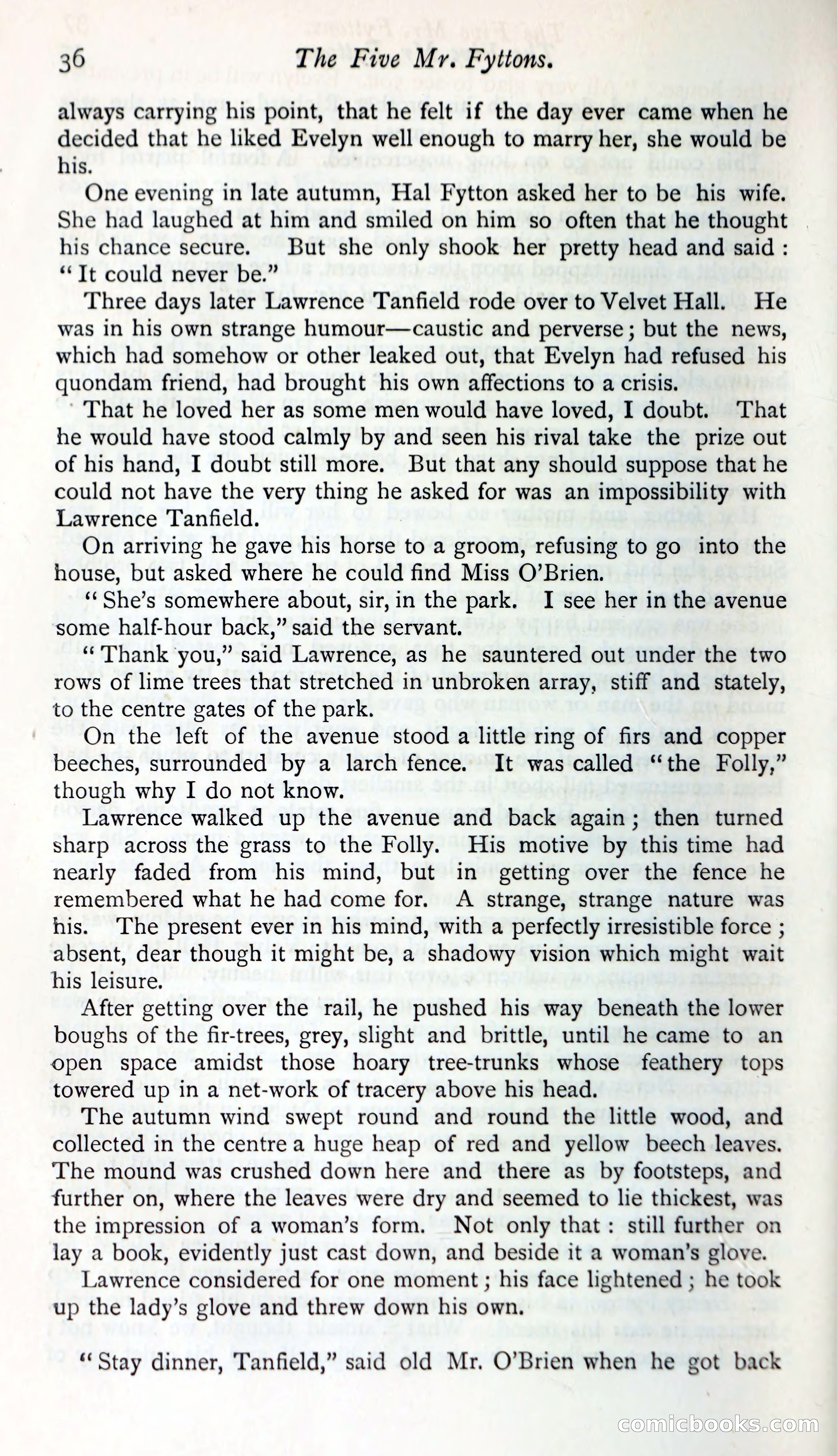
A restored page from Pulp Fiction, 1865. Page through the whole issue in the reader above.
📄 Transcribed text from this page (OCR, searchable)
Machine-transcribed from the original scan — historical spelling and the odd misread are preserved.
36 The Five Mr. Fyttons. always carrying his point, that he felt if the day ever came when he decided that he liked Evelyn well enough to marry her, she would be his. One evening in late autumn, Hal Fytton asked her to be his wife. She had laughed at him and smiled on him so often that he thought | his chance secure. But she only shook her pretty head and said : “Tt could never be.” Three days later Lawrence Tanfield rode over to Velvet Hall. He was in his own strange humour—caustic and perverse; but the news, which had somehow or other leaked out, that Evelyn had refused his quondam friend, had brought his own affections to a crisis. That he loved her as some men would have loved, I doubt. That he would have stood calmly by and seen his rival take the prize out of his hand, I doubt still more. But that any should suppose that he could not have the very thing he asked for was an impossibility with Lawrence Tanfield. On arriving he gave his horse to a groom, refusing to go into the house, but asked where he could find Miss O’Brien. ‘¢ She’s somewhere about, sir,in the park. I see her in the avenue some half-hour back,” said the servant. “Thank you,” said Lawrence, as he sauntered out under the two rows of lime trees that stretched in unbroken array, stiff and stately, to the centre gates of the park. On the left of the avenue stood a little ring of firs and copper beeches, surrounded by a larch fence. It was called “the Folly,” though why I do not know. Lawrence walked up the avenue and back again; then turned sharp across the grass to the Folly. His motive by this time had nearly faded from his mind, but in getting over the fence he remembered what he had come for. A strange, strange nature was his. The present ever in his mind, with a perfectly irresistible force ; absent, dear though it might be, a shadowy vision which might wait his leisure. After getting over the rail, he pushed his way beneath the lower boughs of the fir-trees, grey, slight and brittle, until he came to an open space amidst those hoary tree-trunks whose feathery tops towered up in a net-work of tracery above his head. The autumn wind swept round and round the little wood, and collected in the centre a huge heap of red and yellow beech leaves. The mound was crushed down here and there as by footsteps, and further on, where the leaves were dry and seemed to lie thickest, was the impression of a woman’s form. Not only that: still further on lay a book, evidently just cast down, and beside it a woman’s glove. Lawrence considered for one moment ; his face lightened ; he took up the lady’s glove and threw down his own. ‘Stay dinner, Tanfield,” said old Mr. O’Brien when he got back CONMICLOOKS. © im