
Pulp Fiction, 1865 · page 303 of 400
The Argosy — page 303: what you’re looking at
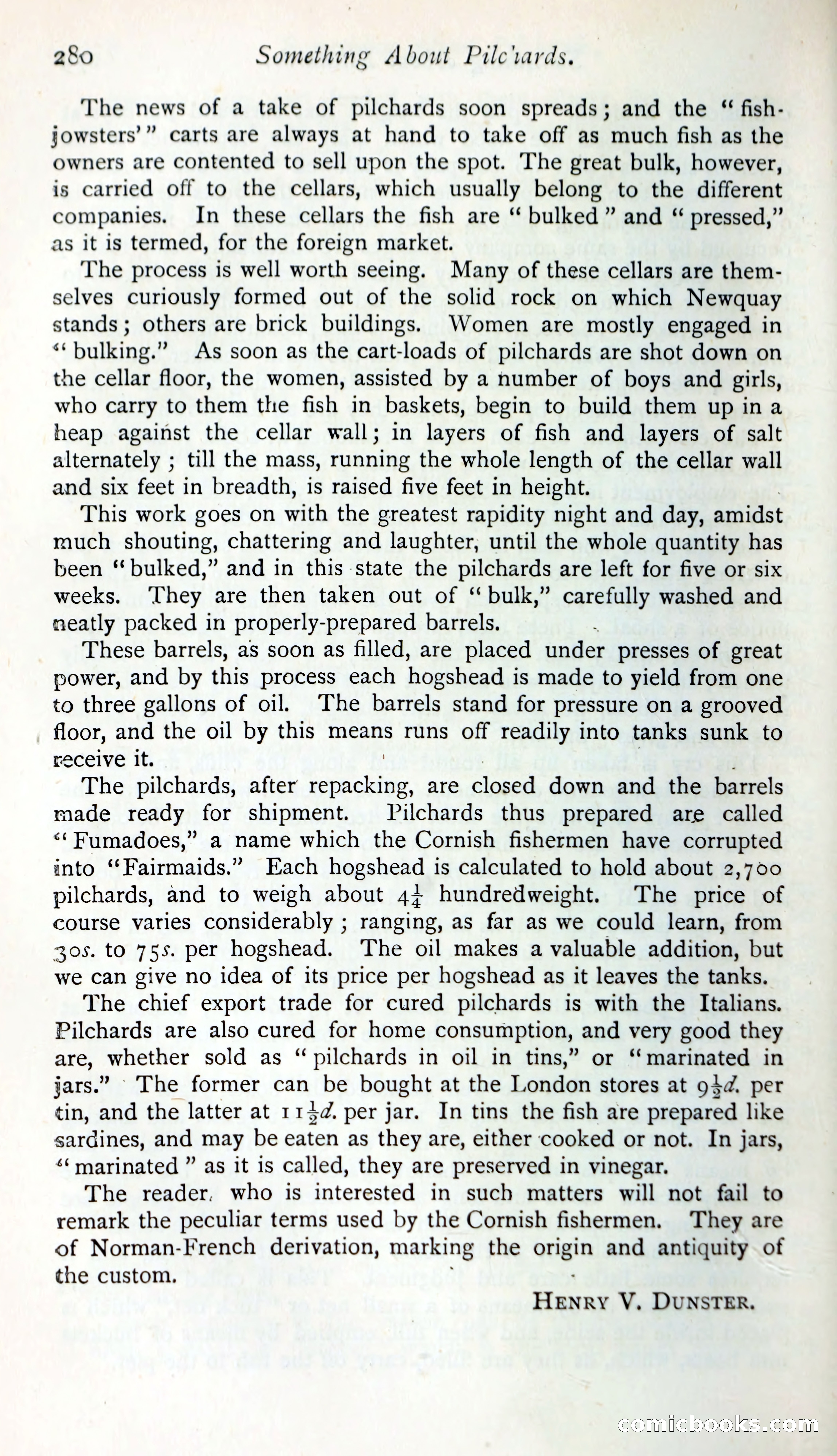
A restored page from Pulp Fiction, 1865. Page through the whole issue in the reader above.
📄 Transcribed text from this page (OCR, searchable)
Machine-transcribed from the original scan — historical spelling and the odd misread are preserved.
280 Something About Pilc ards. The news of a take of pilchards soon spreads; and the “ fish- jowsters’” carts are always at hand to take off as much fish as the owners are contented to sell upon the spot. The great bulk, however, is carried off to the cellars, which usually belong to the different companies. In these cellars the fish are “ bulked” and “ pressed,” - as it is termed, for the foreign market. The process is well worth seeing. Many of these cellars are them- selves curiously formed out of the solid rock on which Newquay stands; others are brick buildings. Women are mostly engaged in ‘* bulking.” As soon as the cart-loads of pilchards are shot down on the cellar floor, the women, assisted by a number of boys and girls, who carry to them the fish in baskets, begin to build them up ina heap against the cellar wall; in layers of fish and layers of salt alternately ; ; till the mass, running the whole length of the cellar wall and six feet in breadth, is raised five feet in height. This work goes on with the greatest rapidity night and day, amidst much shouting, chattering and laughter, until the whole quantity has been ‘‘ bulked,” and in this state the pilchards are left for five or six weeks. ‘They are then taken out of ‘‘ bulk,” carefully washed and neatly packed in properly-prepared barrels. These barrels, as soon as filled, are placed under presses of great power, and by this process each hogshead is made to yield from one to three gallons of oil. The barrels stand for pressure on a grooved floor, and the oil by this means runs off readily into tanks sunk to receive it. The pilchards, after Satie are closed down and the barrels made ready for shipment. Pilchards thus prepared are called “‘Fumadoes,” a name which the Cornish fishermen have corrupted into ‘“‘Fairmaids.” Each hogshead 1s calculated to hold about 2,700 pilchards, and to weigh about 4; hundredweight. The price of course varies considerably ; ranging, as far as we could learn, from 30s. to 75s. per hogshead. The oil makes a valuable addition, but we can give no idea of its price per hogshead as it leaves the tanks. The chief export trade for cured pilchards is with the Italians. Pilchards are also cured for home consumption, and very good they are, swnether sold as “ pilchards in oil in tins,” or ‘marinated in jars.” The former can be bought at the London stores at 93d. per tin, and the latter at 1142. per jar. In tins the fish are prepared like sardines, and may be eaten as they are, either cooked or not. In jars, ‘‘ marinated ” as it is called, they are preserved in vinegar. The reader. who is interested in such matters will not fail to remark the peculiar terms used by the Cornish fishermen. They are of Norman-French derivation, marking the origin and antiquity of the custom. Henny V. DUNSTER. Gomichookssco m