
Pulp Fiction, 1865 · page 302 of 400
The Argosy — page 302: what you’re looking at
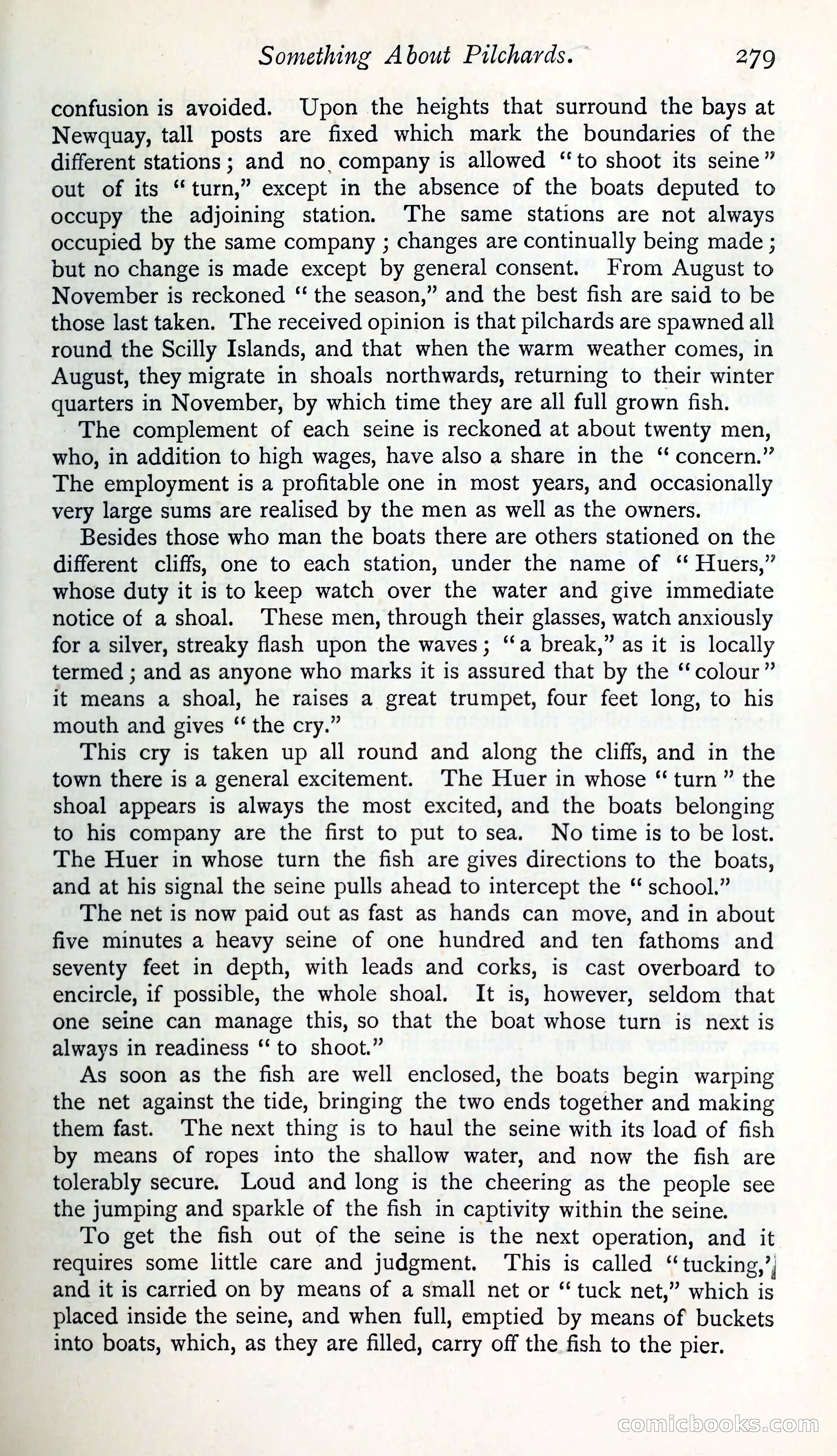
A restored page from Pulp Fiction, 1865. Page through the whole issue in the reader above.
📄 Transcribed text from this page (OCR, searchable)
Machine-transcribed from the original scan — historical spelling and the odd misread are preserved.
Something About Pulchards. 279 confusion is avoided. Upon the heights that surround the bays at Newquay, tall posts are fixed which mark the boundaries of the different stations; and no. company is allowed “to shoot its seine” out of its “turn,” except in the absence of the boats deputed to occupy the adjoining station. The same stations are not always occupied by the same company ; changes are continually being made ; but no change is made except by general consent. From August to November is reckoned ‘‘ the season,” and the best fish are said to be those last taken. The received opinion is that pilchards are spawned all round the Scilly Islands, and that when the warm weather comes, in August, they migrate in shoals northwards, returning to their winter quarters in November, by which time they are all full grown fish. ~The complement of each seine is reckoned at about twenty men, who, in addition to high wages, have also a share in the ‘ concern.” The employment is a profitable one in most years, and occasionally very large sums are realised by the men as well as the owners. Besides those who man the boats there are others stationed on the different cliffs, one to each station, under the name of ‘ Huers,” whose duty it is to keep watch over the water and give immediate notice of a shoal. These men, through their glasses, watch anxiously for a silver, streaky flash upon the waves; ‘‘a break,” as it is locally termed ; and as anyone who marks it is assured that by the ‘‘colour” it means a shoal, he raises a great trumpet, four feet long, to his mouth and gives ‘*‘ the cry.” | This cry is taken up all round and along the cliffs, and in the town there is a general excitement. ‘The Huer in whose “turn” the shoal appears is always the most excited, and the boats belonging to his company are the first to put to sea. No time is to be lost. The Huer in whose turn the fish are gives directions to the boats, and at his signal the seine pulls ahead to intercept the ‘‘ school.” The net is now paid out as fast as hands can move, and in about five minutes a heavy seine of one hundred and ten fathoms and seventy feet in depth, with leads and corks, is cast overboard to encircle, if possible, the whole shoal. It is, however, seldom that one seine can manage this, so that the boat whose turn is next is always in readiness ‘‘ to shoot.” As soon as the fish are well enclosed, the boats begin warping the net against the tide, bringing the two ends together and making them fast. The next thing is to haul the seine with its load of fish by means of ropes into the shallow water, and now the fish are tolerably secure. Loud and long is the cheering as the people see the jumping and sparkle of the fish in captivity within the seine. To get the fish out of the seine is the next operation, and it requires some little care and judgment. This is called “ tucking,’, and it is carried on by means of a small net or “ tuck net,” which is placed inside the seine, and when full, emptied by means of buckets into boats, which, as they are filled, carry off the fish to the pier. COMICOOOKS.C©