
Pulp Fiction, 1865 · page 115 of 400
The Argosy — page 115: what you’re looking at
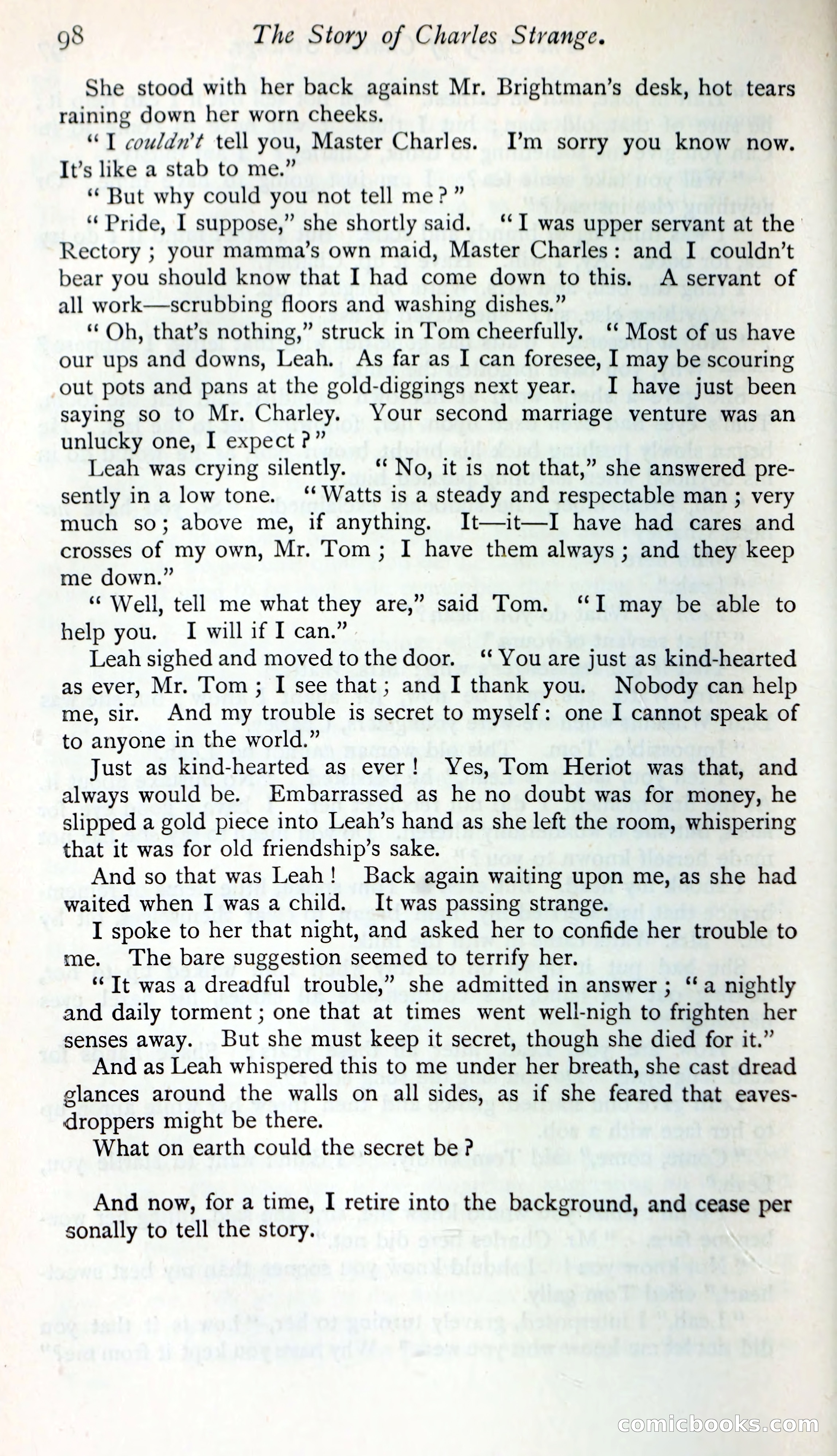
A restored page from Pulp Fiction, 1865. Page through the whole issue in the reader above.
📄 Transcribed text from this page (OCR, searchable)
Machine-transcribed from the original scan — historical spelling and the odd misread are preserved.
98 The Story of Charles Strange. She stood with her back against Mr. Brightman’s desk, hot tears raining down her worn cheeks. “T couldn't tell you, Master Charles. I’m sorry you know now. It’s like a stab to me.” ‘ But why could you not tell me?” ‘Pride, I suppose,” she shortly said. ‘‘I was upper servant at the’ Rectory ; your mamma’s own maid, Master Charles: and I couldn’t bear you should know that I had come down to this. A servant of all work—scrubbing floors and washing dishes.” ‘Oh, that’s nothing,” struck in’Tom cheerfully. ‘‘ Most of us have our ups and downs, Leah. As far as I can foresee, I may be scouring out pots and pans at the gold-diggings next year. I have just been saying so to Mr. Charley. Your second marriage venture was an unlucky one, I expect ?” Leah was crying silently. ‘‘ No, it is not that,” she answered pre- sently in a low tone. ‘‘ Watts is a steady and respectable man ; very much so; above me, if anything. It—it—I have had cares and crosses of my own, Mr. Tom; I have them always ; and they keep me down.” ‘ Well, tell me what they are,” said Tom. ‘I may be able to help you. I will if I can.” Leah sighed and moved tothe door. ‘‘ You are just as kind-hearted as ever, Mr. Tom; I see that; and I thank you. Nobody can help me, sir. And my ‘trouble is secret to myself: one I cannot speak of to anyone in the world.” Just as kind-hearted as ever! Yes, Tom Heriot was that, and always would be. Embarrassed as he no doubt was for money, he slipped a gold piece into Leah’s hand as she left the room, whispering that it was for old friendship’s sake. And so that was Leah! Back again waiting upon me, as she had waited when I was a child. It was passing strange. I spoke to her that night, and asked her to confide her trouble to me. The bare suggestion seemed to terrify her. ‘Tt was a dreadful trouble,” she admitted in answer; “a nightly and daily torment ; one that at times went well-nigh to frighten her senses away. But she must keep it secret, though she died for it.” And as Leah whispered this to me under her breath, she cast dread elances around the walls on all sides, as if she feared that eaves- droppers might be there. What on earth could the secret be? And now, for a time, I retire into the background, and cease per sonally to tell the story. CONMIECLIOO KS. e©) m