
Pulp Fiction, 1865 · page 112 of 400
The Argosy — page 112: what you’re looking at
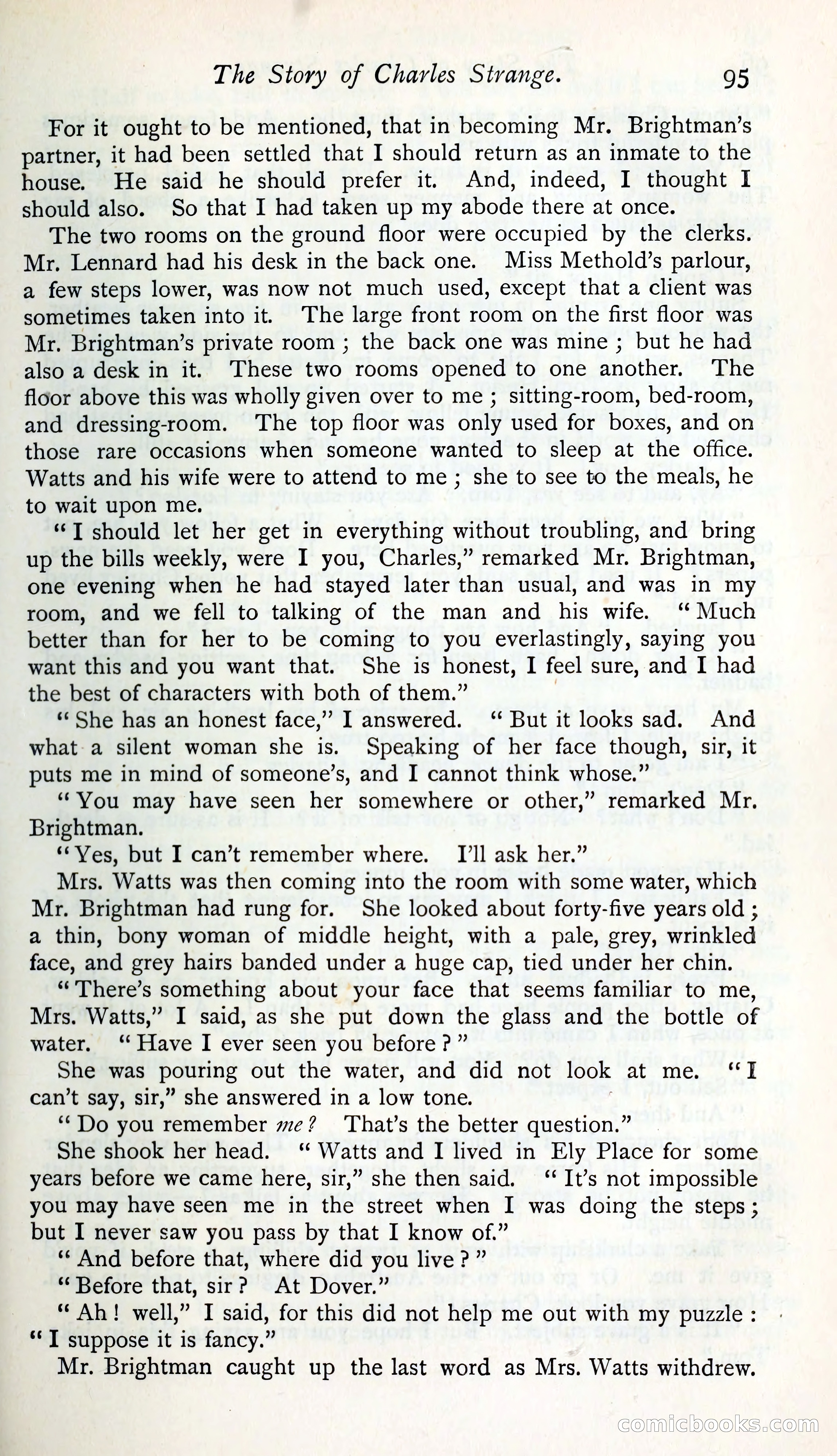
A restored page from Pulp Fiction, 1865. Page through the whole issue in the reader above.
📄 Transcribed text from this page (OCR, searchable)
Machine-transcribed from the original scan — historical spelling and the odd misread are preserved.
The Story of Charles Strange. 95 For it ought to be mentioned, that in becoming Mr. Brightman’s partner, it had been settled that I should return as an inmate to the house. He said he should prefer it. And, indeed, I thought I should also. So that I had taken up my abode there at once. The two rooms on the ground floor were occupied by the clerks. Mr. Lennard had his desk in the back one. Mauss Methold’s parlour, a few steps lower, was now not much used, except that a client was sometimes taken into it. The large front room on the first floor was Mr. Brightman’s private room ; the back one was mine ; but he had also a desk in it. These two rooms opened to one another. The floor above this was wholly given over to me ; sitting-room, bed-room, and dressing-room. ‘The top floor was only used for boxes, and on those rare occasions when someone wanted to sleep at the office. Watts and his wife were to attend to me; she to see to the meals, he to wait upon me. ‘T should let her get in everything without troubling, and bring up the bills weekly, were I you, Charles,” remarked Mr. Brightman, one evening when he had stayed later than usual, and was in my room, and we fell to talking of the man and his wife. ‘* Much better than for her to be coming to you everlastingly, saying you want this and you want that. She is honest, I feel sure, and I had the best of characters with both of them.” ‘‘ She has an honest face,” I answered. ‘ But it looks sad. And what a silent woman she is. Speaking of her face though, sir, it puts me in mind of someone’s, and I cannot think whose.” ‘You may have seen her somewhere or other,” remarked Mr. Brightman. ‘© Ves, but I can’t remember where. I'll ask her.” Mrs. Watts was then coming into the room with some water, which Mr. Brightman had rung for. She looked about forty-five years old ; a thin, bony woman of middle height, with a pale, grey, wrinkled face, and grey hairs banded under a huge cap, tied under her chin. *'There’s something about your face that seems familiar to me, Mrs. Watts,” I said, as she put down the glass and the bottle of water. ‘‘ Have I ever seen you before ?” She was pouting out the water, and did not look at es ek can’t say, sir,” she answered in a low tone. “Do you remember me? That’s the better question.” — She shook her head. ‘“ Watts and I lived in Ely Place for some years before we came here, sir,” she then said. ‘‘ It’s not impossible you may have seen me in the street when I was doing the steps ; but I never saw you pass by that I know of.” ‘* And before that, where did you live ? ” “Before that, sir? At Dover.” “Ah! well,” I said, for this did not help me out with my puzzle : ** IT suppose it is fancy.” Mr. Brightman caught up the last word as Mrs. Watts withdrew. cConmmicooolks (C(O)