
Pulp Fiction, 1865 · page 111 of 400
The Argosy — page 111: what you’re looking at
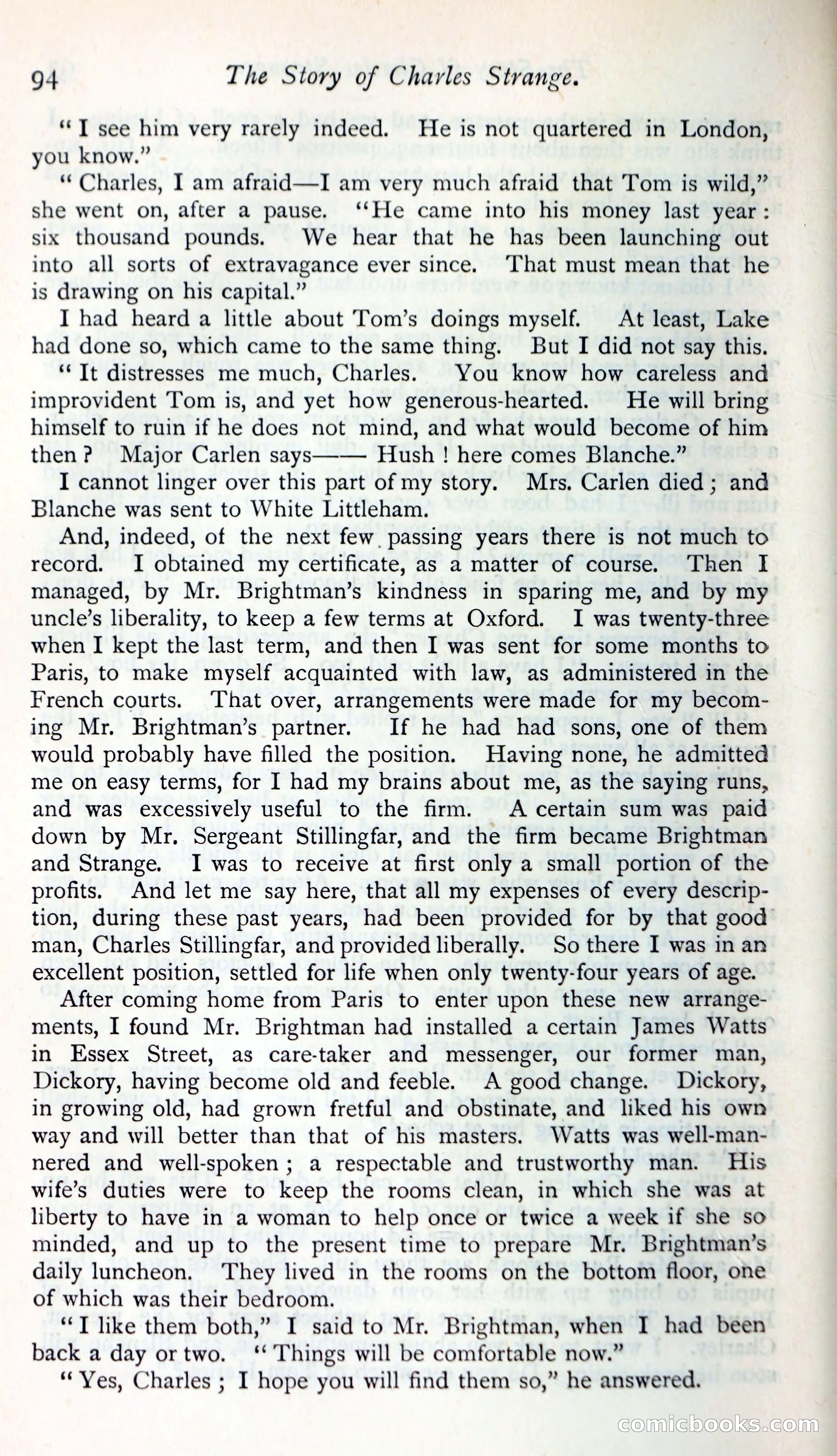
A restored page from Pulp Fiction, 1865. Page through the whole issue in the reader above.
📄 Transcribed text from this page (OCR, searchable)
Machine-transcribed from the original scan — historical spelling and the odd misread are preserved.
94 The Story of Charles Strange. ‘“T see him very rarely indeed. He is not quartered in London, you know.” “ Charles, I am afraid—I am very much afraid that Tom is wild,” she went on, after a pause. ‘‘He came into his money last year: six thousand pounds. We hear that he has been launching out into all sorts of extravagance ever since. ‘That must mean that he is drawing on his capital.” I had heard a little about Tom’s doings myself. At least, Lake had done so, which came to the same thing. But I did not say this. ‘It distresses me much, Charles. You know how careless and improvident ‘Tom is, and yet how generous-hearted. He will bring himself to ruin if he does not mind, and what would become of him then? Major Carlen says——— Hush ! here comes Blanche.” I cannot linger over this part of my story. Mrs. Carlen died; and Blanche was sent to White Littleham. And, indeed, of the next few. passing years there is not much to record. I obtained my certificate, as a matter of course. Then I managed, by Mr. Brightman’s kindness in sparing me, and by my uncle’s liberality, to keep a few terms at Oxford. I was twenty-three when I kept the last term, and then I was sent for some months to Paris, to make myself acquainted with law, as administered in the French courts. ‘That over, arrangements were made for my becom- ing Mr. Brightman’s partner. If he had had sons, one of them would probably have filled the position. Having none, he admitted me on easy terms, for I had my brains about me, as the saying runs, and was excessively useful to the firm. A certain sum was paid down by Mr. Sergeant Stillingfar, and the firm became Brightman and Strange. I was to receive at first only a small portion of the profits. And let me say here, that all my expenses of every descrip- tion, during these past years, had been provided for by that good man, Charles Stillingfar, and provided liberally. So there I was in an excellent position, settled for life when only twenty-four years of age. After coming home from Paris to enter upon these new arrange- ments, I found Mr. Brightman had installed a certain James Watts in Essex Street, as care-taker and messenger, our former man, Dickory, having become old and feeble. A good change. Dickory, in growing old, had grown fretful and obstinate, and liked his own way and will better than that of his masters. Watts was well-man- nered and well-spoken; a respectable and trustworthy man. His wife’s duties were to keep the rooms clean, in which she was at liberty to have in a woman to help once or twice a week if she so minded, and up to the present time to prepare Mr. Brightman’s daily luncheon. ‘They lived in the rooms on the bottom floor, one of which was their bedroom. “T like them both,” I said to Mr. Brightman, when I had been back a day ortwo. ‘‘ Things will be comfortable now.” Yes, Charles ; I hope you will find them so,” he answered. Gomichbooks m