
Pulp Fiction, 1865 · page 346 of 400
The Argosy — page 346: what you’re looking at
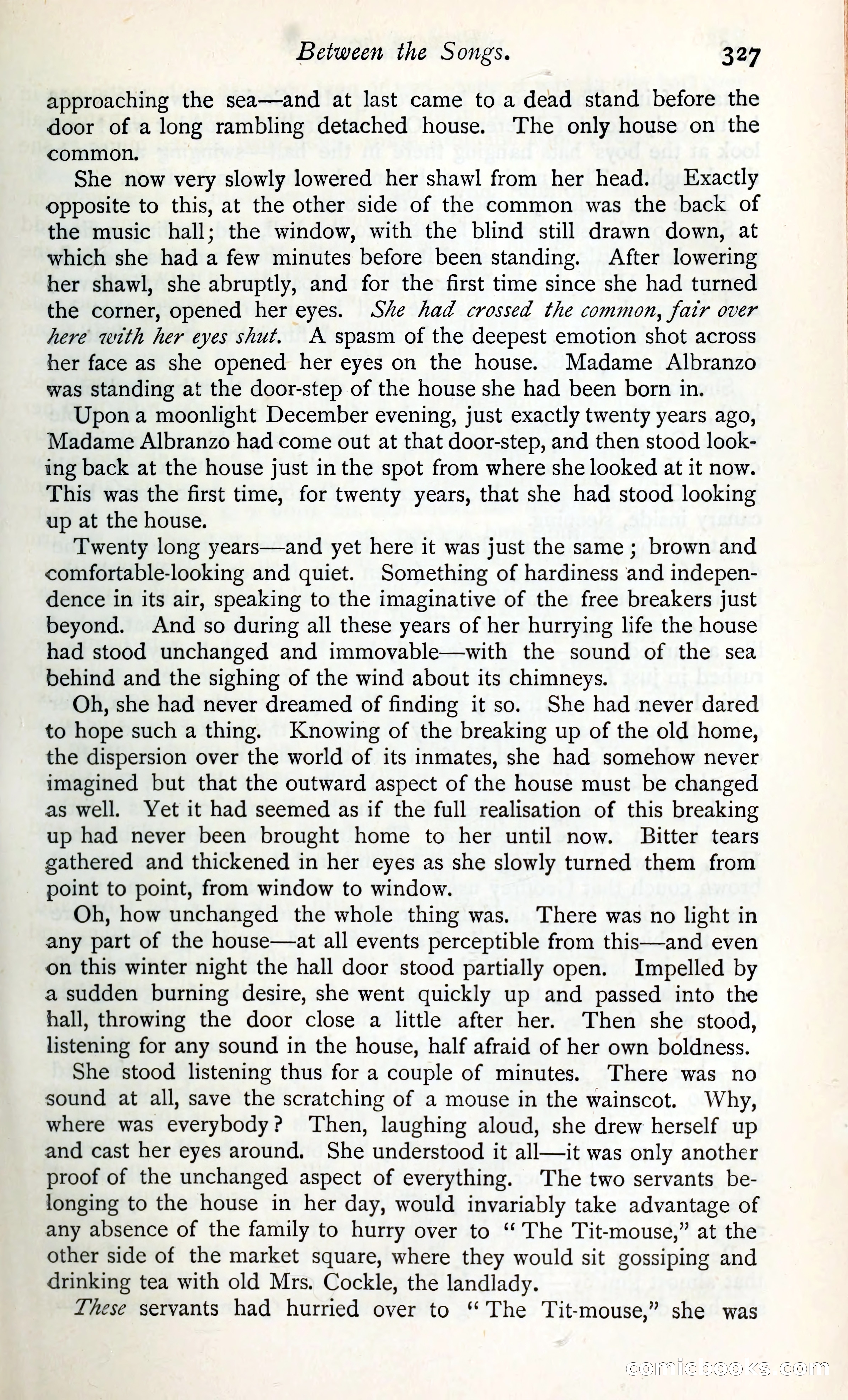
A restored page from Pulp Fiction, 1865. Page through the whole issue in the reader above.
📄 Transcribed text from this page (OCR, searchable)
Machine-transcribed from the original scan — historical spelling and the odd misread are preserved.
Between the Songs. 327 approaching the sea—and at last came to a dead stand before the door of along rambling detached house. The only house on the common. She now very slowly lowered her shawl from her head. Exactly opposite to this, at the other side of the common was the back of the music hall; the window, with the blind still drawn down, at which she had a few minutes before been standing. After lowering her shawl, she abruptly, and for the first time since she had turned the corner, opened her eyes. She had crossed the common, fair over here with her eyes shut. A spasm of the deepest emotion shot across her face as she opened her eyes on the house. Madame Albranzo was standing at the door-step of the house she had been born in. Upon a moonlight December evening, just exactly twenty years ago, Madame Albranzo had come out at that door-step, and then stood look- ing back at the house just in the spot from where she looked at it now. This was the first time, for twenty years, that she had stood looking up at the house. Twenty long years—and yet here it was just the same; brown and comfortable-looking and quiet. Something of hardiness and indepen- dence in its air, speaking to the imaginative of the free breakers just beyond. And so during all these years of her hurrying life the house had stood unchanged and immovable—with the sound of the sea behind and the sighing of the wind about its chimneys. Oh, she had never dreamed of finding it so. She had never dared to hope such a thing. Knowing of the breaking up of the old home, the dispersion over the world of its inmates, she had somehow never imagined but that the outward aspect of the house must be changed as well. Yet it had seemed as if the full realisation of this breaking up had never been brought home to her until now. Bitter tears gathered and thickened in her eyes as she slowly turned them from _ point to point, from window to window. Oh, how unchanged the whole thing was. There was no light in any part of the house—at all events perceptible from this—and even on this winter night the hall door stood partially open. Impelled by a sudden burning desire, she went quickly up and passed into the hall, throwing the door close a little after her. ‘Then she stood, listening for any sound in the house, half afraid of her own boldness. She stood listening thus for a couple of minutes. There was no sound at all, save the scratching of a mouse in the wainscot. Why, where was everybody? ‘Then, laughing aloud, she drew herself up and cast her eyes around. She understood it all—it was only another proof of the unchanged aspect of everything. The two servants be- longing to the house in her day, would invariably take advantage of any absence of the family to hurry over to ‘“‘ The Tit-mouse,” at the other side of the market square, where they would sit gossiping and drinking tea with old Mrs. Cockle, the landlady. These servants had hurried over to “The Tit-mouse,” she was comicoooKks (SO) an