
Pulp Fiction, 1865 · page 324 of 400
The Argosy — page 324: what you’re looking at
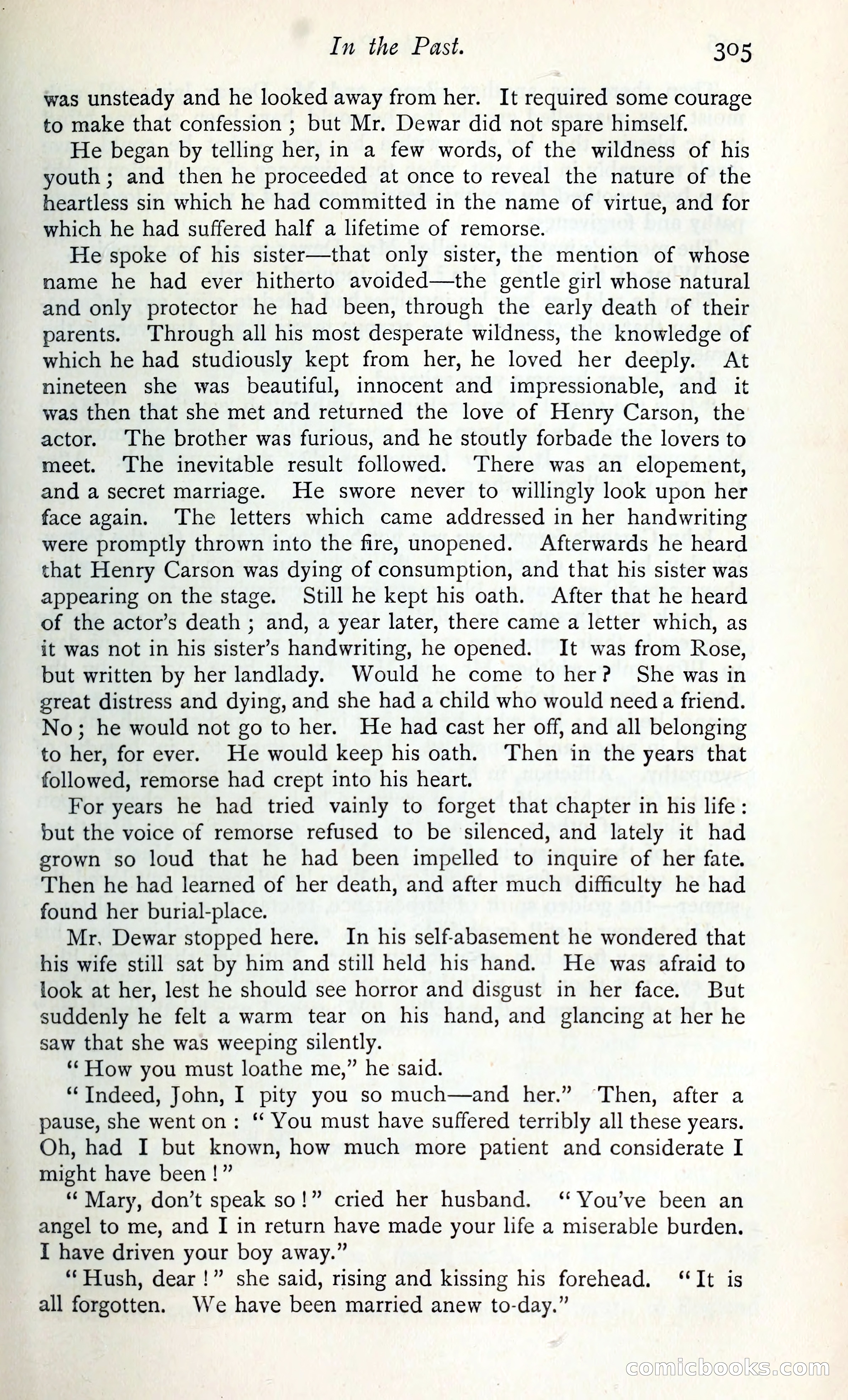
A restored page from Pulp Fiction, 1865. Page through the whole issue in the reader above.
📄 Transcribed text from this page (OCR, searchable)
Machine-transcribed from the original scan — historical spelling and the odd misread are preserved.
In the Past. 305 was unsteady and he looked away from her. It required some courage to make that confession ; but Mr. Dewar did not spare himself. He began by telling her, in a few words, of the wildness of his youth ; and then he proceeded at once to reveal the nature of the heartless sin which he had committed in the name of virtue, and for which he had suffered half a lifetime of remorse. He spoke of his sister—that only sister, the mention of whose mame he had ever hitherto avoided—the gentle girl whose natural and only protector he had been, through the early death of their parents. ‘Through all his most desperate wildness, the knowledge of which he had studiously kept from her, he loved her deeply. At nineteen she was beautiful, innocent and impressionable, and _ it was then that she met and returned the love of Henry Carson, the actor. The brother was furious, and he stoutly forbade the lovers to meet. The inevitable result followed. There was an elopement, and a secret marriage. He swore never to willingly look upon her face again. ‘The letters which came addressed in her handwriting were promptly thrown into the fire, unopened. Afterwards he heard that Henry Carson was dying of consumption, and that his sister was appearing on the stage. Still he kept his oath. After that he heard of the actor’s death ; and, a year later, there came a letter which, as it was not in his sister’s handwriting, he opened. It was from Rose, but written by her landlady. Would he come to her? She was in great distress and dying, and she had a child who would need a friend. No; he would not go to her. He had cast her off, and all belonging to her, for ever. He would keep his oath. ‘Then in the years that followed, remorse had crept into his heart. For years he had tried vainly to forget that chapter in his life: but the voice of remorse refused to be silenced, and lately it had erown so loud that he had been impelled to inquire of her fate. Then he had learned of her death, and after much difficulty he had found her burial-place. Mr, Dewar stopped here. In his self-abasement he wondered that his wife still sat by him and still held his hand. He was afraid to look at her, lest he should see horror and disgust in her face. But suddenly he felt a warm tear on his hand, and glancing at her he saw that she was weeping silently. ‘* How you must loathe me,” he said. “ Indeed, John, I pity you so much—and her.” ‘Then, after a pause, she went on: ‘‘ You must have suffered terribly all these years. Oh, had I but known, how much more patient and considerate I might have been !” “ Mary, don’t speak so!” cried her husband. ‘ You’ve been an angel to me, and I in return have made your life a miserable burden. I have driven your boy away.” ‘Hush, dear!” she said, rising and kissing his forehead. ‘It is all forgotten. We have been married anew to-day.” CORE LHO© (C©) An