
Pulp Fiction, 1865 · page 323 of 400
The Argosy — page 323: what you’re looking at
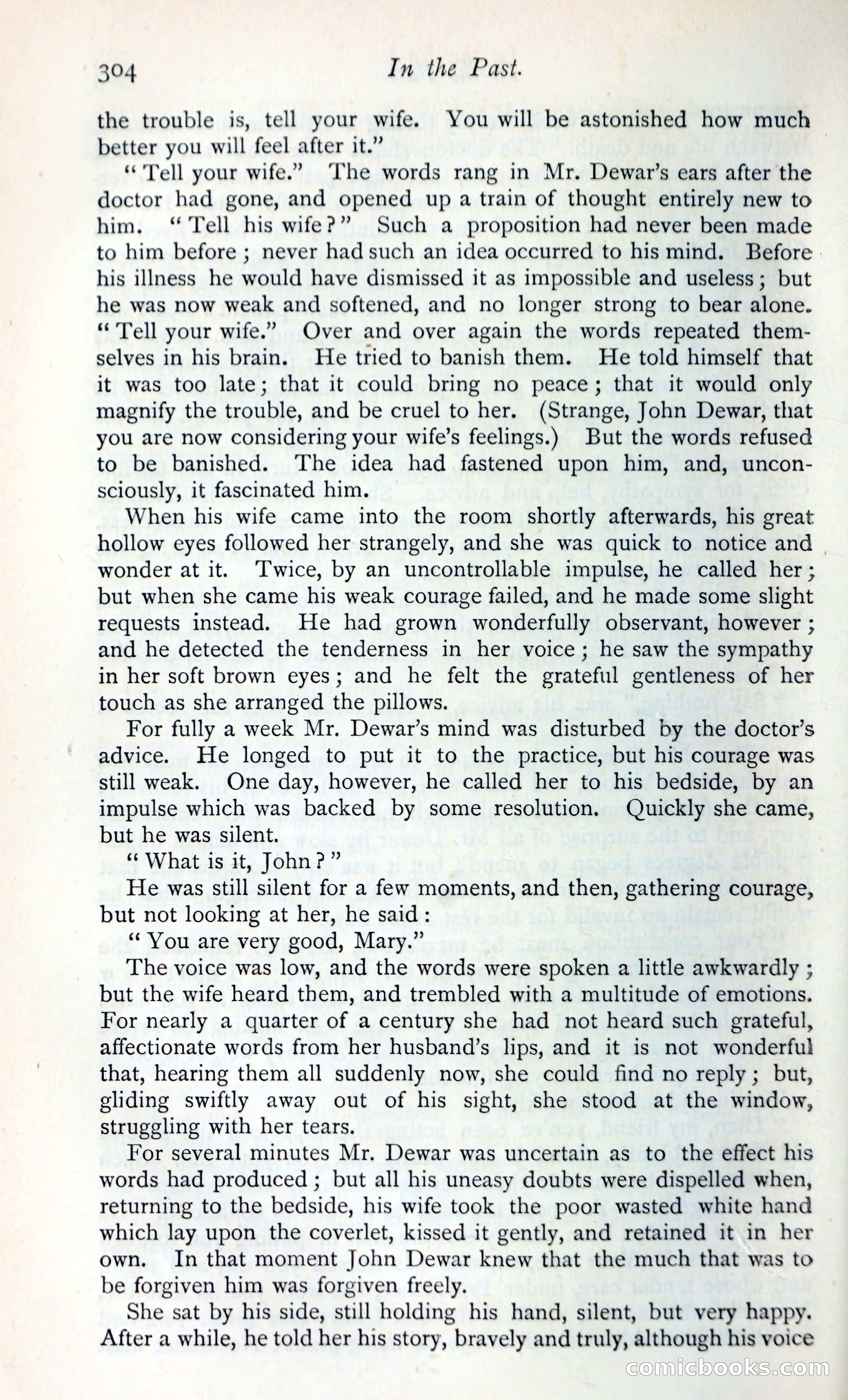
A restored page from Pulp Fiction, 1865. Page through the whole issue in the reader above.
📄 Transcribed text from this page (OCR, searchable)
Machine-transcribed from the original scan — historical spelling and the odd misread are preserved.
304 In the Past. the trouble is, tell your wife. You will be astonished how much better you will feel after it.” “Tell your wife.’ The words rang in Mr. Dewar’s ears after the doctor had gone, and opened up a train of thought entirely new to him. ‘ Tell his wife?” Such a proposition had never been made to him before ; never had such an idea occurred to his mind. Before his illness he would have dismissed it as impossible and useless; but he was now weak and softened, and no longer strong to bear alone. “Tell your wife.” Over and over again the words repeated them- selves in his brain. He tried to banish them. He told himself that it was too late; that it could bring no peace; that it would only magnify the trouble, and be cruel to her. (Strange, John Dewar, that you are now considering your wife’s feelings.) But the words refused to be banished. ‘The idea had fastened upon him, and, uncon- sciously, it fascinated him. When his wife came into the room shortly afterwards, his great hollow eyes followed her strangely, and she was quick to notice and | wonder at it. ‘Twice, by an uncontrollable impulse, he called her ; but when she came his weak courage failed, and he made some slight requests instead. He had grown wonderfully observant, however ; and he detected the tenderness in her voice; he saw the sympathy in her soft brown eyes; and he felt the grateful gentleness of her touch as she arranged the pillows. For fully a week Mr. Dewar’s mind was disturbed by the doctor’s advice. He longed to put it to the practice, but his courage was still weak. One day, however, he called her to his bedside, by an impulse which was backed by some resolution. Quickly she came, but he was silent. ‘What is it, John?” He was still silent for a few moments, and then, gathering courage, but not looking at her, he said: “You are very good, Mary.” The voice was low, and the words were spoken a little awkwardly ; but the wife heard them, and trembled with a multitude of emotions. For nearly a quarter of a century she had not heard such grateful, affectionate words from her husband’s lips, and it is not wonderful that, hearing them all suddenly now, she could find no reply; but, gliding swiftly away out of his sight, she stood at the window, struggling with her tears. For several minutes Mr. Dewar was uncertain as to the effect his words had produced ; but all his uneasy doubts were dispelled when, returning to the bedside, his wife took the poor wasted white hand which lay upon the coverlet, kissed it gently, and retained it in her own. In that moment John Dewar knew that the much that was to be forgiven him was forgiven freely. She sat by his side, still holding his hand, silent, but very happy. After a while, he told her his story, bravely and truly, although his voice COMME IOOKXSacCOnn