
Pulp Fiction, 1865 · page 308 of 400
The Argosy — page 308: what you’re looking at
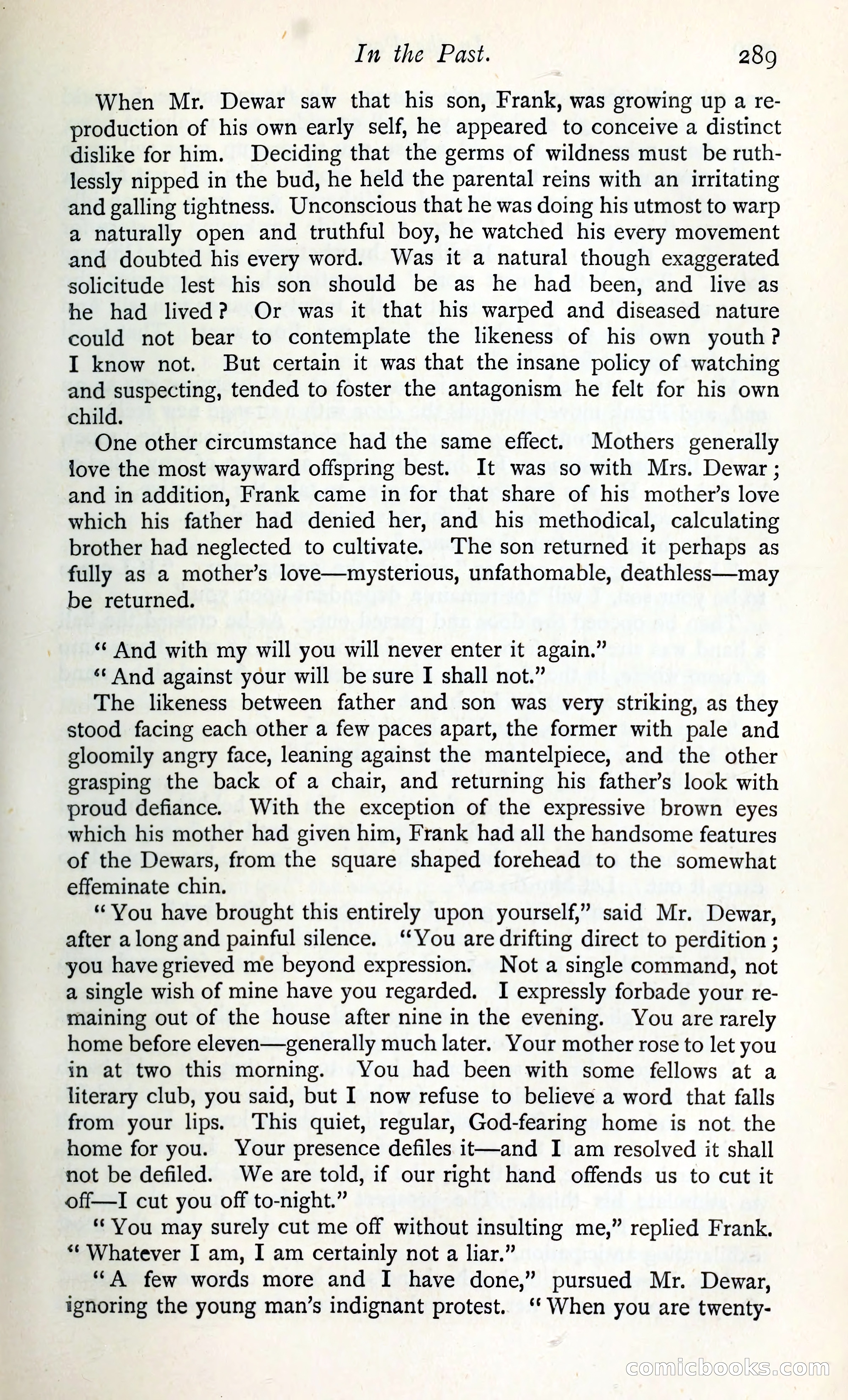
A restored page from Pulp Fiction, 1865. Page through the whole issue in the reader above.
📄 Transcribed text from this page (OCR, searchable)
Machine-transcribed from the original scan — historical spelling and the odd misread are preserved.
In the Past. 289 When Mr. Dewar saw that his son, Frank, was growing up a re- production of his own early self, he appeared to conceive a distinct dislike for him. Deciding that the germs of wildness must be ruth- lessly nipped in the bud, he held the parental reins with an irritating and galling tightness. Unconscious that he was doing his utmost to warp a naturally open and truthful boy, he watched his every movement and doubted his every word. Was it a natural though exaggerated solicitude lest his son should be as he had been, and live as he had lived? Or was it that his warped and diseased nature could not bear to contemplate the likeness of his own youth? I know not. But certain it was that the insane policy of watching and suspecting, tended to foster the antagonism he felt for his own child. One other circumstance had the same effect. Mothers generally love the most wayward offspring best. It was so with Mrs. Dewar ; and in addition, Frank came in for that share of his mother’s love which his father had denied her, and his methodical, calculating brother had neglected to cultivate. ‘The son returned it perhaps as fully as a mother’s love—mysterious, unfathomable, deathless—may be returned. ‘“ And with my will you will never enter it again.” ‘¢ And against your will be sure I shall not.” The likeness between father and son was very striking, as they stood facing each other a few paces apart, the former with pale and sloomily angry face, leaning against the mantelpiece, and the other grasping the back of a chair, and returning his father’s look with proud defiance. With the exception of the expressive brown eyes which his mother had given him, Frank had all the handsome features of the Dewars, from the square shaped forehead to the somewhat effeminate chin. ‘You have brought this entirely upon yourself,” said Mr. Dewar, after along and painful silence. ‘You are drifting direct to perdition ; you have grieved me beyond expression. Not a single command, not a single wish of mine have you regarded. I expressly forbade your re- maining out of the house after nine in the evening. You are rarely home before eleven—generally much later. Your mother rose to let you in at two this morning. You had been with some fellows at a literary club, you said, but I now refuse to believe a word that falls from your lips. This quiet, regular, God-fearing home is not the home for you. Your presence defiles it—and I am resolved it shall not be defiled. We are told, if our nght hand offends us to cut it off—I cut you off to-night.” ‘You may surely cut me off without insulting me,” replied Frank. ** Whatever I am, I am certainly not a liar.” ‘“A few words more and I have done,” pursued Mr. Dewar, ignoring the young man’s indignant protest. ‘‘ When you are twenty- comnmicloookKks (GO) an