
Pulp Fiction, 1865 · page 307 of 400
The Argosy — page 307: what you’re looking at
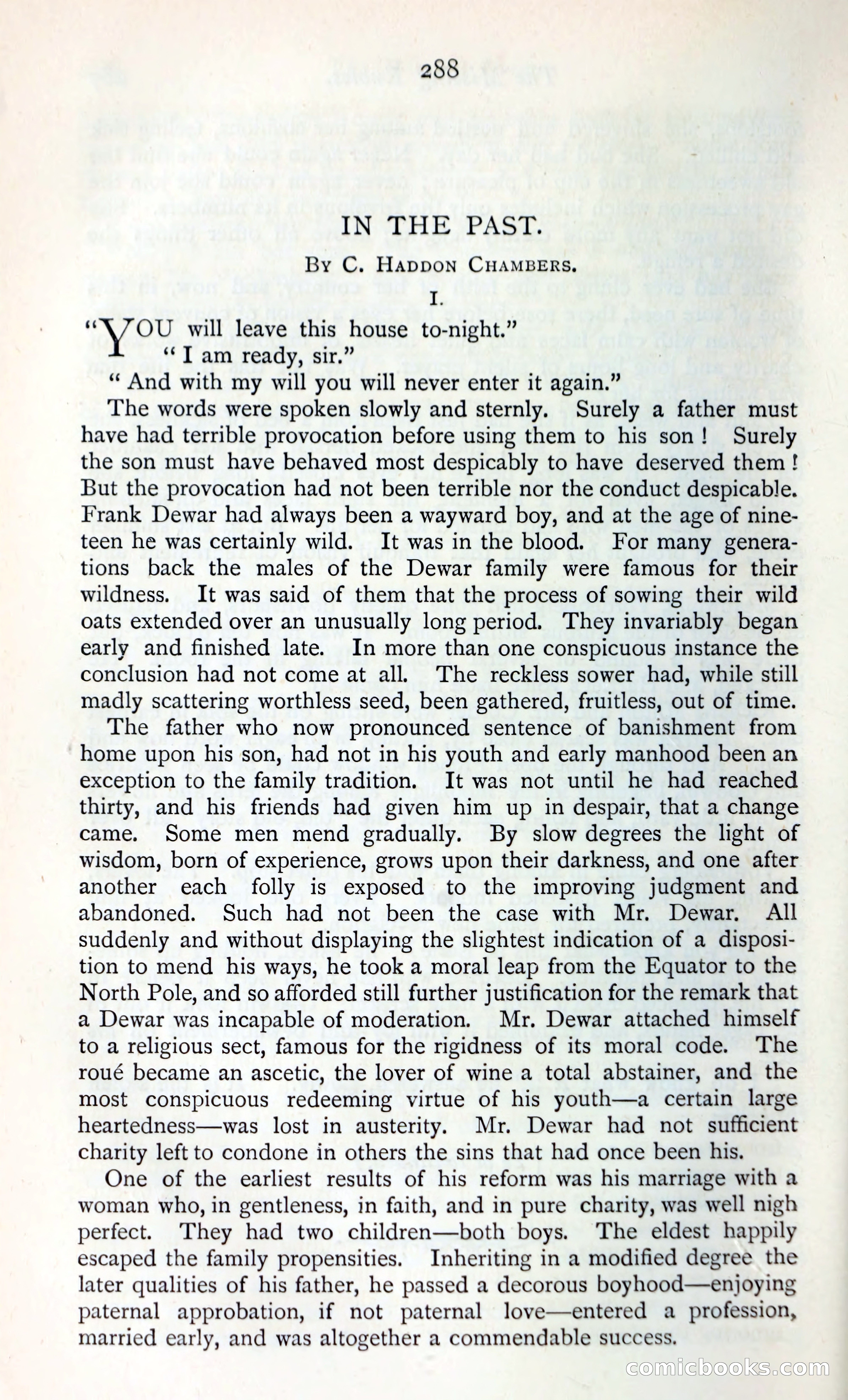
A restored page from Pulp Fiction, 1865. Page through the whole issue in the reader above.
📄 Transcribed text from this page (OCR, searchable)
Machine-transcribed from the original scan — historical spelling and the odd misread are preserved.
288 IN THE PAST. By C. Happon CHAMBERS. I. Sy OU will leave this house to-night.” ‘*T am ready, sir.” “And with my will you will never enter it again.” The words were spoken slowly and sternly. Surely a father must have had terrible provocation before using them to his son! Surely the son must have behaved most despicably to have deserved them ! But the provocation had not been terrible nor the conduct despicable. Frank Dewar had always been a wayward boy, and at the age of nine- teen he was certainly wild. It was in the blood. For many genera- tions back the males of the Dewar family were famous for their wildness. It was said of them that the process of sowing their wild oats extended over an unusually long period. They invariably began early and finished late. In more than one conspicuous instance the conclusion had not come at all. The reckless sower had, while still madly scattering worthless seed, been gathered, fruitless, out of time. The father who now pronounced sentence of banishment from home upon his son, had not in his youth and early manhood been an exception to the family tradition. It was not until he had reached thirty, and his friends had given him up in despair, that a change came. Some men mend gradually. By slow degrees the light of wisdom, born of experience, grows upon their darkness, and one after another each folly is exposed to the improving judgment and abandoned. Such had not been the case with Mr. Dewar. All suddenly and without displaying the slightest indication of a disposi- tion to mend his ways, he took a moral leap from the Equator to the North Pole, and so afforded still further justification for the remark that a Dewar was incapable of moderation. Mr. Dewar attached himself to a religious sect, famous for the rigidness of its moral code. The roué became an ascetic, the lover of wine a total abstainer, and the most conspicuous redeeming virtue of his youth—a certain large heartedness—was lost in austerity. Mr. Dewar had not sufficient charity left to condone in others the sins that had once been his. One of the earliest results of his reform was his marriage with a woman who, in gentleness, in faith, and in pure charity, was well nigh perfect. They had two children—both boys. ‘The eldest happily escaped the family propensities. Inheriting in a modified degree the later qualities of his father, he passed a decorous boyhood—en)joying paternal approbation, if not paternal love—entered a profession, married early, and was altogether a commendable success. ECORNIELOOOKS EO