
Pulp Fiction, 1865 · page 168 of 400
The Argosy — page 168: what you’re looking at
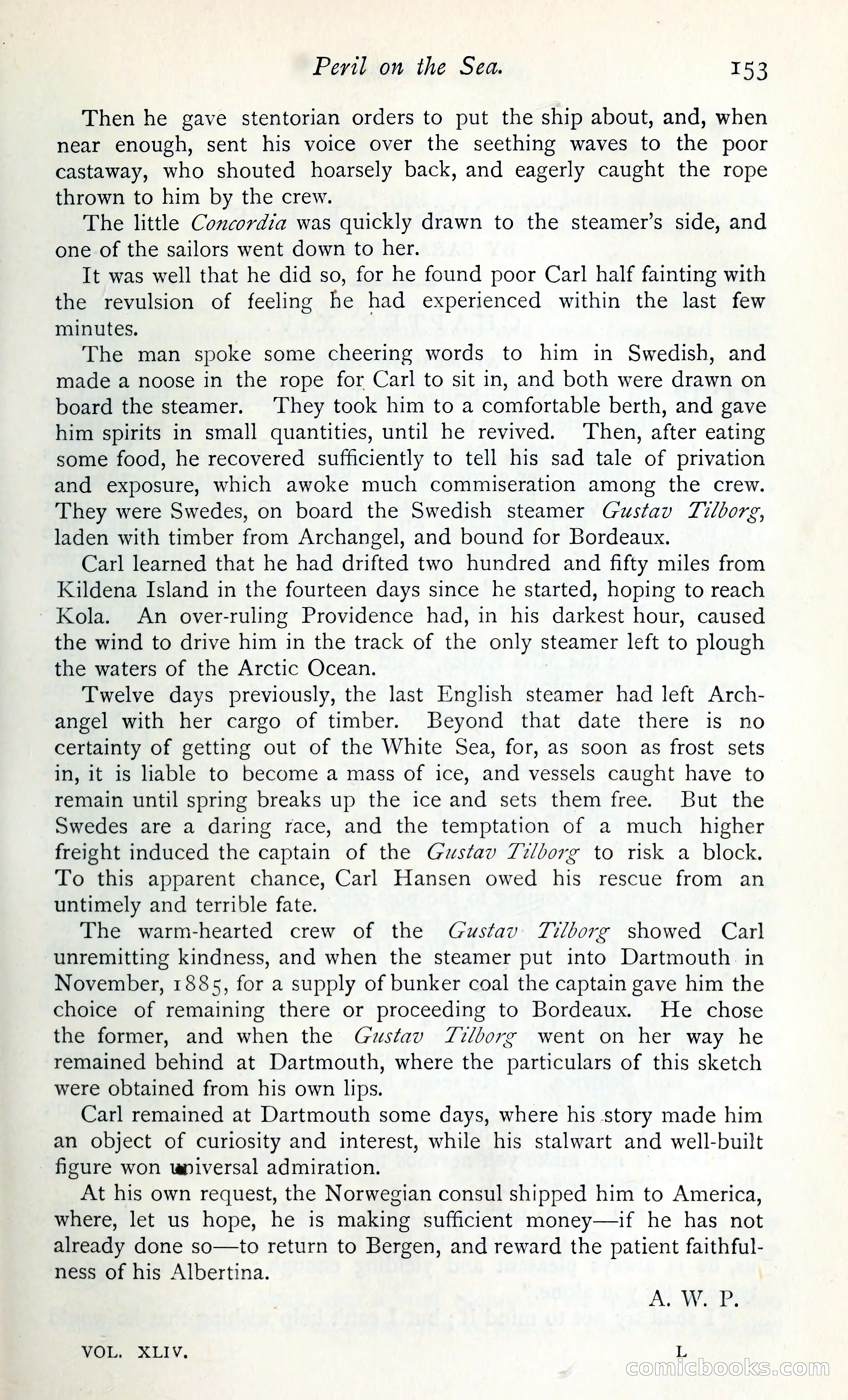
A restored page from Pulp Fiction, 1865. Page through the whole issue in the reader above.
📄 Transcribed text from this page (OCR, searchable)
Machine-transcribed from the original scan — historical spelling and the odd misread are preserved.
Peril on the Sea. 153 Then he gave stentorian orders to put the ship about, and, when near enough, sent his voice over the seething waves to the poor castaway, who shouted hoarsely back, and eagerly caught the rope thrown to him by the crew. The little Concordia was quickly drawn to the steamer’s side, and one of the sailors went down to her. It was well that he did so, for he found poor Carl half fainting with the revulsion of feeling he had experienced within the last few minutes. The man spoke some cheering words to him in Swedish, and made a noose in the rope for Carl to sit in, and both were drawn on board the steamer. They took him to a comfortable berth, and gave him spirits in small quantities, until he revived. ‘Then, after eating some food, he recovered sufficiently to tell his sad tale of privation and exposure, which awoke much commiseration among the crew. They were Swedes, on board the Swedish steamer Gustav Tilborg, laden with timber from Archangel, and bound for Bordeaux. Carl learned that he had drifted two hundred and fifty miles from Kildena Island in the fourteen days since he started, hoping to reach Kola. An over-ruling Providence had, in his darkest hour, caused the wind to drive oa in the track of the only. s steamer left to plough the waters of the Arctic Ocean. Twelve days previously, the last English steamer had left Arch- angel with her cargo of timber. Beyond that date there is no certainty of getting out of the White Sea, for, as soon as frost sets in, it 1s liable to become a mass of ice, and vessels caught have to remain until spring breaks up the ice and sets them free. But the Swedes are a daring race, and the temptation of a much higher freight induced the captain of the Gustav 7ilborg to risk a block. To this apparent chance, Carl Hansen owed his rescue from an untimely and terrible fate. The warm-hearted crew of the Gustav Tilbore showed Carl unremitting kindness, and when the steamer put into Dartmouth in November, 1885, for a supply of bunker coal the captain gave him the choice of remaining there or proceeding to Bordeaux. He chose the former, and when the Gustav Tilborg went on her way he remained behind at Dartmouth, where the particulars of this sketch were obtained from his own lips. Carl remained at Dartmouth some days, where his story made him an object of curiosity and interest, while his stalwart and well-built figure won whiversal admiration. At his own request, the Norwegian consul shipped him to America, where, let us hope, he is making sufficient money—if he has not already done so—to return to Bergen, and reward the patient faithful- ness of his Albertina. A. Woks VOL. XLIV. L comicoooKks im