
Pulp Fiction, 1865 · page 47 of 400
The Argosy — page 47: what you’re looking at
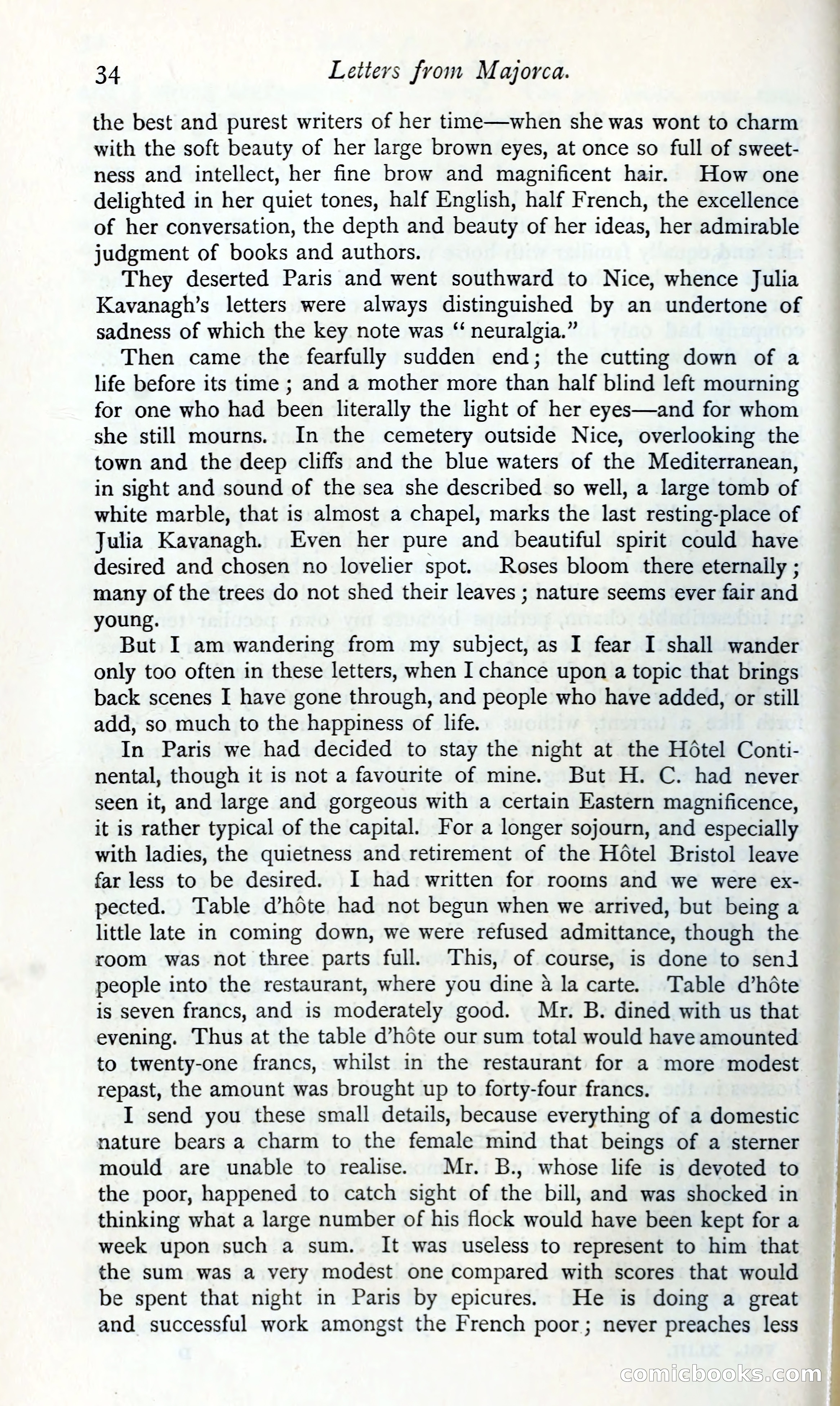
A restored page from Pulp Fiction, 1865. Page through the whole issue in the reader above.
📄 Transcribed text from this page (OCR, searchable)
Machine-transcribed from the original scan — historical spelling and the odd misread are preserved.
34 Letters from Majorca. the best and purest writers of her time—when she was wont to charm with the soft beauty of her large brown eyes, at once so full of sweet- ness and intellect, her fine brow and magnificent hair. How one delighted in her quiet tones, half English, half French, the excellence of her conversation, the depth and beauty of her ideas, her admirable judgment of books and authors. They deserted Paris and went southward to Nice, whence Julia Kavanagh’s letters were always distinguished by an undertone of sadness of which the key note was “‘ neuralgia.” Then came the fearfully sudden end; the cutting down of a life before its time ; and a mother more than half blind left mourning for one who had been literally the light of her eyes—and for whom she still mourns. In the cemetery outside Nice, overlooking the town and the deep cliffs and the blue waters of the Mediterranean, in sight and sound of the sea she described so well, a large tomb of white marble, that is almost a chapel, marks the last resting-place of Julia Kavanagh. Even her pure and beautiful spirit could have desired and chosen no lovelier spot. Roses bloom there eternally ; many of the trees do not shed their leaves ; nature seems ever fair and young. But I am wandering from my subject, as I fear I shall wander only too often in these letters, when I chance upon a topic that brings back scenes I have gone through, and people who have added, or still add, so much to the happiness of life. In Paris we had decided to stay the night at the Hotel Conti- nental, though it is not a favourite of mine. But H. C. had never seen it, and large and gorgeous with a certain Eastern magnificence, it is rather typical of the capital. For a longer sojourn, and especially with ladies, the quietness and retirement of the Hotel Bristol leave far less to be desired. I had written for rooms and we were ex- pected. Table d’hote had not begun when we arrived, but being a little late in coming down, we were refused admittance, though the room was not three parts full. This, of course, is done to send people into the restaurant, where you dine a la carte. Table d’héte is seven francs, and is moderately good. Mr. B. dined with us that evening. Thus at the table d’hote our sum total would have amounted to twenty-one francs, whilst in the restaurant for a more modest repast, the amount was brought up to forty-four francs. I send you these small details, because everything of a domestic nature bears a charm to the female mind that beings of a sterner mould are unable to realise. Mr. B., whose life is devoted to the poor, happened to catch sight of the bill, and was shocked in thinking what a large number of his flock would have been kept for a week upon such a sum. It was useless to represent to him that the sum was a very modest one compared with scores that would be spent that night in Paris by epicures. He is doing a great and successful work amongst the French poor; never preaches less COMMIEOOOKS».E@