
Pulp Fiction, 1865 · page 46 of 400
The Argosy — page 46: what you’re looking at
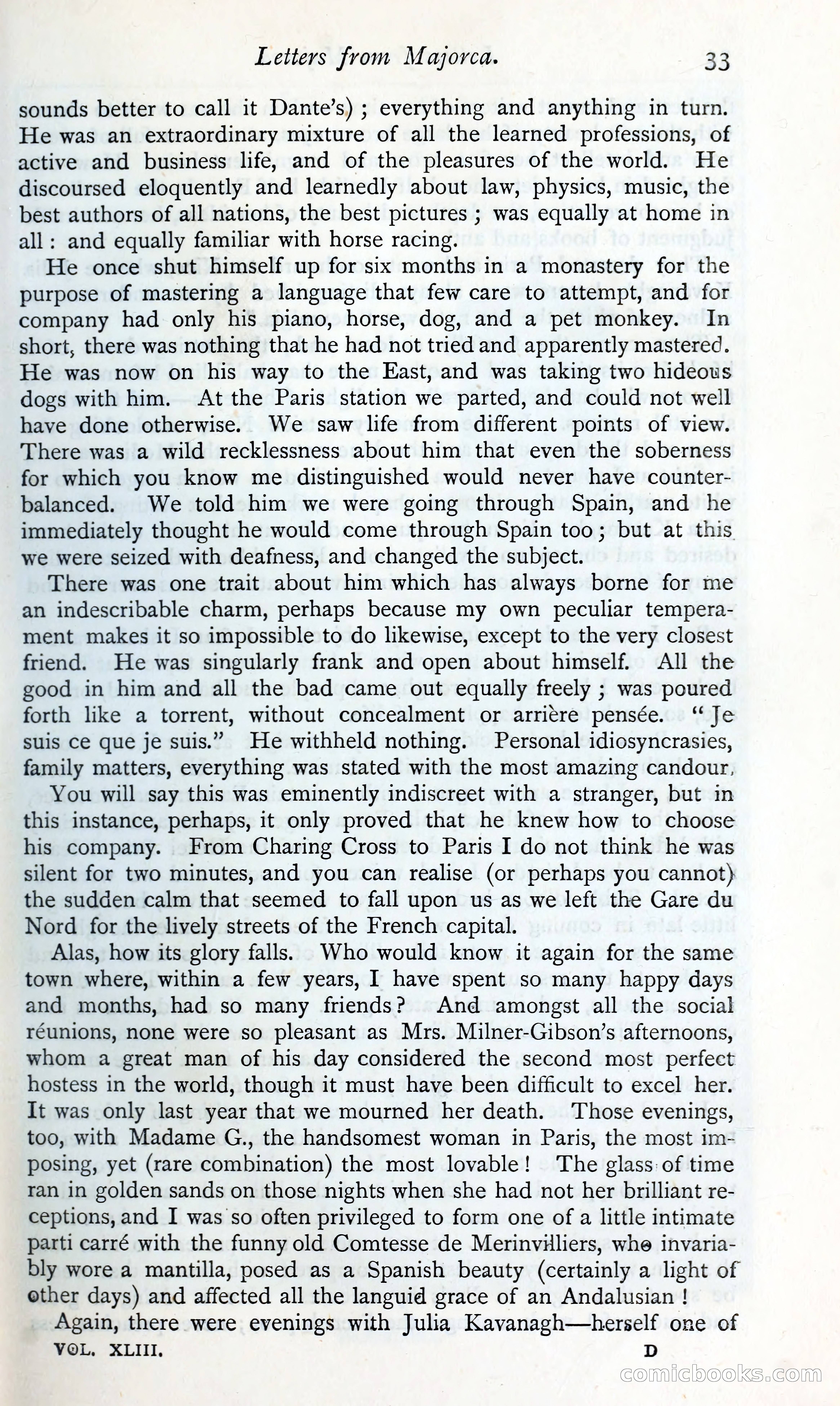
A restored page from Pulp Fiction, 1865. Page through the whole issue in the reader above.
📄 Transcribed text from this page (OCR, searchable)
Machine-transcribed from the original scan — historical spelling and the odd misread are preserved.
Letters from Majorca. 33 sounds better to call it Dante’s) ; everything and anything in turn. He was an extraordinary mixture of all the learned professions, of active and business life, and of the pleasures of the world. He discoursed eloquently and learnedly about law, physics, music, the best authors of all nations, the best pictures ; was equally at home in all: and equally familiar with horse racing. He once shut himself up for six months in a monastery for the purpose of mastering a language that few care to attempt, and for company had only his piano, horse, dog, and a pet monkey. In short, there was nothing that he had not tried and apparently mastered. He was now on his way to the East, and was taking two hideous dogs with him. At the Paris station we parted, and could not well have done otherwise. We saw life from different points of view. There was a wild recklessness about him that even the soberness for which you know me distinguished would never have counter- balanced. We told him we were going through Spain, and he immediately thought he would come through Spain too; but at this we were seized with deafness, and changed the subject. There was one trait about him which has always borne for me an indescribable charm, perhaps because my own peculiar tempera- ment makes it so impossible to do likewise, except to the very closest friend. He was singularly frank and open about himself. All the good in him and all the bad came out equally freely ; was poured forth like a torrent, without concealment or arriere pensée. “Je suis ce que je suis.” He withheld nothing. Personal idiosyncrasies, family matters, everything was stated with the most amazing candour, You will say this was eminently indiscreet with a stranger, but in this instance, perhaps, it only proved that he knew how to choose his company. From Charing Cross to Paris I do not think he was silent for two minutes, and you can realise (or perhaps you cannot) the sudden calm that seemed to fall upon us as we left the Gare du Nord for the lively streets of the French capital. Alas, how its glory falls. Who would know it again for the same town where, within a few years, I have spent so many happy days and months, had so many friends? And amongst all the social réunions, none were so pleasant as Mrs. Milner-Gibson’s afternoons, whom a great man of his day considered the second most perfect hostess in the world, though it must have been difficult to excel her. It was only last year that we mourned her death. ‘Those evenings, too, with Madame G., the handsomest woman in Paris, the most im- posing, yet (rare combination) the most lovable! The glass:of time ran in golden sands on those nights when she had not her brilliant re- ceptions, and I was so often privileged to form one of a little intimate parti carré with the funny old Comtesse de Merinvuliers, whe invaria- bly wore a mantilla, posed as a Spanish beauty (certainly a light of other days) and affected all the languid grace of an Andalusian ! Again, there were evenings with Julia Kavanagh—herself one of VOL. XLIII. D COMIC OOO SS) (C©) im