
Pulp Fiction, 1865 · page 375 of 400
The Argosy — page 375: what you’re looking at
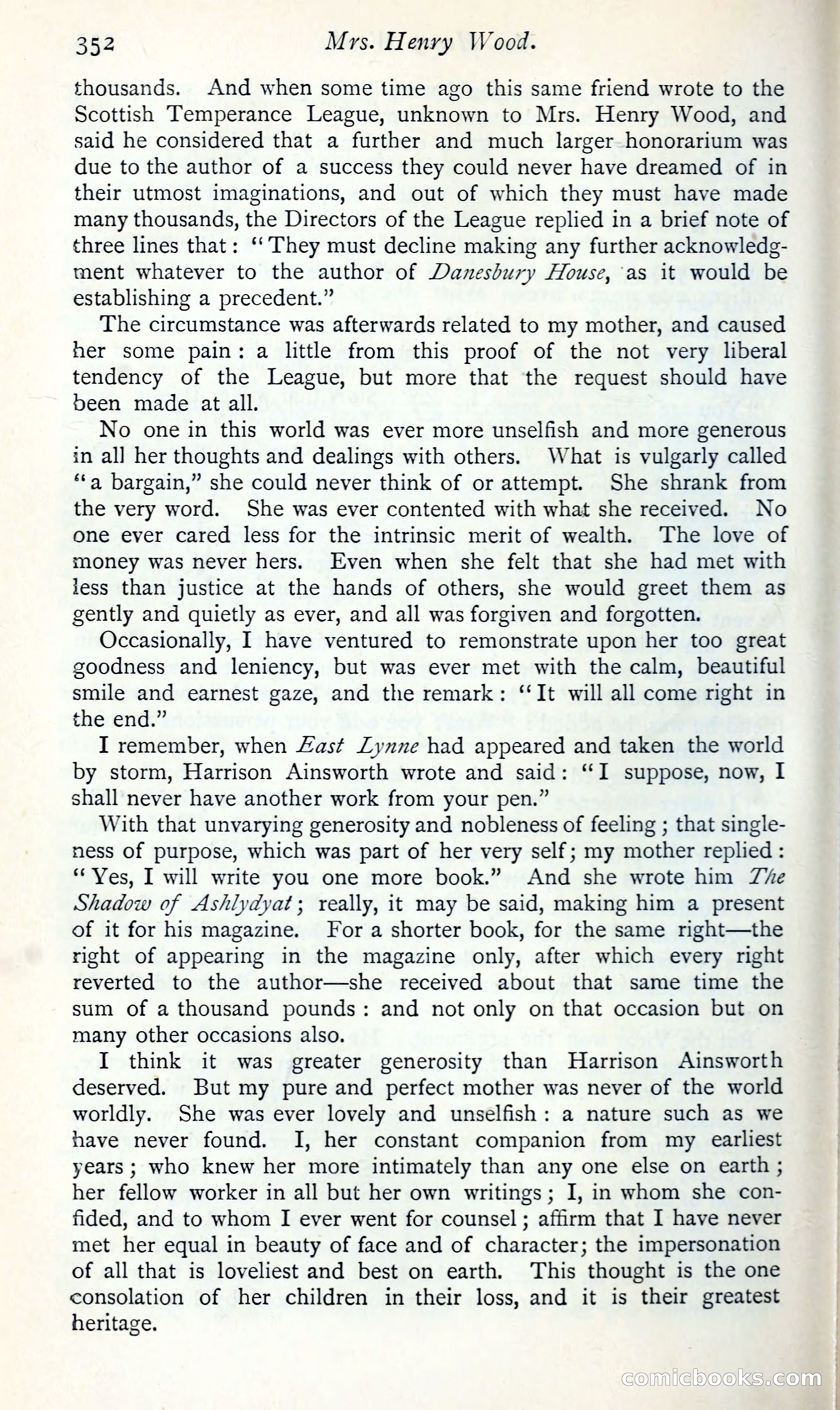
A restored page from Pulp Fiction, 1865. Page through the whole issue in the reader above.
📄 Transcribed text from this page (OCR, searchable)
Machine-transcribed from the original scan — historical spelling and the odd misread are preserved.
352 Mrs. Henry Wood. thousands. And when some time ago this same friend wrote to the Scottish —Temperance League, unknown to Mrs. Henry Wood, and said he considered that a further and much larger honorarium was due to the author of a success they could never have dreamed of in their utmost imaginations, and out of which they must have made many thousands, the Directors of the League replied in a brief note of three lines that: ‘‘ They must decline making any further acknowledg- ment whatever to the author of Danesbury House, as it would be establishing a precedent.” The circumstance was afterwards related to my mother, and caused her some pain: a little from this proof of the not very liberal tendency of the League, but more that the request should have been made at all. No one in this world was ever more unselfish and more generous in all her thoughts and dealings with others. What is vulgarly called ‘a bargain,” she could never think of or attempt. She shrank from the very word. She was ever contented with what she received. No one ever cared less for the intrinsic merit of wealth. The love of money was never hers. Even when she felt that she had met with less than justice at the hands of others, she would greet them as gently and quietly as ever, and all was forgiven and forgotten. Occasionally, I have ventured to remonstrate upon her too great goodness and leniency, but was ever met with the calm, beautiful smile and earnest gaze, and the remark: ‘‘It will all come right in the end.” I remember, when Aas¢ Lynne had appeared and taken the world by storm, Harrison Ainsworth wrote and said: ‘‘I suppose, now, I shall never have another work from your pen.” With that unvarying generosity and nobleness of feeling ; that single- ness of purpose, which was part of her very self; my mother replied : “Yes, I will write you one more book.” And she wrote him Zz%e Shadow of Ashlydyat; really, it may be said, making him a present of it for his magazine. For a shorter book, for the same right—the right of appearing in the magazine only, after which every right reverted to the author—she received about that same time the sum of a thousand pounds: and not only on that occasion but on many other occasions also. I think it was greater generosity than Harrison Ainsworth deserved. But my pure and perfect mother was never of the world worldly. She was ever lovely and unselfish: a nature such as we have never found. I, her constant companion from my earliest years ; who knew her more intimately than any one else on earth ; her fellow worker in all but her own writings; I, in whom she con- fided, and to whom I ever went for counsel ; affirm that I have never met her equal in beauty of face and of character; the impersonation of all that is loveliest and best on earth. This thought is the one consolation of her children in their loss, and it is their greatest heritage. COMNICLMOOOLKS, (Evo)