
Pulp Fiction, 1865 · page 374 of 400
The Argosy — page 374: what you’re looking at
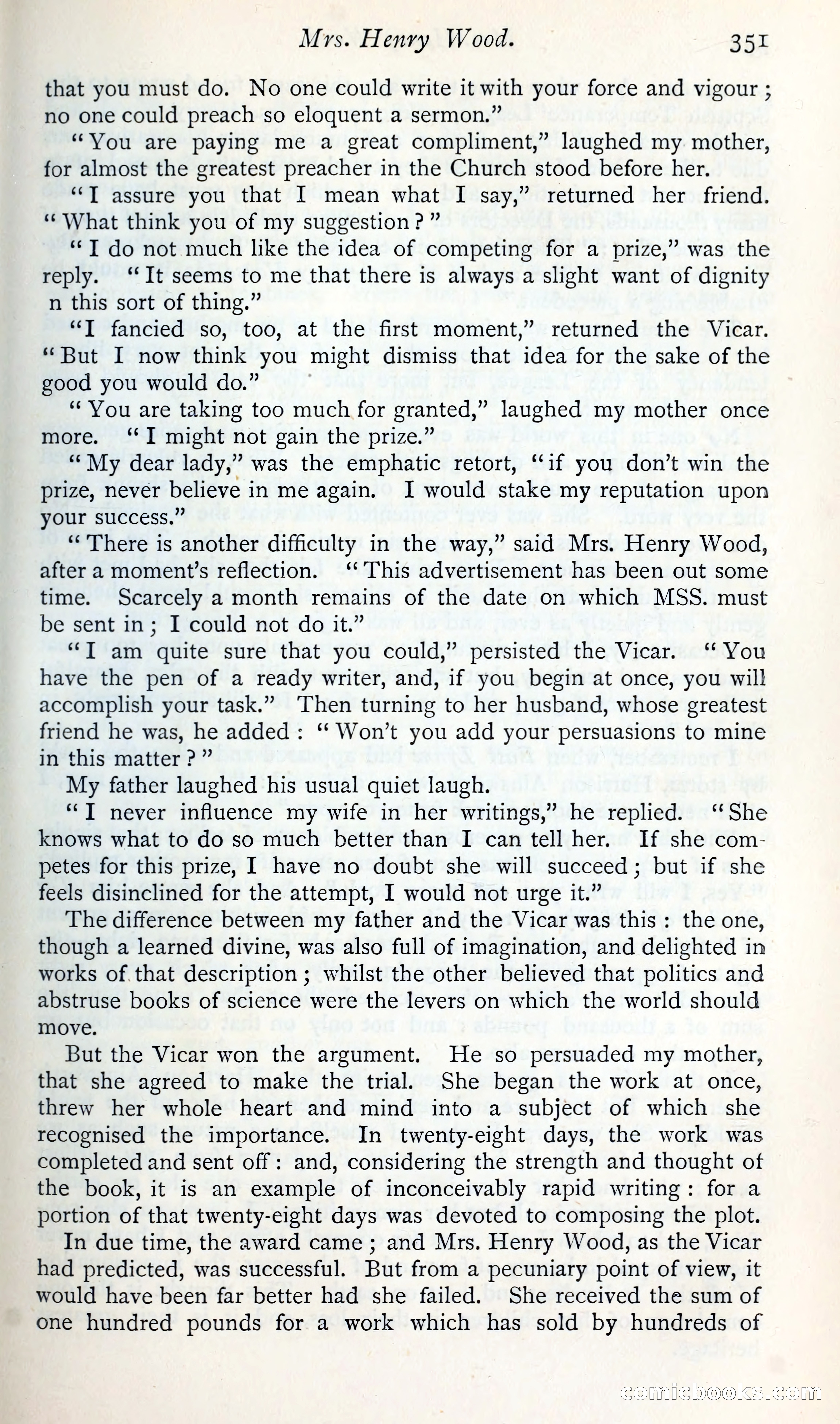
A restored page from Pulp Fiction, 1865. Page through the whole issue in the reader above.
📄 Transcribed text from this page (OCR, searchable)
Machine-transcribed from the original scan — historical spelling and the odd misread are preserved.
Mrs. Henry Wood. 351 that you must do. No one could write it with your force and vigour ; no one could preach so eloquent a sermon.” “Vou are paying me a great compliment,” laughed my. mother, for almost the greatest preacher in the Church stood before her. “T assure you that I mean what I say,” returned her friend. ‘What think you of my suggestion ? ” “I do not much like the idea of competing for a prize,” was the reply. ‘‘It seems to me that there is always a slight want of dignity n this sort of thing.” “T fancied so, too, at the first moment,” returned the Vicar. * But I now think you might dismiss that idea for the sake of the good you would do.” “You are taking too much for granted,” laughed my mother once more. “I might not gain the prize.” “My dear lady,” was the emphatic retort, “‘if you don’t win the prize, never believe in me again. I would stake my reputation upon your success.” ‘There is another difficulty in the way,” said Mrs. Henry Wood, aftera moment’s reflection. ‘This advertisement has been out some time. Scarcely a month remains of the date on which MSS. must be sent in; I could not do it.” “T am quite sure that you could,” persisted the Vicar. ‘‘ You have the pen of a ready writer, and, if you begin at once, you will accomplish your task.” ‘Then turning to her husband, whose greatest friend he was, he added: ‘“‘ Won’t you add your persuasions to mine in this matter ?” My father laughed his usual quiet laugh. “I never influence my wife in her writings,” he replied. ‘‘She knows what to do so much better than I can tell her. If she com- petes for this prize, I have no doubt she will succeed; but if she feels disinclined for the attempt, I would not urge it.” The difference between my father and the Vicar was this: the one, though a learned divine, was also full of imagination, and delighted in works of. that description ; whilst the other believed that politics and abstruse books of science were the levers on which the world should move. But the Vicar won the argument. He so persuaded my mother, that she agreed to make the trial. She began the work at once, threw her whole heart and mind into a subject of which she recognised the importance. In twenty-eight days, the work was completed and sent off: and, considering the strength and thought of the book, it is an example of inconceivably rapid writing: for a portion of that twenty-eight days was devoted to composing the plot. In due time, the award came; and Mrs. Henry Wood, as the Vicar had predicted, was successful. But from a pecuniary point of view, it would have been far better had she failed. She received the sum of one hundred pounds for a work which has sold by hundreds of comnmicooolks (CO