
Pulp Fiction, 1865 · page 367 of 400
The Argosy — page 367: what you’re looking at
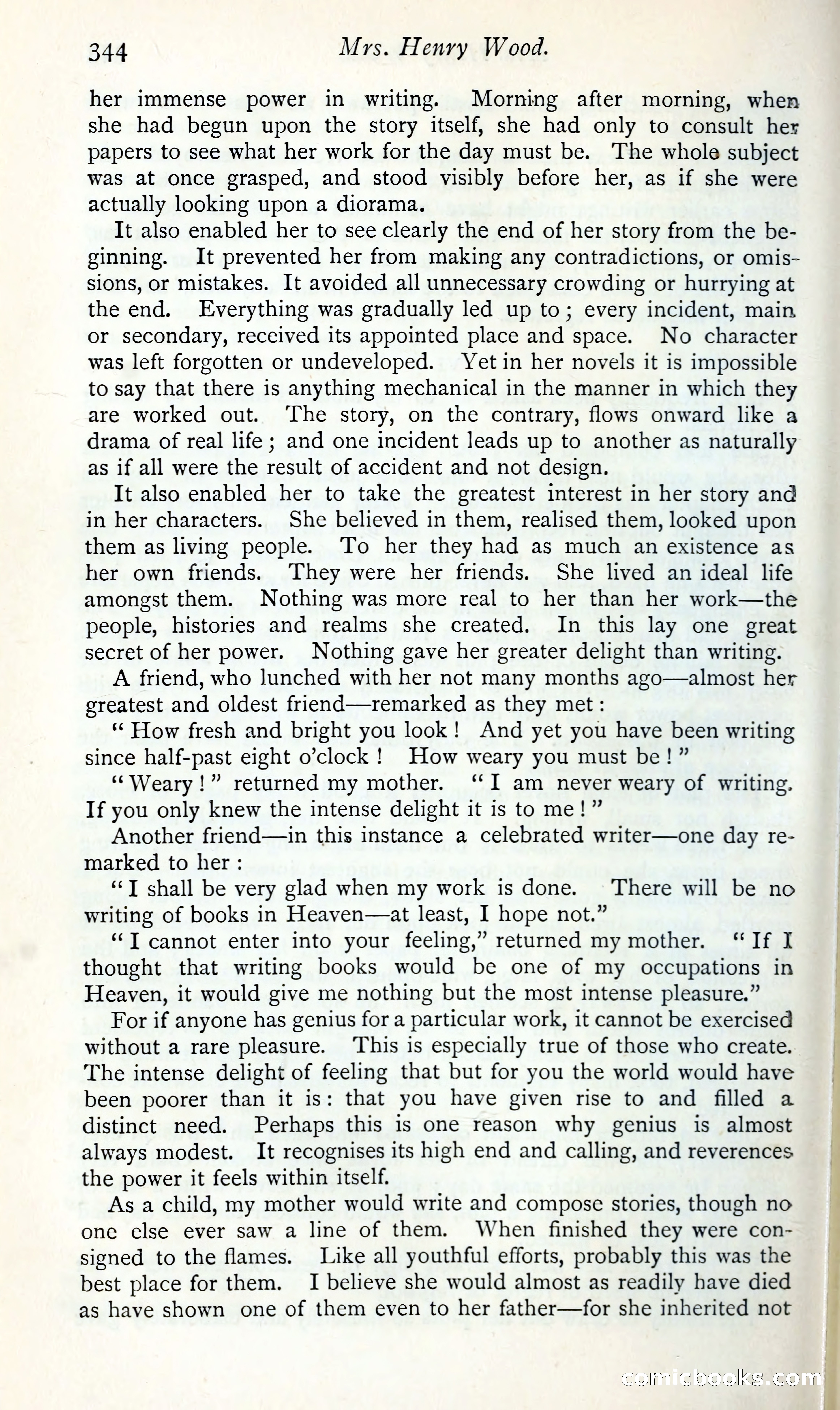
A restored page from Pulp Fiction, 1865. Page through the whole issue in the reader above.
📄 Transcribed text from this page (OCR, searchable)
Machine-transcribed from the original scan — historical spelling and the odd misread are preserved.
344 Mrs. Henry Wood. her immense power in writing. Morning after morning, when she had begun upon the story itself, she had only to consult her papers to see what her work for the day must be. The whole subject was at once grasped, and stood visibly before her, as if she were actually looking upon a diorama. It also enabled her to see clearly the end of her story from the be- ginning. It prevented her from making any contradictions, or omis- sions, or mistakes. It avoided all unnecessary crowding or hurrying at the end. Everything was gradually led up to; every incident, main or secondary, received its appointed place and space. No character was left forgotten or undeveloped. Yetin her novels it is impossible to say that there is anything mechanical in the manner in which they are worked out. ‘The story, on the contrary, flows onward like a drama of real life; and one incident leads up to another as naturally as if all were the result of accident and not design. It also enabled her to take the greatest interest in her story and in her characters. She believed in them, realised them, looked upon them as living people. To her they had as much an existence as her own friends. ‘They were her friends. She lived an ideal life amongst them. Nothing was more real to her than her work—the people, histories and realms she created. In this lay one great secret of her power. Nothing gave her greater delight than writing. A friend, who lunched with her not many months ago—almost her greatest and oldest friend—remarked as they met: ‘ How fresh and bright you look! And yet you have been writing since half-past eight o’clock ! How weary you must be! ” “Weary!” returned my mother. “I am never weary of writing. If you only knew the intense delight it is to me!” Another friend—in this instance a celebrated writer—one day re- marked to her: ‘‘T shall be very glad when my work is done. There will be no writing of books in Heaven—at least, I hope not.” ‘TIT cannot enter into your feeling,” returned my mother. “If I thought that writing books would be one of my occupations in Heaven, it would give me nothing but the most intense pleasure.” For if anyone has genius for a particular work, it cannot be exercised without a rare pleasure. This is especially true of those who create. The intense delight of feeling that but for you the world would have been poorer than it is: that you have given rise to and filled a distinct need. Perhaps this is one reason why genius is almost always modest. It recognises its high end and calling, and reverences the power it feels within itself. As a child, my mother would write and compose stories, though no one else ever saw a line of them. When finished they were con- signed to the flames. Like all youthful efforts, probably this was the best place for them. I believe she would almost as readily have died as have shown one of them even to her father—for she inherited not CONICMHOOLKS, (EC) =) eS Loe ae a — ——ae