
Pulp Fiction, 1865 · page 218 of 400
The Argosy — page 218: what you’re looking at
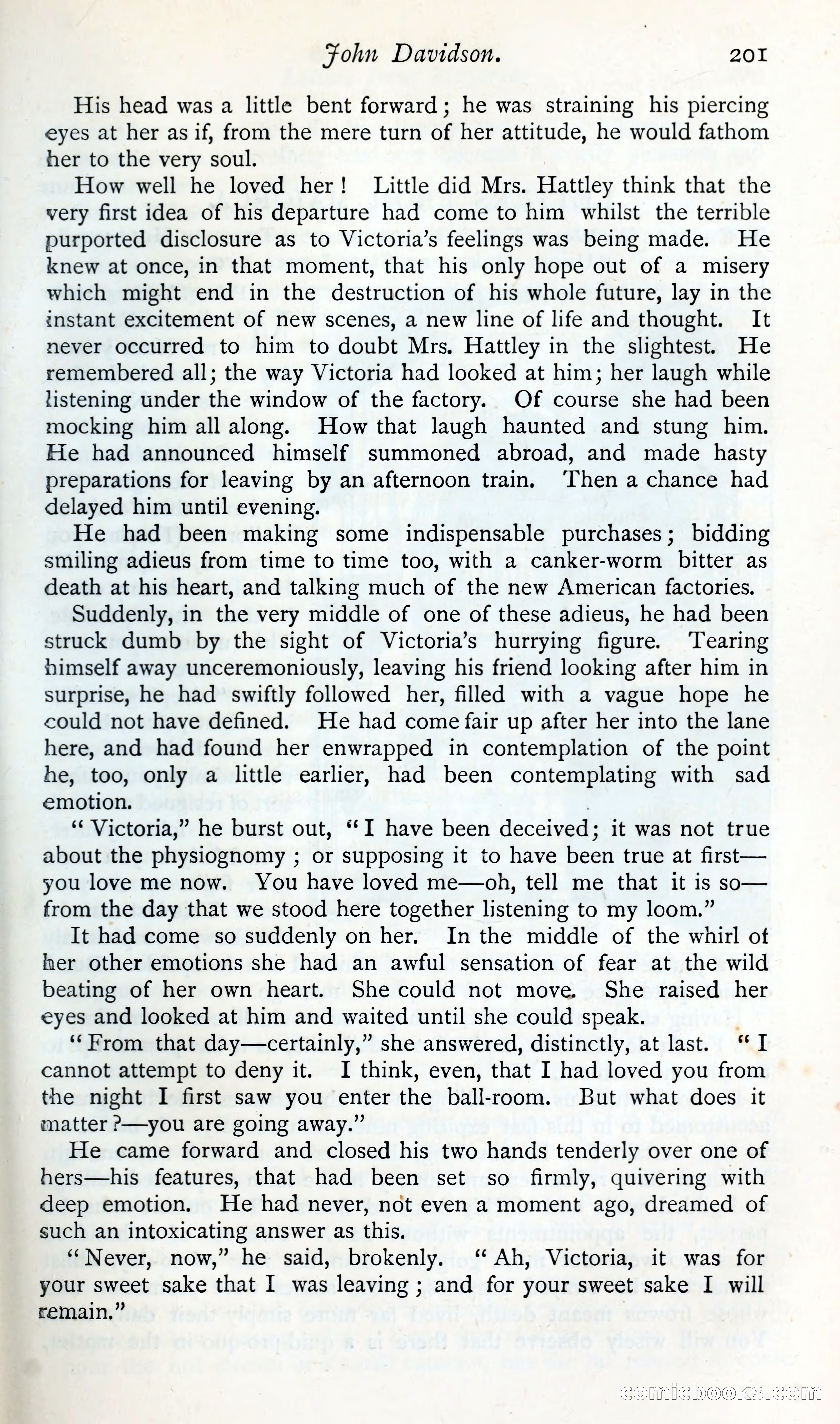
A restored page from Pulp Fiction, 1865. Page through the whole issue in the reader above.
📄 Transcribed text from this page (OCR, searchable)
Machine-transcribed from the original scan — historical spelling and the odd misread are preserved.
Fohn Davidson. 201 His head was a little bent forward; he was straining his piercing eyes at her asif, from the mere turn of her attitude, he would fathom her to the very soul. How well he loved her! Little did Mrs. Hattley think that the very first idea of his departure had come to him whilst the terrible purported disclosure as to Victoria’s feelings was being made. He knew at once, in that moment, that his only hope out of a misery which might end in the destruction of his whole future, lay in the instant excitement of new scenes, a new line of life and thought. It never occurred to him to doubt Mrs. Hattley in the slightest. He remembered all; the way Victoria had looked at him; her laugh while listening under the window of the factory. Of course she had been mocking him all along. How that laugh haunted and stung him. He had announced himself summoned abroad, and made hasty preparations for leaving by an afternoon train. ‘Then a chance had delayed him until evening. He had been making some indispensable purchases; bidding smiling adieus from time to time too, with a canker-worm bitter as death at his heart, and talking much of the new American factories. Suddenly, in the very middle of one of these adieus, he had been struck dumb by the sight of Victoria’s hurrying figure. ‘Tearing himself away unceremoniously, leaving his friend looking after him in surprise, he had swiftly followed her, filled with a vague hope he could not have defined. He had come fair up after her into the lane here, and had found her enwrapped in contemplation of the point he, too, only a little earlier, had been contemplating with sad emotion. | ‘‘ Victoria,” he burst out, ‘I have been deceived; it was not true about the physiognomy ; or supposing it to have been true at first— you love me now. You have loved me—oh, tell me that it is so— from the day that we stood here together listening to my loom.” It had come so suddenly on her. In the middle of the whirl of her other emotions she had an awful sensation of fear at the wild beating of her own heart. She could not move. She raised her eyes and looked at him and waited until she could speak. “From that day—certainly,” she answered, distinctly, at last. “I cannot attempt to deny it. I think, even, that I had loved you from the night I first saw you enter the ball-room. But what does it matter p—you are going away.” He came forward and closed his two hands tenderly over one of hers—his features, that had been set so firmly, quivering with deep emotion. He had never, not even a moment ago, dreamed of such an intoxicating answer as this. ‘““Never, now,” he said, brokenly. ‘‘ Ah, Victoria, it was for your sweet sake that I was leaving ; and for your sweet sake I will remain.” COMmicooolkks () (SO)