
Pulp Fiction, 1865 · page 398 of 400
The Argosy — page 398: what you’re looking at
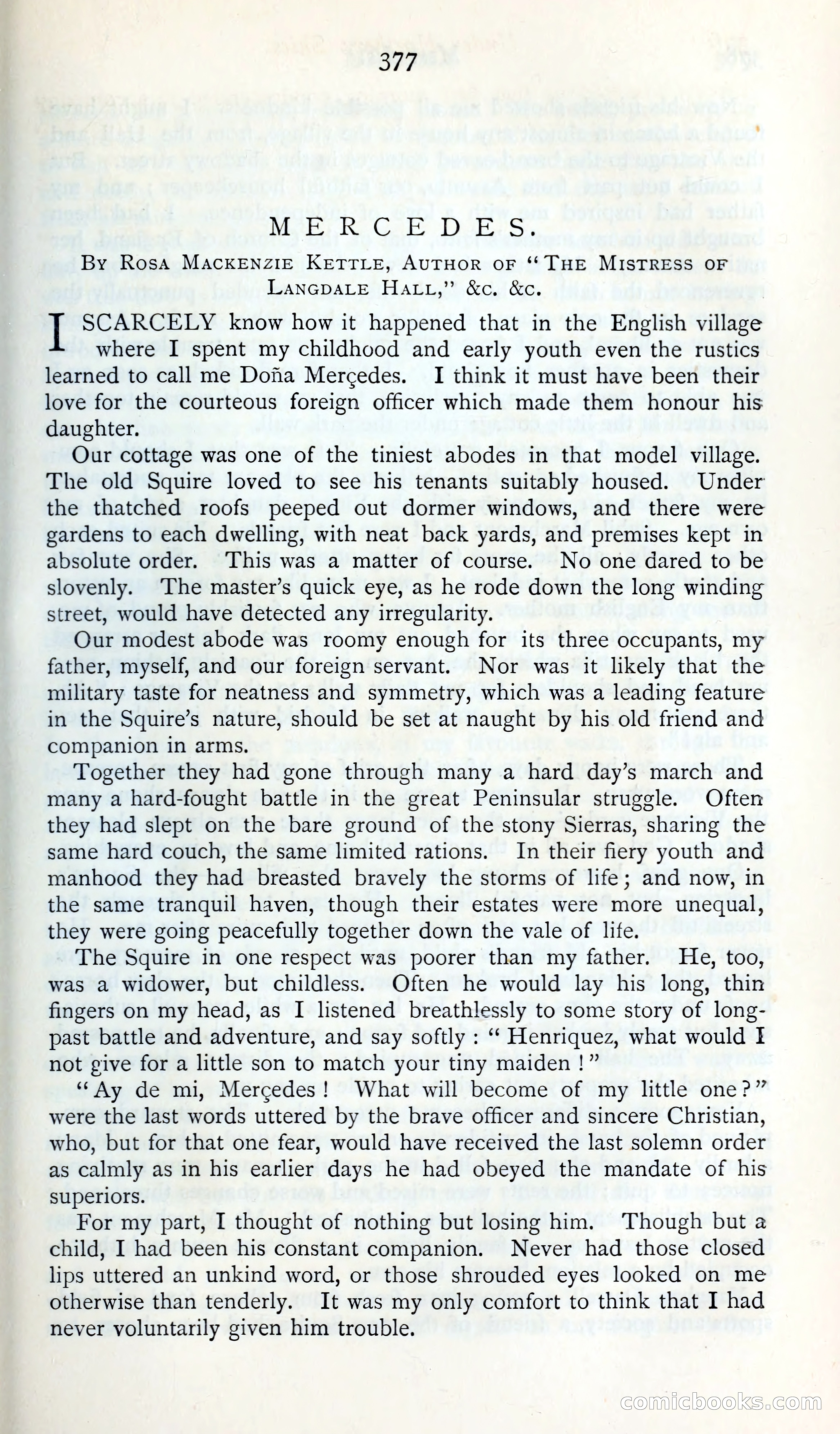
A restored page from Pulp Fiction, 1865. Page through the whole issue in the reader above.
📄 Transcribed text from this page (OCR, searchable)
Machine-transcribed from the original scan — historical spelling and the odd misread are preserved.
377 eather In Gok, TB) Sy, By RosA MACKENZIE KETTLE, AUTHOR OF ‘**‘ THE MISTRESS OF LANGDALE HALL,” &c. &c. | SCARCELY know how it happened that in the English village where I spent my childhood and early youth even the rustics learned to call me Dona Mercedes. I think it must have been their love for the courteous foreign officer which made them honour his daughter. Our cottage was one of the tiniest abodes in that model village. The old Squire loved to see his tenants suitably housed. Under the thatched roofs peeped out dormer windows, and there were gardens to each dwelling, with neat back yards, and premises kept in absolute order. ‘This was a matter of course. No one dared to be slovenly. ‘The master’s quick eye, as he rode down the long winding street, would have detected any irregularity. Our modest abode was roomy enough for its three occupants, my father, myself, and our foreign servant. Nor was it likely that the military taste for neatness and symmetry, which was a leading feature in the Squire’s nature, should be set at naught by his old friend and companion in arms. Together they had gone through many a hard day’s march and many a hard-fought battle in the great Peninsular struggle. Often they had slept on the bare ground of the stony Sierras, sharing the same hard couch, the same limited rations. In their fiery youth and manhood they had breasted bravely the storms of life; and now, in the same tranquil haven, though their estates were more unequal, they were going peacefully together down the vale of life. The Squire in one respect was poorer than my father. He, too, was a widower, but childless. Often he would lay his long, thin fingers on my head, as I listened breathlessly to some story of long- past battle and adventure, and say softly : ‘‘ Henriquez, what would | not give for a little son to match your tiny maiden !” “Ay de mi, Mercedes! What will become of my little one?” were the last words uttered by the brave officer and sincere Christian, who, but for that one fear, would have received the last solemn order as calmly as in his earlier days he had obeyed the mandate of his superiors. For my part, I thought of nothing but losing him. Though but a child, I had been his constant companion. Never had those closed lips uttered an unkind word, or those shrouded eyes looked on me otherwise than tenderly. It was my only comfort to think that I had never voluntarily given him trouble. COnnicloooks (CO)