
Pulp Fiction, 1865 · page 209 of 400
The Argosy — page 209: what you’re looking at
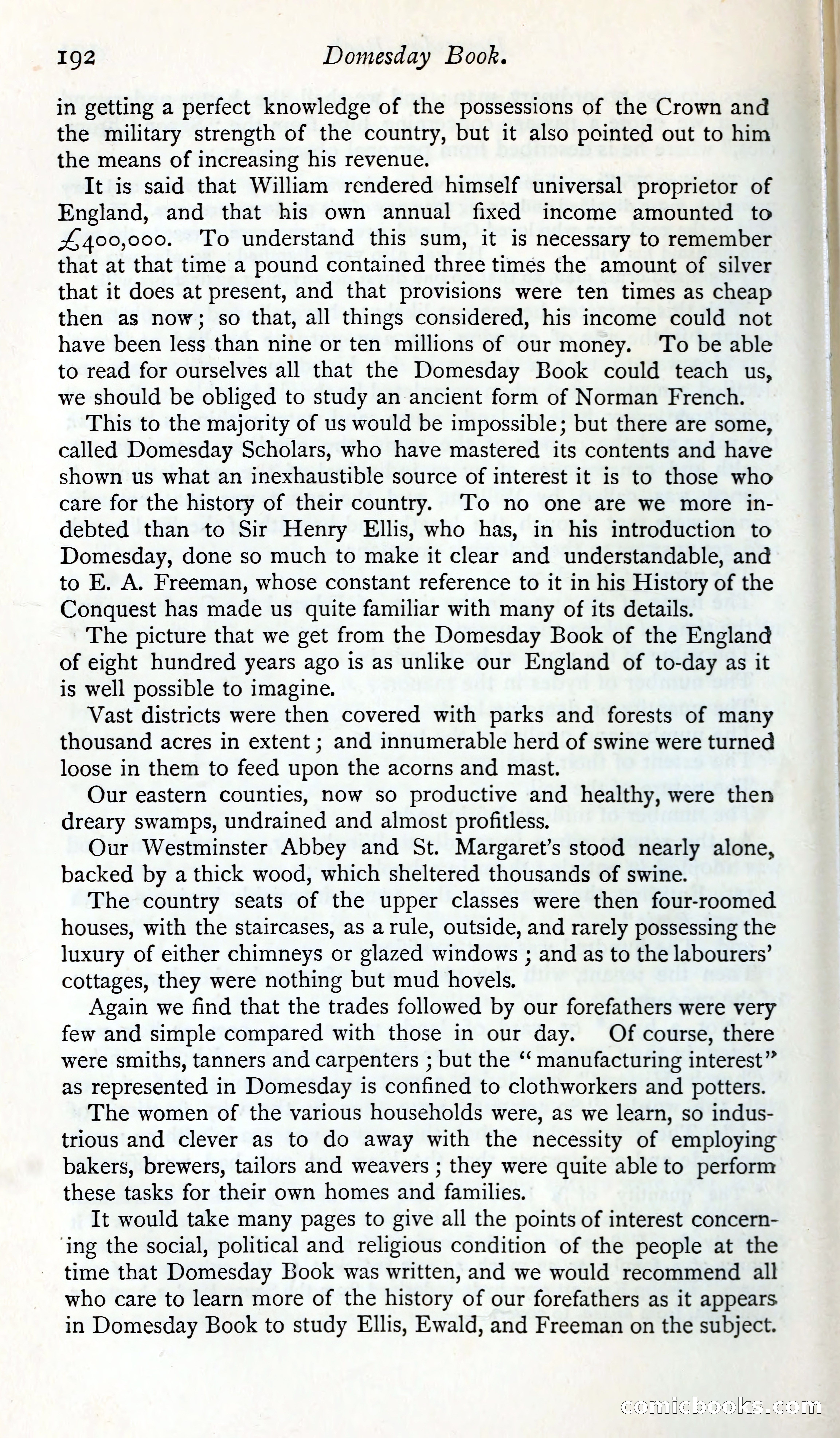
A restored page from Pulp Fiction, 1865. Page through the whole issue in the reader above.
📄 Transcribed text from this page (OCR, searchable)
Machine-transcribed from the original scan — historical spelling and the odd misread are preserved.
192 Domesday Book. in getting a perfect knowledge of the possessions of the Crown and the military strength of the country, but it also pointed out to him the means of increasing his revenue. It is said that William rendered himself universal proprietor of England, and that his own annual fixed income amounted to 4,400,000. To understand this sum, it is necessary to remember that at that time a pound contained three times the amount of silver that it does at present, and that provisions were ten times as cheap then as now; so that, all things considered, his income could not have been less than nine or ten millions of our money. To be able to read for ourselves all that the Domesday Book could teach us, we should be obliged to study an ancient form of Norman French. This to the majority of us would be impossible; but there are some, called Domesday Scholars, who have mastered its contents and have shown us what an inexhaustible source of interest it 1s to those who care for the history of their country. To no one are we more in- debted than to Sir Henry Ellis, who has, in his introduction to Domesday, done so much to make it clear and understandable, and to E. A. Freeman, whose constant reference to it in his History of the Conquest has made us quite familiar with many of its details. The picture that we get from the Domesday Book of the England of eight hundred years ago is as unlike our England of to-day as it is well possible to imagine. Vast districts were then covered with parks and forests of many thousand acres in extent ; and innumerable herd of swine were turned loose in them to feed upon the acorns and mast. Our eastern counties, now so productive and healthy, were then dreary swamps, undrained and almost profitless. Our Westminster Abbey and St. Margaret’s stood nearly alone, backed by a thick wood, which sheltered thousands of swine. The country seats of the upper classes were then four-roomed houses, with the staircases, as arule, outside, and rarely possessing the luxury of either chimneys or glazed windows ; and as to the labourers’ cottages, they were nothing but mud hovels. Again we find that the trades followed by our forefathers were very few and simple compared with those in our day. Of course, there were smiths, tanners and carpenters ; but the ‘‘ manufacturing interest” as represented in Domesday is confined to clothworkers and potters. The women of the various households were, as we learn, so indus- trious and clever as to do away with the necessity of employing bakers, brewers, tailors and weavers ; they were quite able to perform these tasks for their own homes and families. It would take many pages to give all the points of interest concern- ‘ing the social, political and religious condition of the people at the time that Domesday Book was written, and we would recommend all who care to learn more of the history of our forefathers as it appears in Domesday Book to study Ellis, Ewald, and Freeman on the subject. COUN (A) OOO KS,E©