
Pulp Fiction, 1865 · page 205 of 400
The Argosy — page 205: what you’re looking at
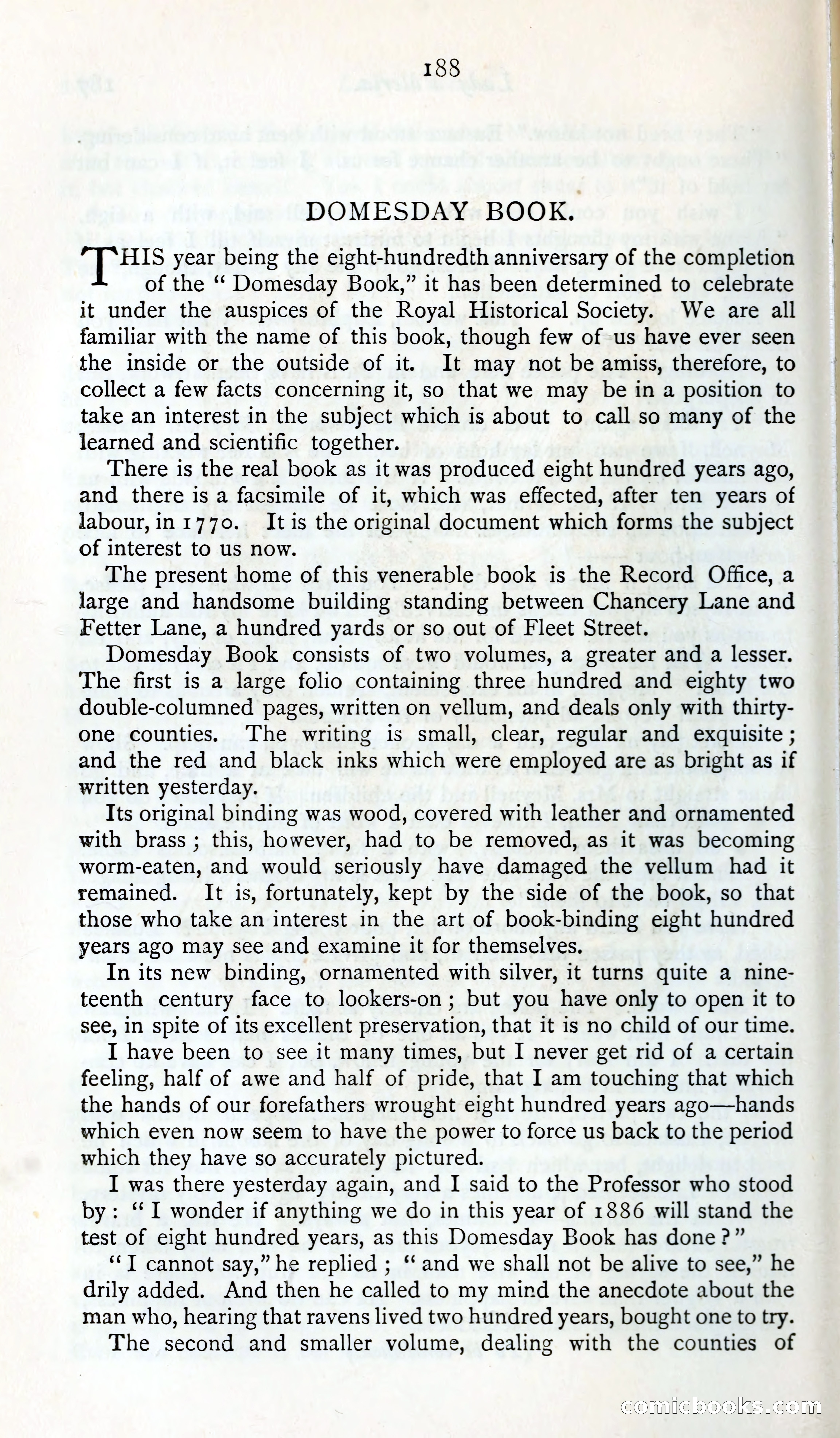
A restored page from Pulp Fiction, 1865. Page through the whole issue in the reader above.
📄 Transcribed text from this page (OCR, searchable)
Machine-transcribed from the original scan — historical spelling and the odd misread are preserved.
188 DOMESDAY BOOK. of AHS year being the eight-hundredth anniversary of the completion of the “‘ Domesday Book,” it has been determined to celebrate it under the auspices of the Royal Historical Society. We are all familiar with the name of this book, though few of us have ever seen the inside or the outside of it. It may not be amiss, therefore, to collect a few facts concerning it, so that we may be in a position to take an interest in the subject which is about to call so many of the learned and scientific together. There is the real book as it was produced eight hundred years ago, and there is a facsimile of it, which was effected, after ten years of labour,in1770. Itis the original document which forms the subject of interest to us now. The present home of this venerable book is the Record Office, a large and handsome building standing between Chancery Lane and Fetter Lane, a hundred yards or so out of Fleet Street. Domesday Book consists of two volumes, a greater and a lesser. The first is a large folio containing three hundred and eighty two double-columned pages, written on vellum, and deals only with thirty- one counties. ‘The writing is small, clear, regular and exquisite ; and the red and black inks which were employed are as bright as if written yesterday. Its original binding was wood, covered with leather and ornamented with brass ; this, however, had to be removed, as it was becoming worm-eaten, and would seriously have damaged the vellum had it remained. It is, fortunately, kept by the side of the book, so that those who take an interest in the art of book-binding eight hundred years ago may see and examine it for themselves. In its new binding, ornamented with silver, it turns quite a nine- teenth century face to lookers-on; but you have only to open it to see, in spite of its excellent preservation, that it is no child of our time. I have been to see it many times, but I never get rid of a certain feeling, half of awe and half of pride, that I am touching that which the hands of our forefathers wrought eight hundred years ago—hands which even now seem to have the power to force us back to the period which they have so accurately pictured. I was there yesterday again, and I said to the Professor who stood by: “I wonder if anything we do in this year of 1886 will stand the test of eight hundred years, as this Domesday Book has done ?” “T cannot say,” he replied ; ‘‘ and we shall not be alive to see,” he drily added. And then he called to my mind the anecdote about the man who, hearing that ravens lived two hundred years, bought one to try. The second and smaller volume, dealing with the counties of CORNICMOOOKS. ©