
Pulp Fiction, 1865 · page 204 of 400
The Argosy — page 204: what you’re looking at
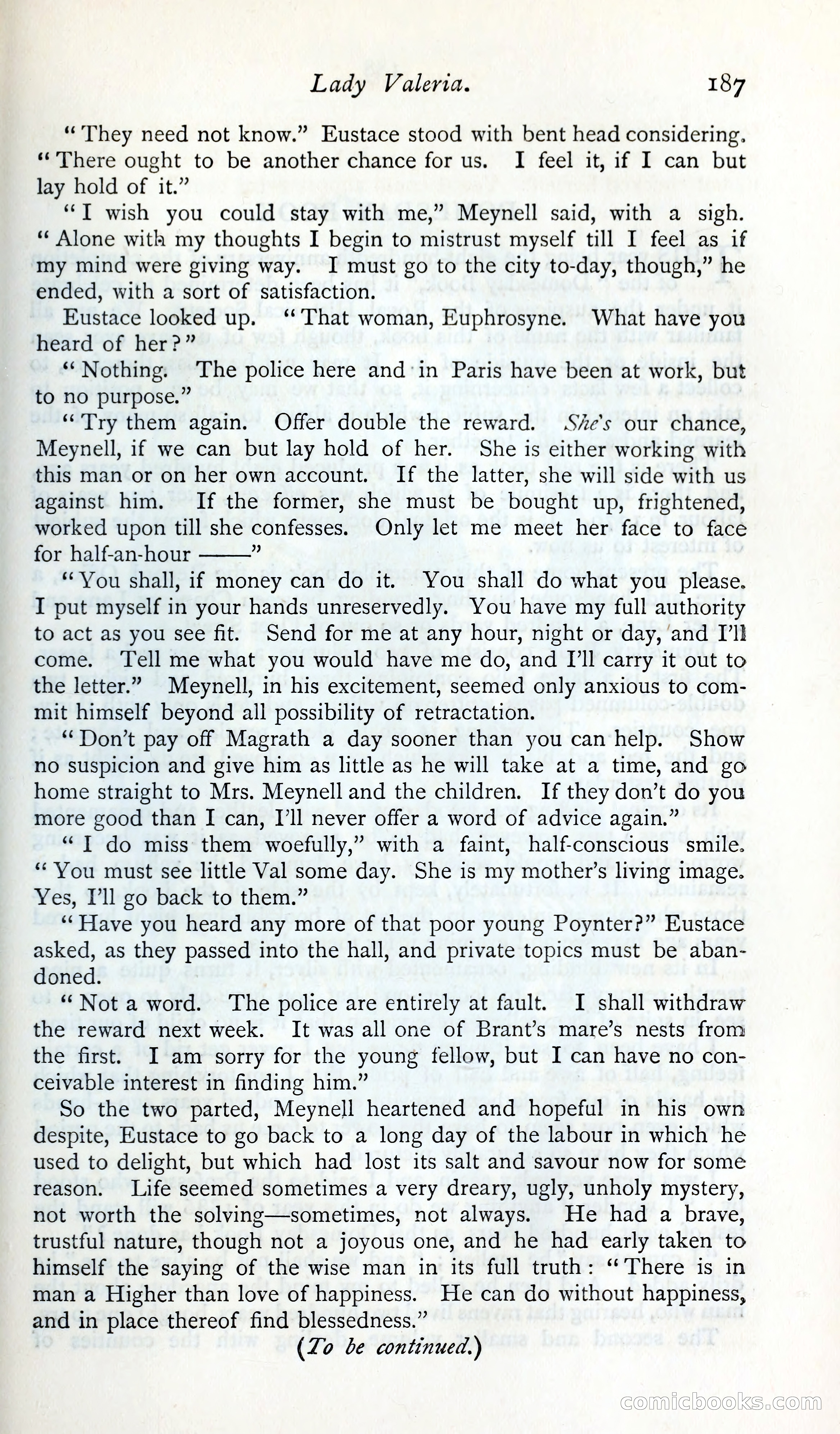
A restored page from Pulp Fiction, 1865. Page through the whole issue in the reader above.
📄 Transcribed text from this page (OCR, searchable)
Machine-transcribed from the original scan — historical spelling and the odd misread are preserved.
Lady Valeria. 187 “They need not know.” Eustace stood with bent head considering. “There ought to be another chance for us. I feel it, if I can but lay hold of it.” ““T wish you could stay with me,” Meynell said, with a sigh. ‘* Alone with my thoughts I begin to mistrust myself till I feel as if my mind were giving way. I must go to the city to-day, though,” he ended, with a sort of satisfaction. Eustace looked up. ‘‘ That woman, Euphrosyne. What have you heard of her?” “Nothing. The police here and’in Paris have been at work, but to no purpose.” “Try them again. Offer double the reward. Ses our chance, Meynell, if we can but lay hold of her. She is either working with this man or on her own account. If the latter, she will side with us against him. If the former, she must be bought up, frightened, worked upon till she confesses. Only let me meet her face to face for half-an-hour 5 “You shall, if money can do it. You shall do what you please. I put myself in your hands unreservedly. You have my full authority to act as you see fit. Send for me at any hour, night or day, ‘and Ill come. Tell me what you would have me do, and [’ll carry it out to the letter.” Meynell, in his excitement, seemed only anxious to com- mit himself beyond all possibility of retractation. “Don’t pay off Magrath a day sooner than you can help. Show no suspicion and give him as little as he will take at a time, and go home straight to Mrs. Meynell and the children. If they don’t do you more good than I can, I’ll never offer a word of advice again.” “I do miss them woefully,” with a faint, half-conscious smile. “You must see little Val some day. She is my mother’s living image. Yes, I'll go back to them.” ‘““Have you heard any more of that poor young Poynter?” Eustace asked, as they passed into the hall, and private topics must be aban- doned. “Not a word. The police are entirely at fault. I shall withdraw the reward next week. It was all one of Brant’s mare’s nests from the first. I am sorry for the young fellow, but I can have no con- ceivable interest in finding him.” So the two parted, Meynell heartened and hopeful in his own despite, Eustace to go back to a long day of the labour in which he used to delight, but which had lost its salt and savour now for some reason. Life seemed sometimes a very dreary, ugly, unholy mystery, not worth the solving—sometimes, not always. He had a brave, trustful nature, though not a joyous one, and he had early taken to himself the saying of the wise man in its full truth: ‘There is in man a Higher than love of happiness. He can do without happiness, and in place thereof find blessedness.” (Zo be continued.) Conmnicboooks (CO)