
Pulp Fiction, 1865 · page 394 of 400
The Argosy — page 394: what you’re looking at
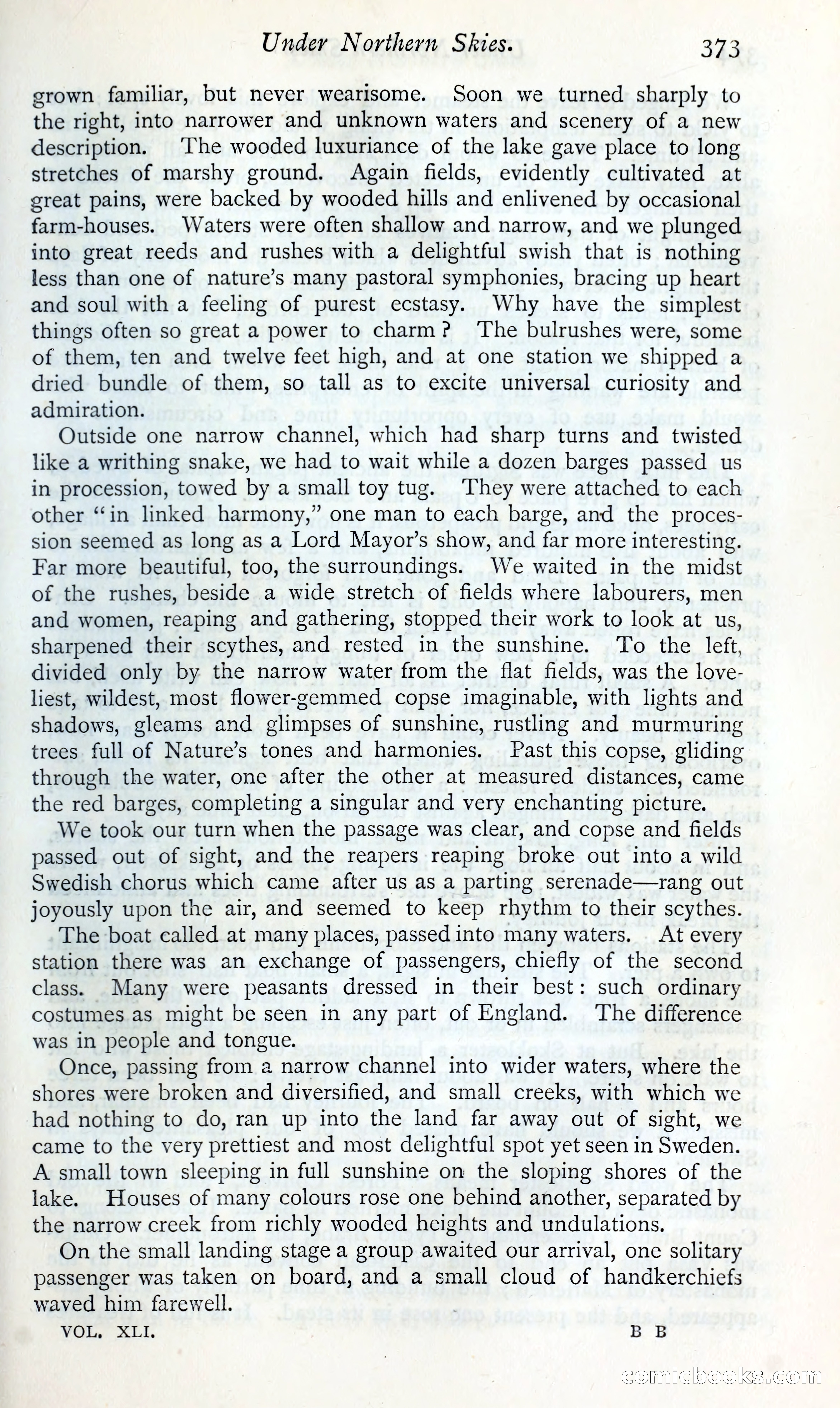
A restored page from Pulp Fiction, 1865. Page through the whole issue in the reader above.
📄 Transcribed text from this page (OCR, searchable)
Machine-transcribed from the original scan — historical spelling and the odd misread are preserved.
Under Northern Skies. 373 grown familiar, but never wearisome. Soon we turned sharply to the right, into narrower and unknown waters and scenery of a new description. ‘The wooded luxuriance of the lake gave place to long stretches of marshy ground. Again fields, evidently cultivated at great pains, were backed by wooded hills and enlivened by occasional farm-houses. Waters were often shallow and narrow, and we plunged into great reeds and rushes with a delightful swish that is nothing less than one of nature’s many pastoral symphonies, bracing up heart and soul with a feeling of purest ecstasy. Why have the simplest things often so great a power to charme The bulrushes were, some of them, ten and twelve feet high, and at one station we shipped a dried bundle of them, so tall as to excite universal curiosity and admiration. Outside one narrow channel, which had sharp turns and twisted like a writhing snake, we had to wait while a dozen barges passed us in procession, towed by a small toy tug. ‘They were attached to each other “in linked harmony,” one man to each barge, and the proces- sion seemed as long as a Lord Mayor’s show, and far more interesting. Far more beautiful, too, the surroundings. We waited in the midst of the rushes, beside a wide stretch of fields where labourers, men and women, reaping and gathering, stopped their work to look at us, sharpened their scythes, and rested in the sunshine. To the left, divided only by the narrow water from the flat fields, was the love- liest, wildest, most flower-gemmed copse imaginable, with lights and shadows, gleams and glimpses of sunshine, rustling and murmuring trees full of Nature’s tones and harmonies. Past this copse, gliding through the water, one after the other at measured distances, came the red barges, completing a singular and very enchanting picture. We took our turn when the passage was clear, and copse and fields passed out of sight, and the reapers reaping broke out into a wild Swedish chorus which came after us as a parting serenade—rang out joyously upon the air, and seemed to keep rhythm to their scythes. The boat called at many places, passed into many waters. At every station there was an exchange of passengers, chiefly of the second class. Many were peasants dressed in their best: such ordinary costumes as might be seen in any part of England. The difference was in people and tongue. Once, passing from a narrow channel into wider waters, where the shores were broken and diversified, and small creeks, with which we had nothing to do, ran up into the land far away out of sight, we came to the very prettiest and most delightful spot yet seen in Sweden. A small town sleeping in full sunshine on the sloping shores of the lake. Houses of many colours rose one behind another, separated by the narrow creek from richly wooded heights and undulations. On the small landing stage a group awaited our arrival, one solitary passenger was taken on board, and a small cloud of handkerchiefs waved him farewell. | | VoL, XL. BB COMIC OOO SS (c@) im