
Pulp Fiction, 1865 · page 107 of 400
The Argosy — page 107: what you’re looking at
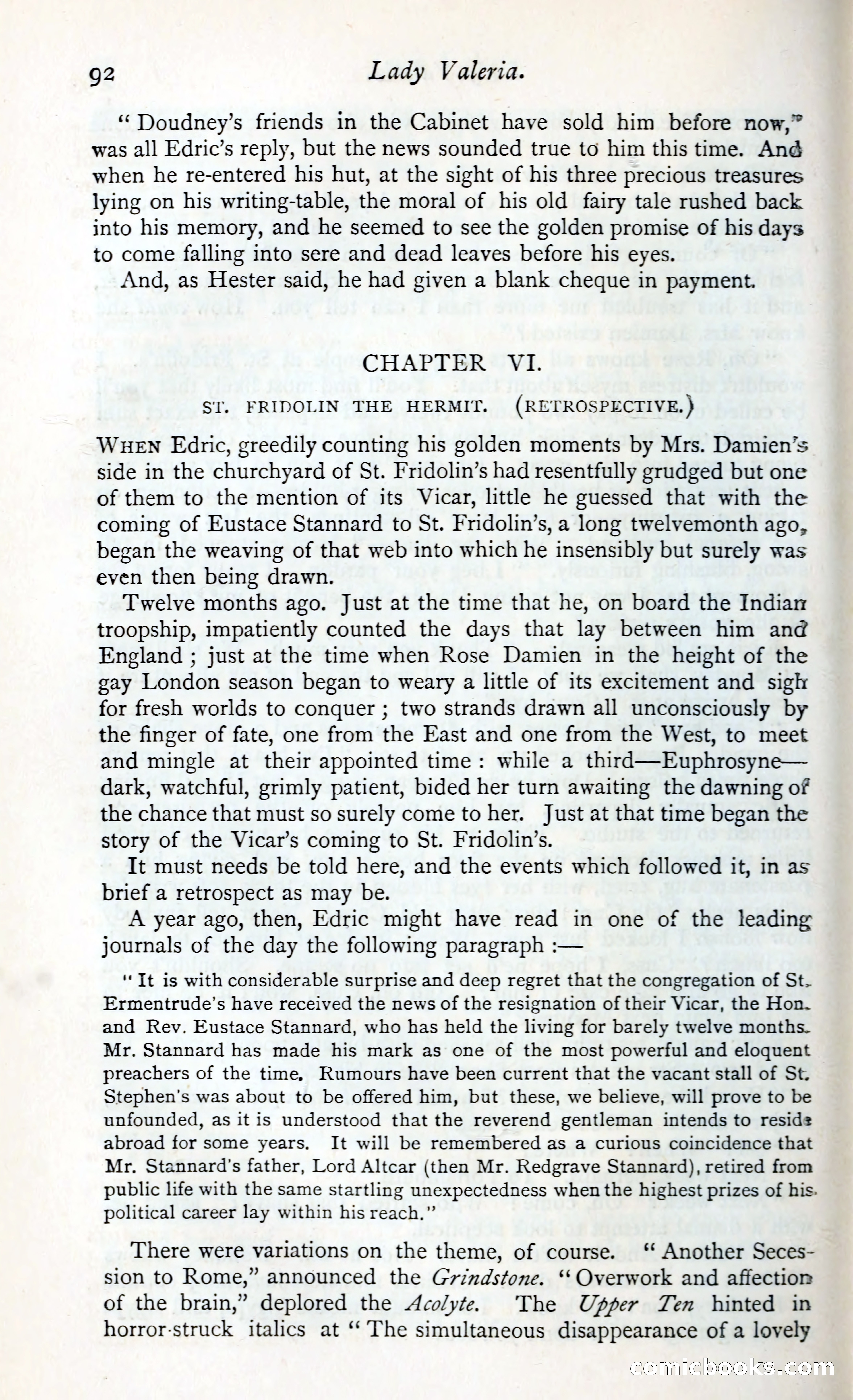
A restored page from Pulp Fiction, 1865. Page through the whole issue in the reader above.
📄 Transcribed text from this page (OCR, searchable)
Machine-transcribed from the original scan — historical spelling and the odd misread are preserved.
Q2 Lady Valeria. ‘‘Doudney’s friends in the Cabinet have sold him before now,” was all Edric’s reply, but the news sounded true to him this time. And when he re-entered his hut, at the sight of his three precious treasures lying on his writing-table, the moral of his old fairy tale rushed back into his memory, and he seemed to see the golden promise of his days to come falling into sere and dead leaves before his eyes. And, as Hester said, he had given a blank cheque in payment. CHAPTER: VI. ST. FRIDOLIN THE HERMIT. (RETROSPECTIVE. ) WHEN Edric, greedily counting his golden moments by Mrs. Damien’s side in the churchyard of St. Fridolin’s had resentfully grudged but one of them to the mention of its Vicar, little he guessed that with the coming of Eustace Stannard to St. Fridolin’s, a long twelvemonth ago, began the weaving of that web into which he insensibly but surely was even then being drawn. Twelve months ago. Just at the time that he, on board the Indian troopship, impatiently counted the days that lay between him an@ England ; just at the time when Rose Damien in the height of the gay London season began to weary a little of its excitement and sigh for fresh worlds to conquer ; two strands drawn all unconsciously by the finger of fate, one from the East and one from the West, to meet and mingle at their appointed time: while a third—Euphrosyne— dark, watchful, grimly patient, bided her turn awaiting the dawning of the chance that must so surely come to her. Just at that time began the story of the Vicar’s coming to St. Fridolin’s. It must needs be told here, and the events which followed it, in as brief a retrospect as may be. A year ago, then, Edric might have read in one of the leading journals of the day the following paragraph :— ‘It is with considerable surprise and deep regret that the congregation of St. Ermentrude’s have received the news of the resignation of their Vicar, the Hon. and Rev. Eustace Stannard, who has held the living for barely twelve months. Mr. Stannard has made his mark as one of the most powerful and eloquent preachers of the time. Rumours have been current that the vacant stall of St. Stephen's was about to be offered him, but these, we believe, will prove to be unfounded, as it is understood that the reverend gentleman intends to reside abroad for some years. It will be remembered as a curious coincidence that Mr. Stannard’s father, Lord Altcar (then Mr. Redgrave Stannard), retired from public life with the same startling unexpectedness when the highest prizes of his. political career lay within his reach.” There were variations on the theme, of course. ‘‘ Another Seces- sion to Rome,” announced the Grindstone. ‘‘Overwork and affection of the brain,” deplored the Acolyte. The Upper Ten hinted in horror-struck italics at ‘‘ The simultaneous disappearance of a lovely CORnNIELOOOKS a (Ee)