
Pulp Fiction, 1865 · page 99 of 400
The Argosy — page 99: what you’re looking at
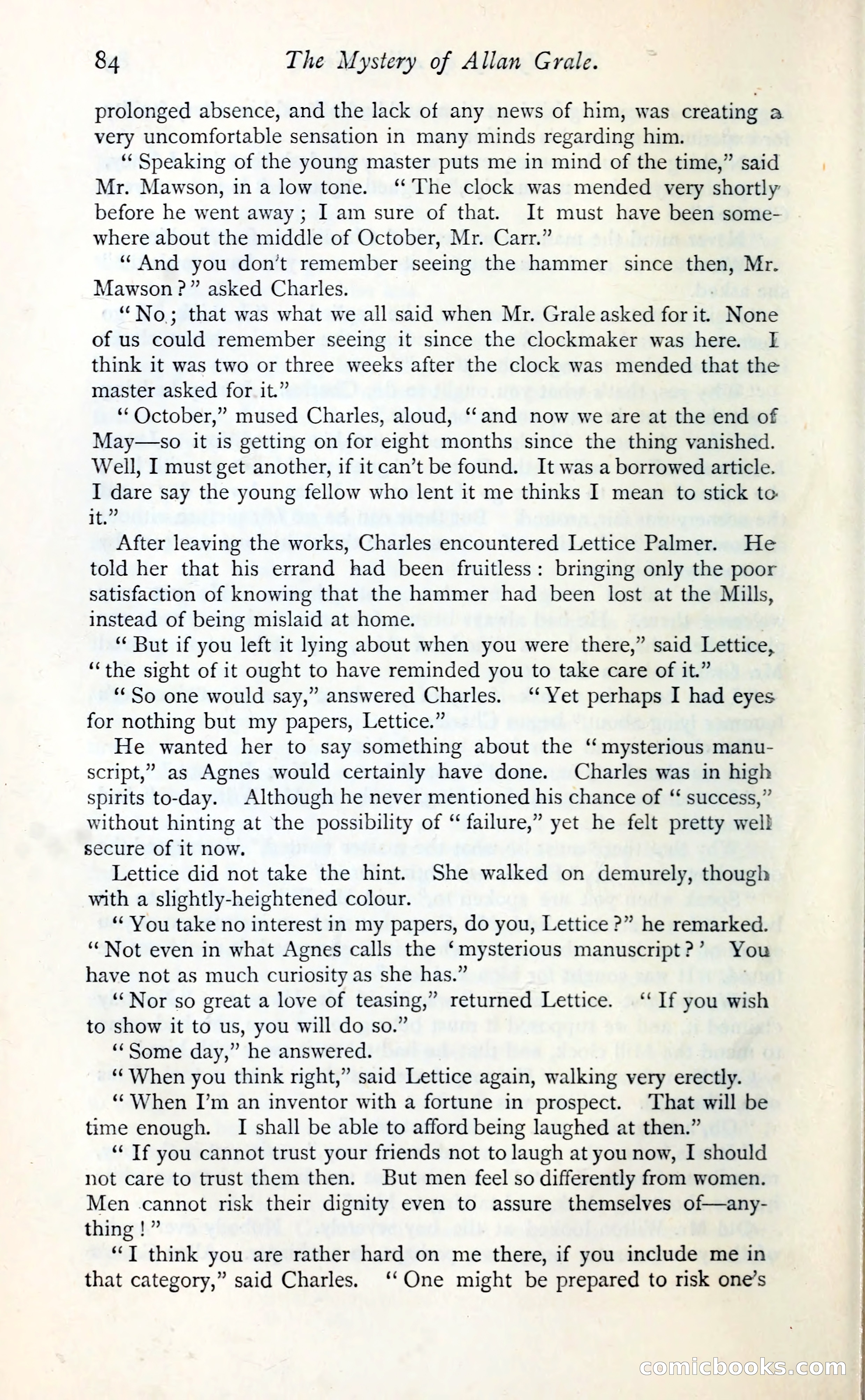
A restored page from Pulp Fiction, 1865. Page through the whole issue in the reader above.
📄 Transcribed text from this page (OCR, searchable)
Machine-transcribed from the original scan — historical spelling and the odd misread are preserved.
84 The Mystery of Allan Grale. prolonged absence, and the lack of any news of him, was creating a very uncomfortable sensation in many minds regarding him. ‘‘ Speaking of the young master puts me in mind of the time,” said Mr. Mawson, ina lowtone. ‘The clock was mended very shortly before he went away; I am sure of that. It must have been some- where about the middle of October, Mr. Carr.” ‘And you don’t remember seeing the hammer since then, Mr. Mawson ?” asked Charles. | “No; that was what we all said when Mr. Grale asked for it. None of us could remember seeing it since the clockmaker was here. I think it was two or three weeks after the clock was mended that the master asked for it.” “October,” mused Charles, aloud, ‘‘and now we are at the end of May—so it is getting on for eight months since the thing vanished. Well, I must get another, if it can’t be found. It was a borrowed article. I dare say the young fellow who lent it me thinks I mean to stick to ro After leaving the works, Charles encountered Lettice Palmer. He told her that his errand had been fruitless: bringing only the poor satisfaction of knowing that the hammer had been lost at the Mills, instead of being mislaid at home. ‘“‘ But if you left it lying about when you were there,” said Lettice, “the sight of it ought to have reminded you to take care of it.” «So one would say,” answered Charles. ‘‘ Yet perhaps I had eyes for nothing but my papers, Lettice.” He wanted her to say something about the “mysterious manu- script,” as Agnes would certainly have done. Charles was in high spirits to-day. Although he never mentioned his chance of “‘ success,” without hinting at the possibility of “‘ failure,” yet he felt pretty well secure of it now. Lettice did not take the hint. She walked on demurely, though with a slightly-heightened colour. ‘You take no interest in my papers, do you, Lettice ?” he remarked. ‘Not even in what Agnes calls the ‘mysterious manuscript?’ You have not as much curiosity as she has.” : ‘Nor so great a love of teasing,” returned Lettice. ‘‘ If you wish to show it to us, you will do so.” ‘“Some day,” he answered. ‘When you think right,” said Lettice again, walking very erectly. “When I’m an inventor with a fortune in prospect. That will be time enough. I shall be able to afford being laughed at then.” ‘“ If you cannot trust your friends not to laugh at you now, I should not care to trust them then. But men feel so differently from women. Men cannot risk their dignity even to assure themselves of—any- thing!” “‘T think you are rather hard on me there, if you include me in that category,” said Charles. ‘‘One might be prepared to risk one’s GOMlGdoo Ss (E(©) m