
Pulp Fiction, 1865 · page 100 of 400
The Argosy — page 100: what you’re looking at
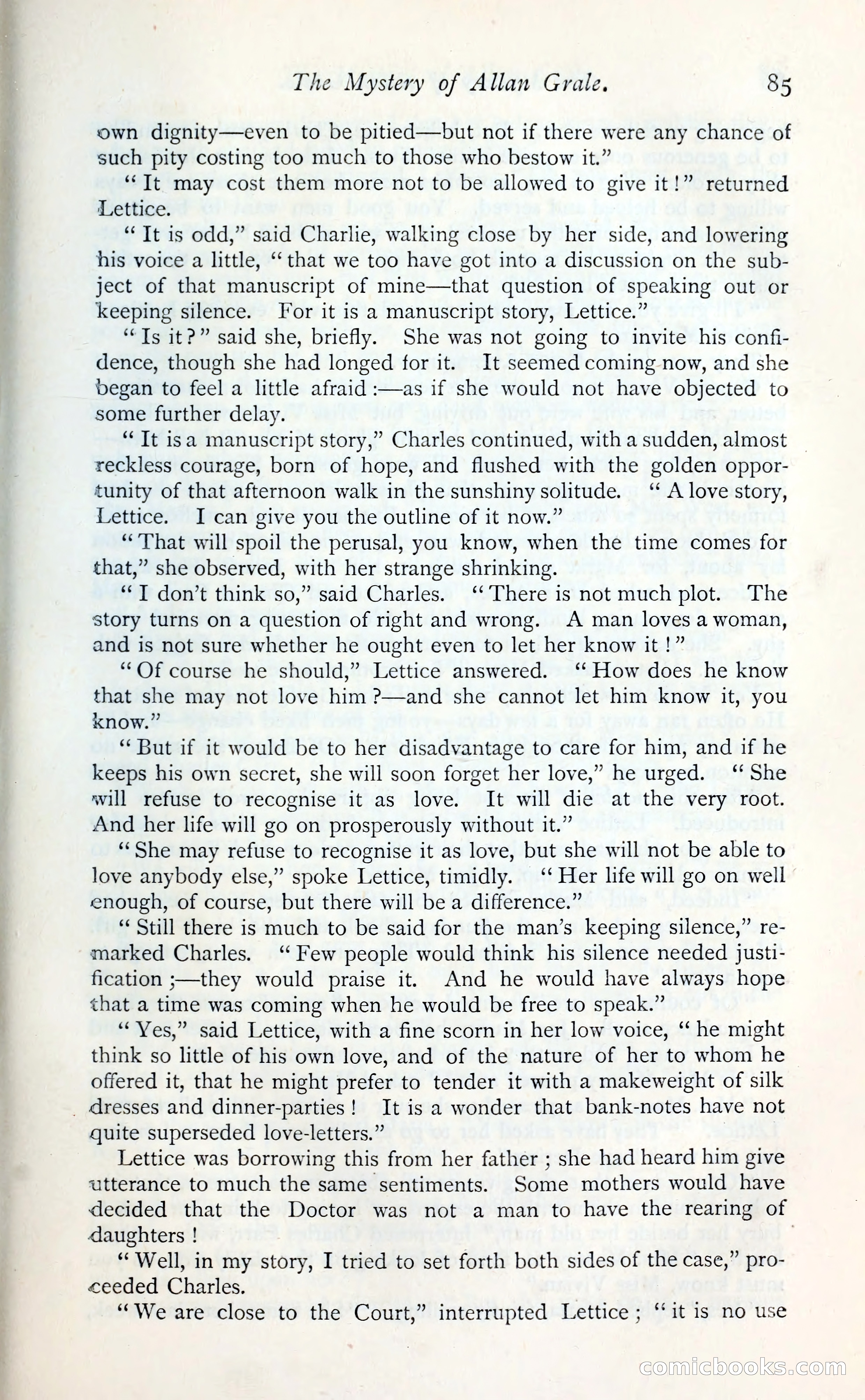
A restored page from Pulp Fiction, 1865. Page through the whole issue in the reader above.
📄 Transcribed text from this page (OCR, searchable)
Machine-transcribed from the original scan — historical spelling and the odd misread are preserved.
The Mystery of Allan Grale. 85 own dignity—even to be pitied—but not if there were any chance of such pity costing too much to those who bestow it.” ‘“It may cost them more not to be allowed to give it!” returned Lettice. “Tt is odd,” said Charlie, walking close by her side, and lowering his voice a little, ‘‘that we too have got into a discussion on the sub- ject of that manuscript of mine—that question of speaking out or keeping silence. For it is a manuscript story, Lettice.” ‘Ts it?” said she, briefly. She was not going to invite his confi- dence, though she had longed for it. It seemed coming now, and she began to feel a little afraid :—as if she would not have objected to some further delay. ‘Tt isa manuscript story,” Charles continued, with a sudden, almost reckless courage, born of hope, and flushed with the golden oppor- tunity of that afternoon walk in the sunshiny solitude. ‘‘ A love story, Lettice. I can give you the outline of it now.” “That will spoil the perusal, you know, when the time comes for that,” she observed, with her strange shrinking. ‘““T don’t think so,” said Charles. ‘‘ There is not much plot. The story turns on a question of right and wrong. A man loves a woman, and is not sure whether he ought even to let her know it !” *“Of course he should,” Lettice answered. ‘‘ How does he know that she may not love him ?—and she cannot let him know it, you know.” “ But if it would be to her disadvantage to care for him, and if he keeps his own secret, she will soon forget her love,” he urged. ‘“* She will refuse to recognise it as love. It will die at the very root. And her life will go on prosperously without it.” ‘She may refuse to recognise it as love, but she will not be able to love anybody else,” spoke Lettice, timidly. ‘‘ Her life will go on well enough, of course, but there will be a difference.” ‘Still there is much to be said for the man’s keeping silence,” re- marked Charles. ‘“ Few people would think his silence needed justi- fication ;—they would praise it. And he would have always hope that a time was coming when he would be free to speak.” “Yes,” said Lettice, with a fine scorn in her low voice, ‘* he might think so little of his own love, and of the nature of her to whom he offered it, that he might prefer to tender it with a makeweight of silk _ dresses and dinner-parties! It is a wonder that bank-notes have not quite superseded love-letters.” Lettice was borrowing this from her father ; she had heard him give utterance to much the same sentiments. Some mothers would have decided that the Doctor was not a man to have the rearing of daughters ! ‘Well, in my story, I tried to set forth both sides of the case,” pro- ceeded Charles. ““We are close to the Court,” interrupted Lettice; “it is no use COnniclooolkks (CO) an