
Pulp Fiction, 1865 · page 395 of 400
The Argosy — page 395: what you’re looking at
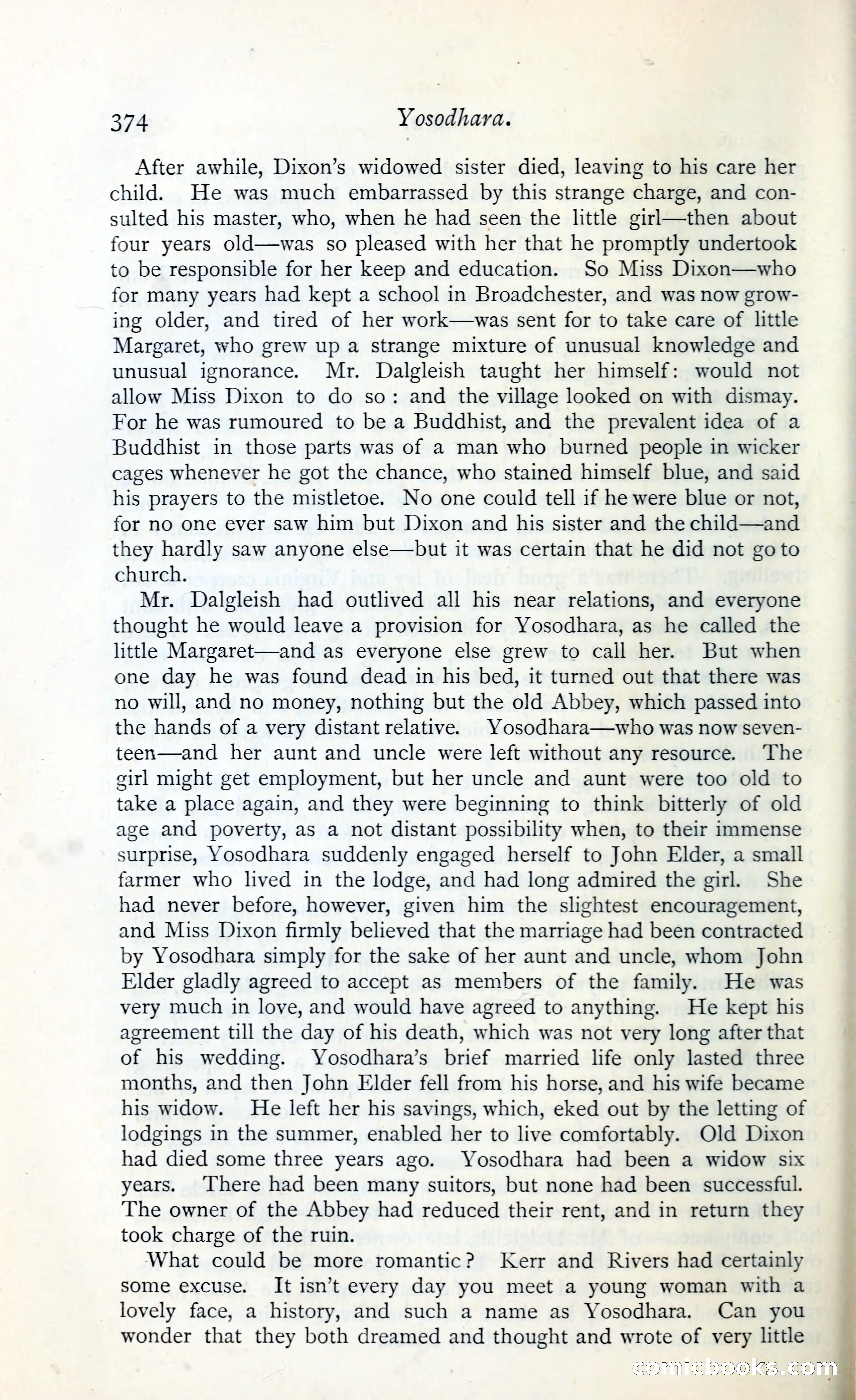
A restored page from Pulp Fiction, 1865. Page through the whole issue in the reader above.
📄 Transcribed text from this page (OCR, searchable)
Machine-transcribed from the original scan — historical spelling and the odd misread are preserved.
374 Yosodhara. After awhile, Dixon’s widowed sister died, leaving to his care her child. He was much embarrassed by this strange charge, and con- sulted his master, who, when he had seen the little girl—then about four years old—was so pleased with her that he promptly undertook to be responsible for her keep and education. So Miss Dixon—who for many years had kept a school in Broadchester, and was now grow- ing older, and tired of her work—was sent for to take care of little Margaret, who grew up a strange mixture of unusual knowledge and unusual ignorance. Mr. Dalgleish taught her himself: would not allow Miss Dixon to do so: and the village looked on with dismay. For he was rumoured to be a Buddhist, and the prevalent idea of a Buddhist in those parts was of a man who burned people in wicker cages whenever he got the chance, who stained himself blue, and said his prayers to the mistletoe. No one could tell if he were blue or not, for no one ever saw him but Dixon and his sister and the child—and they hardly saw anyone else—but it was certain that he did not goto church. Mr. Dalgleish had outlived all his near relations, and everyone thought he would leave a provision for Yosodhara, as he called the little Margaret—and as everyone else grew to call her. But when one day he was found dead in his bed, it turned out that there was no will, and no money, nothing but the old Abbey, which passed into the hands of a very distant relative. Yosodhara—who was now seven- teen—and her aunt and uncle were left without any resource. ‘The girl might get employment, but her uncle and aunt were too old to take a place again, and they were beginning to think bitterly of old age and poverty, as a not distant possibility when, to their immense surprise, Yosodhara suddenly engaged herself to John Elder, a small farmer who lived in the lodge, and had long admired the girl. She had never before, however, given him the slightest encouragement, and Miss Dixon firmly believed that the marriage had been contracted by Yosodhara simply for the sake of her aunt and uncle, whom John Elder gladly agreed to accept as members of the family. He was very much in love, and would have agreed to anything. He kept his agreement till the day of his death, which was not very long after that of his wedding. Yosodhara’s brief married life only lasted three months, and then John Elder fell from his horse, and his wife became his widow. He left her his savings, which, eked out by the letting of lodgings in the summer, enabled her to live comfortably. Old Dixon had died some three years ago. Yosodhara had been a widow six years. ‘There had been many suitors, but none had been successful. The owner of the Abbey had reduced their rent, and in return they | took charge of the ruin. ‘ What could be more romantic? Kerr and Rivers had certainly some excuse. It isn’t every day you meet a young woman with a lovely face, a history, and such a name as Yosodhara. Can you wonder that they both dreamed and thought and wrote of very little EORMGEOOOXKS COA