
Pulp Fiction, 1865 · page 391 of 400
The Argosy — page 391: what you’re looking at
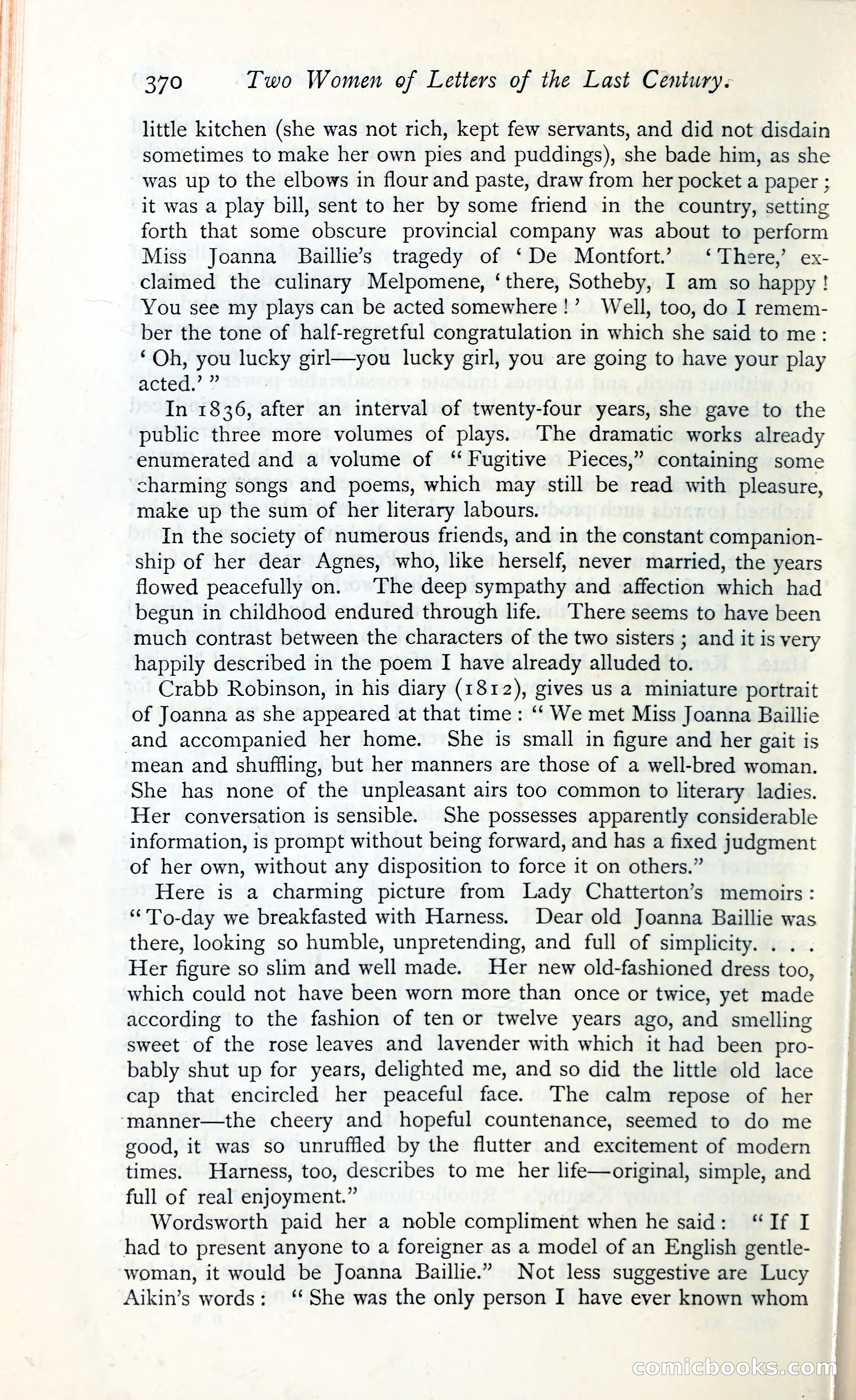
A restored page from Pulp Fiction, 1865. Page through the whole issue in the reader above.
📄 Transcribed text from this page (OCR, searchable)
Machine-transcribed from the original scan — historical spelling and the odd misread are preserved.
370 Two Women of Letters of the Last Century. little kitchen (she was not rich, kept few servants, and did not disdain sometimes to make her own pies and puddings), she bade him, as she was up to the elbows in flour and paste, draw from her pocket a paper ; it was a play bill, sent to her by some friend in the country, setting forth that some obscure provincial company was about to perform Miss Joanna Baillie’s tragedy of ‘De Montfort.’ ‘There,’ ex- claimed the culinary Melpomene, ‘there, Sotheby, I am so happy ! You see my plays can be acted somewhere!’ Well, too, do I remem- ber the tone of half-regretful congratulation in which she said to me: ‘Oh, you lucky girl—you lucky girl, you are going to have your play acted.’ ” , In 1836, after an interval of twenty-four years, she gave to the public three more volumes of plays. The dramatic works already enumerated and a volume of “ Fugitive Pieces,” containing some charming songs and poems, which may still be read with pleasure, make up the sum of her literary labours. In the society of numerous friends, and in the constant companion- ship of her dear Agnes, who, like herself, never married, the years flowed peacefully on. The deep sympathy and affection which had begun in childhood endured through life. There seems to have been much contrast between the characters of the two sisters ; and it is very happily described in the poem I have already alluded to. Crabb Robinson, in his diary (1812), gives us a miniature portrait of Joanna as she appeared at that time: ‘‘ We met Miss Joanna Baillie and accompanied her home. She is small in figure and her gait is mean and shuffling, but her manners are those of a well-bred woman. She has none of the unpleasant airs too common to literary ladies. Her conversation is sensible. She possesses apparently considerable information, is prompt without being forward, and has a fixed judgment of her own, without any disposition to force it on others.” Here is a charming picture from Lady Chatterton’s memoirs: ‘To-day we breakfasted with Harness. Dear old Joanna Baillie was there, looking so humble, unpretending, and full of simplicity... . Her figure so slim and well made. Her new old-fashioned dress too, which could not have been worn more than once or twice, yet made according to the fashion of ten or twelve years ago, and smelling sweet of the rose leaves and lavender with which it had been pro- bably shut up for years, delighted me, and so did the little old lace cap that encircled her peaceful face. The calm repose of her ‘manner—the cheery and hopeful countenance, seemed to do me good, it was so unruffled by the flutter and excitement of modern times. Harness, too, describes to me her life—original, simple, and full of real enjoyment.” Wordsworth paid her a noble compliment when he said: “If I had to present anyone to a foreigner as a model of an English gentle- woman, it would be Joanna Baillie.” Not less suggestive are Lucy Aikin’s words: ‘* She was the only person I have ever known whom ECORNICLOOKSnEO