
Pulp Fiction, 1865 · page 330 of 400
The Argosy — page 330: what you’re looking at
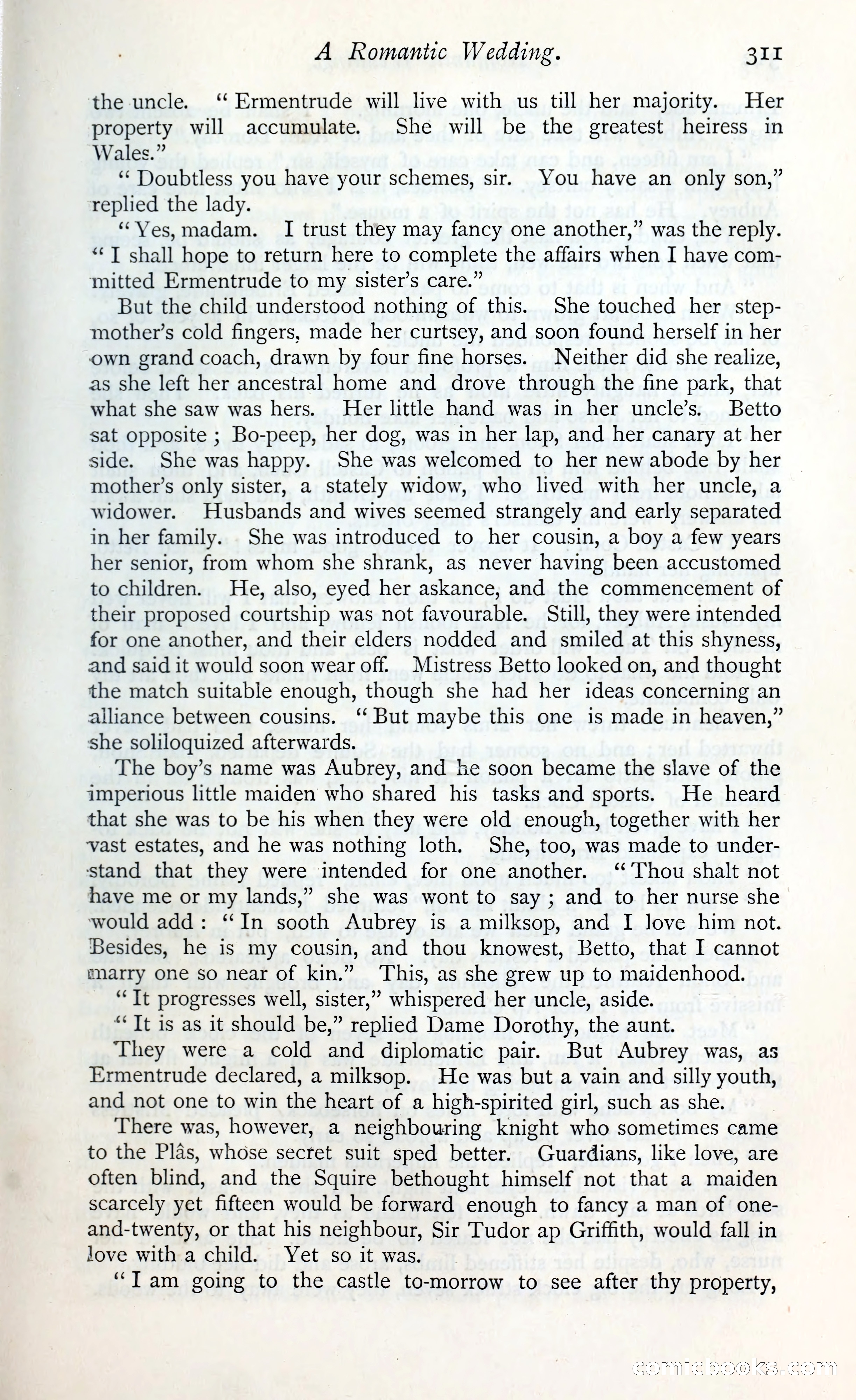
A restored page from Pulp Fiction, 1865. Page through the whole issue in the reader above.
📄 Transcribed text from this page (OCR, searchable)
Machine-transcribed from the original scan — historical spelling and the odd misread are preserved.
A Romantic Wedding. 311 the uncle. ‘“ Ermentrude will live with us till her majority. Her property will accumulate. She will be the greatest heiress in Wales.” ‘Doubtless you have your schemes, sir. You have an only son,” replied the lady. “Ves,madam. I trust they may fancy one another,” was the reply. ‘** T shall hope to return here to complete the affairs when I have com- mitted Ermentrude to my sister’s care.” But the child understood nothing of this. She touched her step- mother’s cold fingers, made her curtsey, and soon found herself in her own grand coach, drawn by four fine horses. Neither did she realize, as she left her ancestral home and drove through the fine park, that what she saw was hers. Her little hand was in her uncle’s. Betto sat opposite ; Bo-peep, her dog, was in her lap, and her canary at her side. She was happy. She was welcomed to her new abode by her mother’s only sister, a stately widow, who lived with her uncle, a widower. Husbands and wives seemed strangely and early separated in her family. She was introduced to her cousin, a boy a few years her senior, from whom she shrank, as never having been accustomed to children. He, also, eyed her askance, and the commencement of their proposed courtship was not favourable. Still, they were intended for one another, and their elders nodded and smiled at this shyness, and said it would soon wear off. Mistress Betto looked on, and thought the match suitable enough, though she had her ideas concerning an alliance between cousins. ‘‘ But maybe this one is made in heaven,” she soliloquized afterwards. The boy’s name was Aubrey, and he soon became the slave of the imperious little maiden who shared his tasks and sports. He heard that she was to be his when they were old enough, together with her vast estates, and he was nothing loth. She, too, was made to under- stand that they were intended for one another. ‘Thou shalt not have me or my lands,” she was wont to say ; and to her nurse she would add: ‘‘In sooth Aubrey is a milksop, and I love him not. Besides, he is my cousin, and thou knowest, Betto, that I cannot marry one so near of kin.” ‘This, as she grew up to maidenhood. “It progresses well, sister,” whispered her uncle, aside. “Tt is as it should be,” replied Dame Dorothy, the aunt. ‘They were a cold and diplomatic pair. But Aubrey was, as Ermentrude declared, a milksop. He was but a vain and silly youth, and not one to win the heart of a high-spirited girl, such as she. There was, however, a neighbouring knight who sometimes came to the Plas, whose sectet suit sped better. Guardians, like love, are often blind, and the Squire bethought himself not that a maiden scarcely yet fifteen would be forward enough to fancy a man of one- and-twenty, or that his neighbour, Sir Tudor ap Griffith, would fall in Jove with a child. Yet so it was. “Tam going to the castle to-morrow to see after thy property, COMICOOOKS @. (C(O)