
Pulp Fiction, 1865 · page 309 of 400
The Argosy — page 309: what you’re looking at
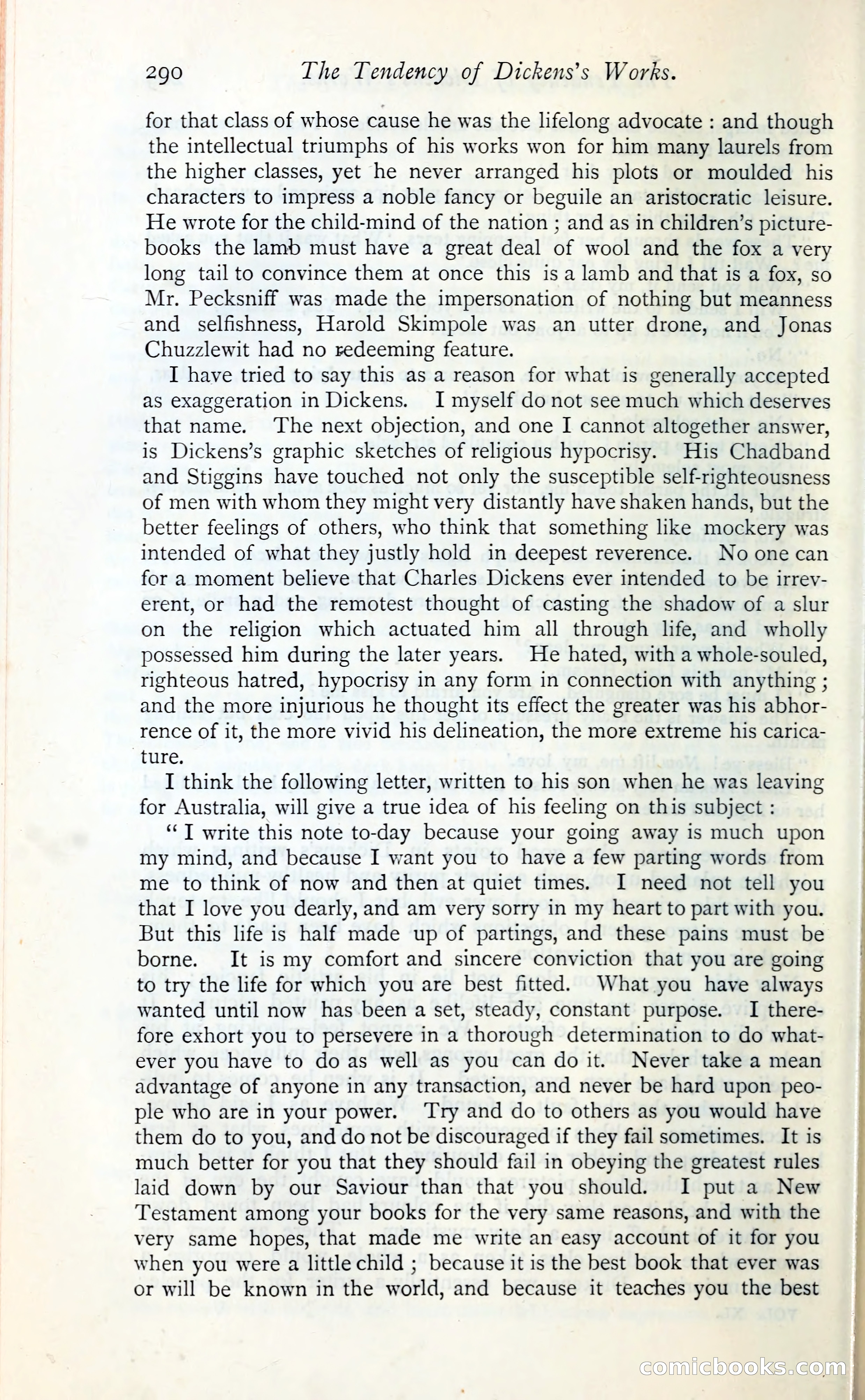
A restored page from Pulp Fiction, 1865. Page through the whole issue in the reader above.
📄 Transcribed text from this page (OCR, searchable)
Machine-transcribed from the original scan — historical spelling and the odd misread are preserved.
290 The Tendency of Dickens’s Works. for that class of whose cause he was the lifelong advocate : and though the intellectual triumphs of his works won for him many laurels from the higher classes, yet he never arranged his plots or moulded his characters to impress a noble fancy or beguile an aristocratic leisure. He wrote for the child-mind of the nation ; and as in children’s picture- books the lamb must have a great deal of wool and the fox a very long tail to convince them at once this is a lamb and that is a fox, so Mr. Pecksniff was made the impersonation of nothing but meanness and selfishness, Harold Skimpole was an utter drone, and Jonas Chuzzlewit had no redeeming feature. I have tried to say this as a reason for what is generally accepted as exaggeration in Dickens. I myself do not see much which deserves that name. The next objection, and one I cannot altogether answer, is Dickens’s graphic sketches of religious hypocrisy. His Chadband and Stiggins have touched not only the susceptible self-righteousness of men with whom they might very distantly have shaken hands, but the better feelings of others, who think that something like mockery was intended of what they justly hold in deepest reverence. No one can for a moment believe that Charles Dickens ever intended to be irrey- erent, or had the remotest thought of casting the shadow of a slur on the religion which actuated him all through life, and wholly possessed him during the later years. He hated, with a whole-souled, righteous hatred, hypocrisy in any form in connection with anything ; and the more injurious he thought its effect the greater was his abhor- rence of it, the more vivid his delineation, the more extreme his carica- ture. I think the following letter, written to his son when he was leaving for Australia, will give a true idea of his feeling on this subject : ‘‘T write this note to-day because your going away is much upon my mind, and because I want you to have a few parting words from me to think of now and then at quiet times. I need not tell you that I love you dearly, and am very sorry in my heart to part with you. But this life is half made up of partings, and these pains must be borne. It is my comfort and sincere conviction that you are going to try the life for which you are best fitted. What you have always wanted until now has been a set, steady, constant purpose. I there- fore exhort you to persevere in a thorough determination to do what- ever you have to do as well as you can doit. Never take a mean advantage of anyone in any transaction, and never be hard upon peo- ple who are in your power. ‘Try and do to others as you would have them do to you, and do not be discouraged if they fail sometimes. It is much better for you that they should fail in obeying the greatest rules laid down by our Saviour than that you should. I put a New Testament among your books for the very same reasons, and with the very same hopes, that made me write an easy account of it for you when you were a little child ; because it is the best book that ever was or will be known in the world, and because it teaches you the best CONMMIC OOO KS,(€O)