
Pulp Fiction, 1865 · page 308 of 400
The Argosy — page 308: what you’re looking at
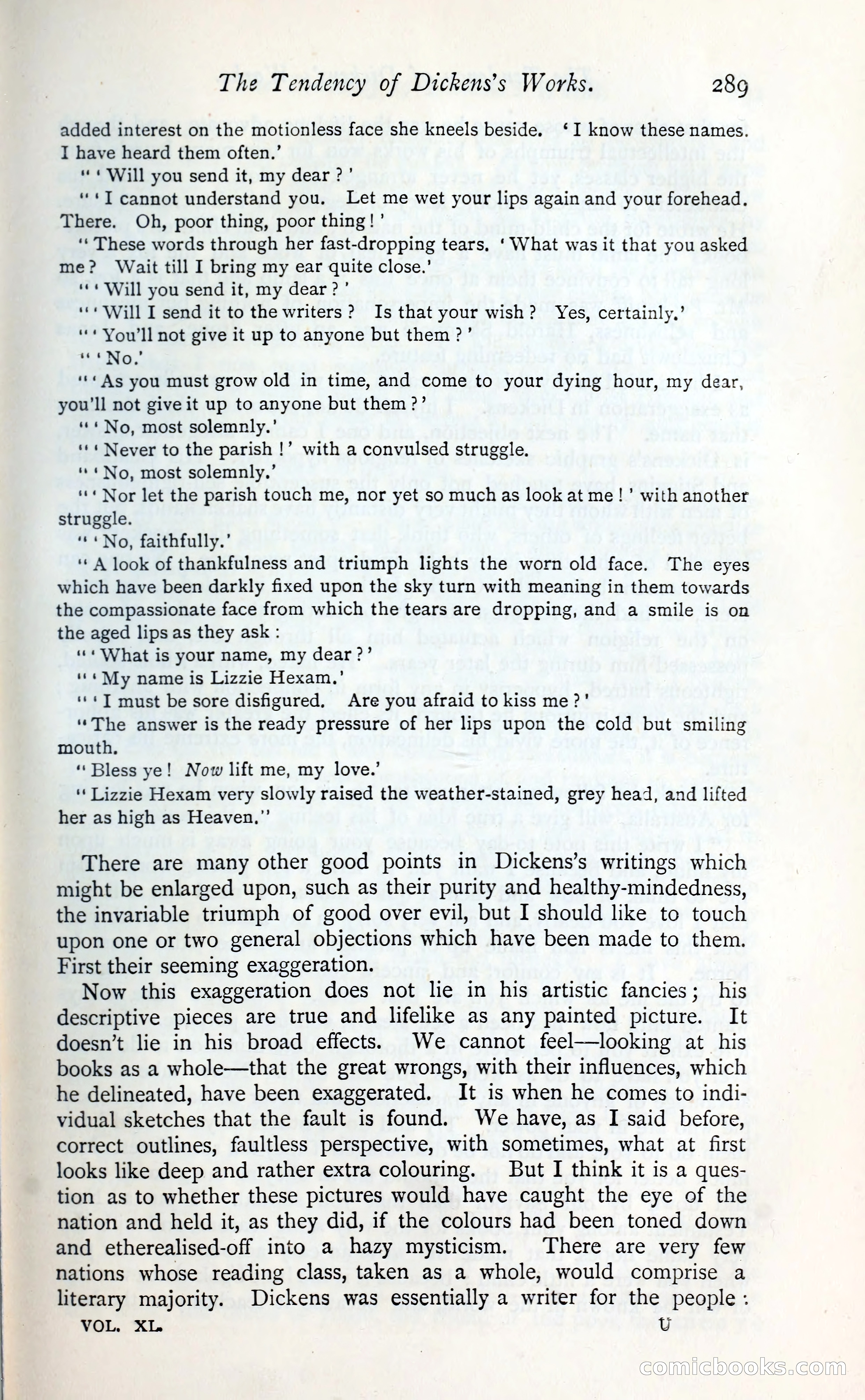
A restored page from Pulp Fiction, 1865. Page through the whole issue in the reader above.
📄 Transcribed text from this page (OCR, searchable)
Machine-transcribed from the original scan — historical spelling and the odd misread are preserved.
The Tendency of Dickens's Works. 289 added interest on the motionless face she kneels beside. ‘I know these names. I have heard them often.’ “* Will you send it, my dear ?’ “*T cannot understand you. Let me wet your lips again and your forehead. There. Oh, poor thing, poor thing!’ ‘‘ These words through her fast-dropping tears, ‘ What was it that you asked me? Wait till I bring my ear quite close.’ ‘«* Will you send it, my dear?’ ‘‘* Will I send it to the writers? Is that your wish? Yes, certainly,’ ‘** You'll not give it up to anyone but them ?’ SSO, ‘‘* As you must grow old in time, and come to your dying hour, my dear, you'll not give it up to anyone but them ?’ ‘* No, most solemnly.’ ‘«* Never to the parish !’ with a convulsed struggle. «No, most solemnly,’ ‘«* Nor let the parish touch me, nor yet so much as look at me!’ with another struggle. ‘** No, faithfully.’ ‘‘ A look of thankfulness and triumph lights the worn old face. The eyes which have been darkly fixed upon the sky turn with meaning in them towards the compassionate face from which the tears are dropping, and a smile is on the aged lips as they ask : ‘“* What is your name, my dear?’ «My name is Lizzie Hexam.’ ‘“*T must be sore disfigured, Are you afraid to kiss me?’ ‘‘The answer is the ready pressure of her lips upon the cold but smiling mouth. ‘Bless ye! Now lift me, my love.’ ‘‘ Lizzie Hexam very slowly raised the weather-stained, grey head, and lifted her as high as Heaven,”’ There are many other good points in Dickens’s writings which might be enlarged upon, such as their purity and healthy-mindedness, the invariable triumph of good over evil, but I should like to touch upon one or two general objections which have been made to them. First their seeming exaggeration. Now this exaggeration does not lie in his artistic fancies; his descriptive pieces are true and lifelike as any painted picture. It doesn’t lie in his broad effects. We cannot feel—looking at his books as a whole—that the great wrongs, with their influences, which he delineated, have been exaggerated. It is when he comes to indi- vidual sketches that the fault is found. We have, as I said before, correct outlines, faultless perspective, with sometimes, what at first looks like deep and rather extra colouring. But I think it is a ques- tion as to whether these pictures would have caught the eye of the nation and held it, as they did, if the colours had been toned down and etherealised-off into a hazy mysticism. There are very few nations whose reading class, taken as a whole, would comprise a literary majority. Dickens was essentially a writer for the people: VOL. XL. U GOnNIGDOO (CO)