
Pulp Fiction, 1865 · page 319 of 400
The Argosy — page 319: what you’re looking at
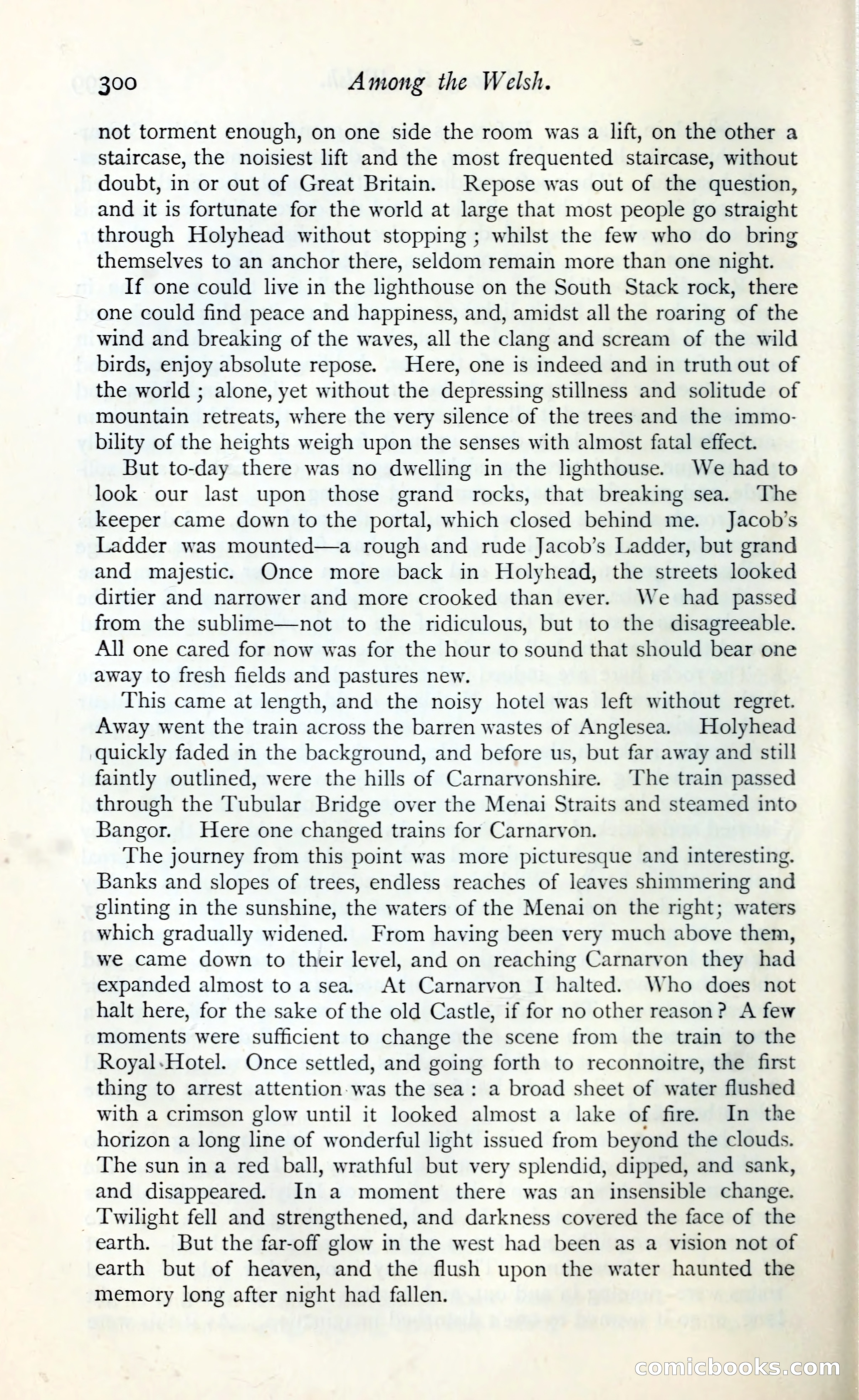
A restored page from Pulp Fiction, 1865. Page through the whole issue in the reader above.
📄 Transcribed text from this page (OCR, searchable)
Machine-transcribed from the original scan — historical spelling and the odd misread are preserved.
300 Among the Welsh. not torment enough, on one side the room was a lift, on the other a staircase, the noisiest lift and the most frequented staircase, without doubt, in or out of Great Britain. Repose was out of the question, and it is fortunate for the world at large that most people go straight through Holyhead without stopping ; whilst the few who do bring themselves to an anchor there, seldom remain more than one night. If one could live in the lighthouse on the South Stack rock, there one could find peace and happiness, and, amidst all the roaring of the wind and breaking of the waves, all the clang and scream of the wild birds, enjoy absolute repose. Here, one is indeed and in truth out of the world ; alone, yet without the depressing stillness and solitude of mountain retreats, where the very silence of the trees and the immo- bility of the heights weigh upon the senses with almost fatal effect. But to-day there was no dwelling in the lighthouse. We had to look our last upon those grand rocks, that breaking sea. ‘The keeper came down to the portal, which closed behind me. Jacob’s Ladder was mounted—a rough and rude Jacob’s Ladder, but grand and majestic. Once more back in Holyhead, the streets looked dirtier and narrower and more crooked than ever. We had passed from the sublime—not to the ridiculous, but to the disagreeable. All one cared for now was for the hour to sound that should bear one away to fresh fields and pastures new. This came at length, and the noisy hotel was left without regret. Away went the train across the barren wastes of Anglesea. Holyhead quickly faded in the background, and before us, but far away and still faintly outlined, were the hills of Carnarvonshire. The train passed through the Tubular Bridge over the Menai Straits and steamed into Bangor. Here one changed trains for Carnarvon. The journey from this point was more picturesque and interesting. Banks and slopes of trees, endless reaches of leaves shimmering and glinting in the sunshine, the waters of the Menai on the right; waters which gradually widened. From having been very much above them, we came down to their level, and on reaching Carnarvon they had expanded almost to a sea. At Carnarvon I halted. Who does not halt here, for the sake of the old Castle, if for no other reason? A few moments were sufficient to change the scene from the train to the Royal.Hotel. Once settled, and going forth to reconnoitre, the first thing to arrest attention-was the sea: a broad sheet of water flushed with a crimson glow until it looked almost a lake of fire. In the horizon a long line of wonderful light issued from beyond the clouds. The sun in a red ball, wrathful but very splendid, dipped, and sank, and disappeared. In a moment there was an insensible change. _ ‘Twilight fell and strengthened, and darkness covered the face of the earth. But the far-off glow in the west had been as a vision not of earth but of heaven, and the flush upon the water haunted the memory long after night had fallen. ECORNICLIOOKS eo) m