
Pulp Fiction, 1865 · page 297 of 400
The Argosy — page 297: what you’re looking at
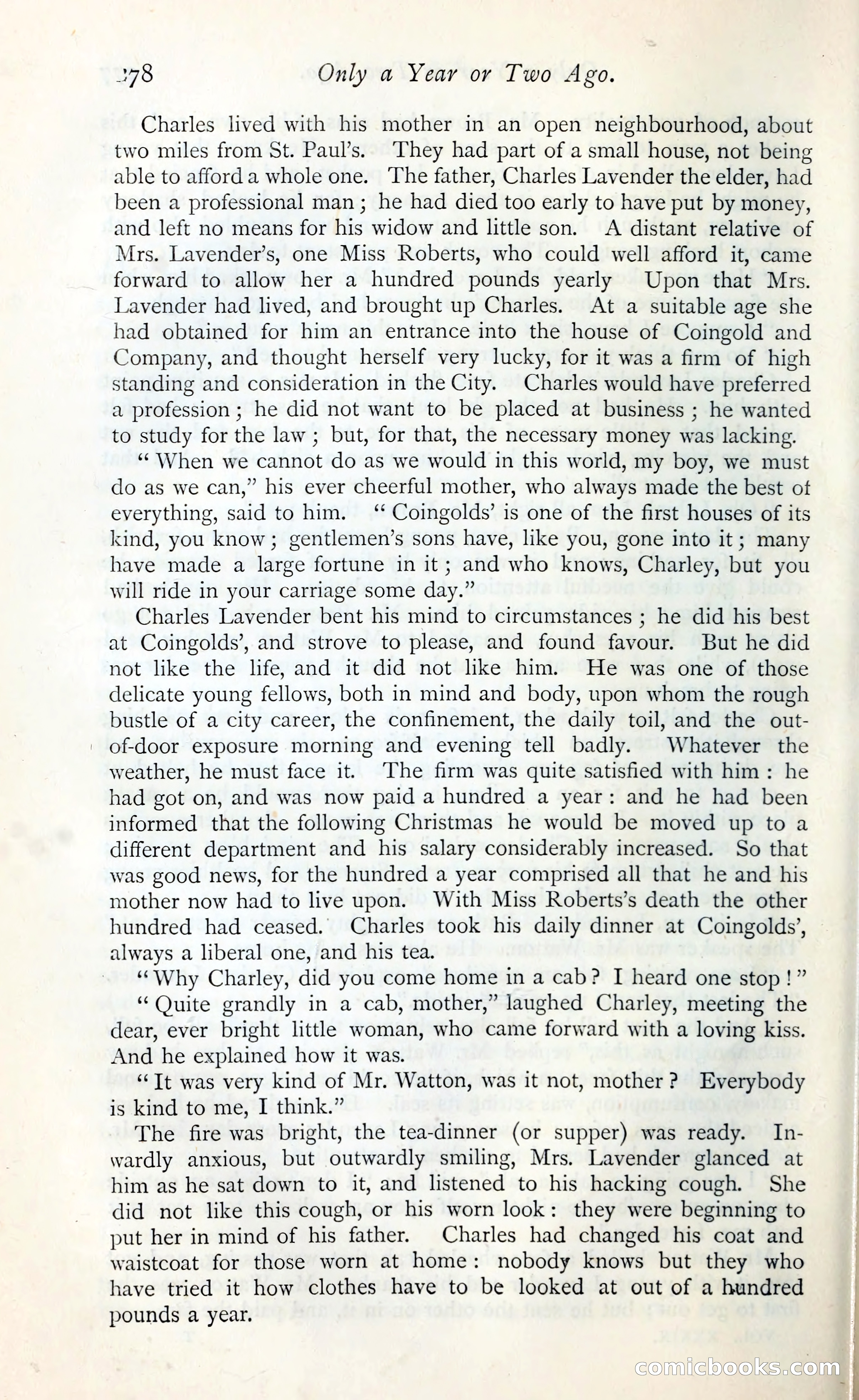
A restored page from Pulp Fiction, 1865. Page through the whole issue in the reader above.
📄 Transcribed text from this page (OCR, searchable)
Machine-transcribed from the original scan — historical spelling and the odd misread are preserved.
178 Only a Year or Two Ago. Charles lived with his mother in an open neighbourhood, about two miles from St. Paul’s. ‘They had part of a small house, not being able to afforda whole one. ‘The father, Charles Lavender the elder, had been a professional man; he had died too early to have put by money, and left no means for his widow and little son. A distant relative of Mrs. Lavender’s, one Miss Roberts, who could well afford it, came forward to allow her a hundred pounds yearly Upon that Mrs. Lavender had lived, and brought up Charles. At a suitable age she had obtained for him an entrance into the house of Coingold and Company, and thought herself very lucky, for it was a firm of high standing and consideration in the City. Charles would have preferred a profession ; he did not want to be placed at business ; he wanted to study for the law ; but, for that, the necessary money was lacking. ‘When we cannot do as we would in this world, my boy, we must do as we can,” his ever cheerful mother, who always made the best of everything, said to him. ‘‘ Coingolds’ is one of the first houses of its kind, you know; gentlemen’s sons have, like you, gone into it; many have made a large fortune in it; and who knows, Charley, but you will ride in your carriage some day.” Charles Lavender bent his mind to circumstances ; he did his best at Coingolds’, and strove to please, and found favour. But he did not like the life, and it did not hke him. He was one of those delicate young fellows, both in mind and body, upon whom the rough bustle of a city career, the confinement, the daily toil, and the out- ' of-door exposure morning and evening tell badly. Whatever the weather, he must face it. The firm was quite satisfied with him: he had got on, and was now paid a hundred a year: and he had been informed that the following Christmas he would be moved up to a different department and his salary considerably increased. So that was good news, for the hundred a year comprised all that he and his mother now had to live upon. With Miss Roberts’s death the other hundred had ceased. Charles took his daily dinner at Coingolds’, always a liberal one, and his tea. ‘“Why Charley, did you come home in a cab? I heard one stop!” ‘Quite grandly in a cab, mother,” laughed Charley, meeting the dear, ever bright littke woman, who came forward with a loving kiss. And he explained how it was. ‘It was very kind of Mr. Watton, was it not, mother? Everybody is kind to me, I think.” The fire was bright, the tea-dinner (or supper) was ready. In- wardly anxious, but outwardly smiling, Mrs. Lavender glanced at him as he sat down to it, and listened to his hacking cough. She did not like this cough, or his worn look: they were beginning to put her in mind of his father. Charles had changed his coat and waistcoat for those worn at home: nobody knows but they who have tried it how clothes have to be looked at out of a hundred pounds a year. GoOmicbookssco