
Pulp Fiction, 1865 · page 296 of 400
The Argosy — page 296: what you’re looking at
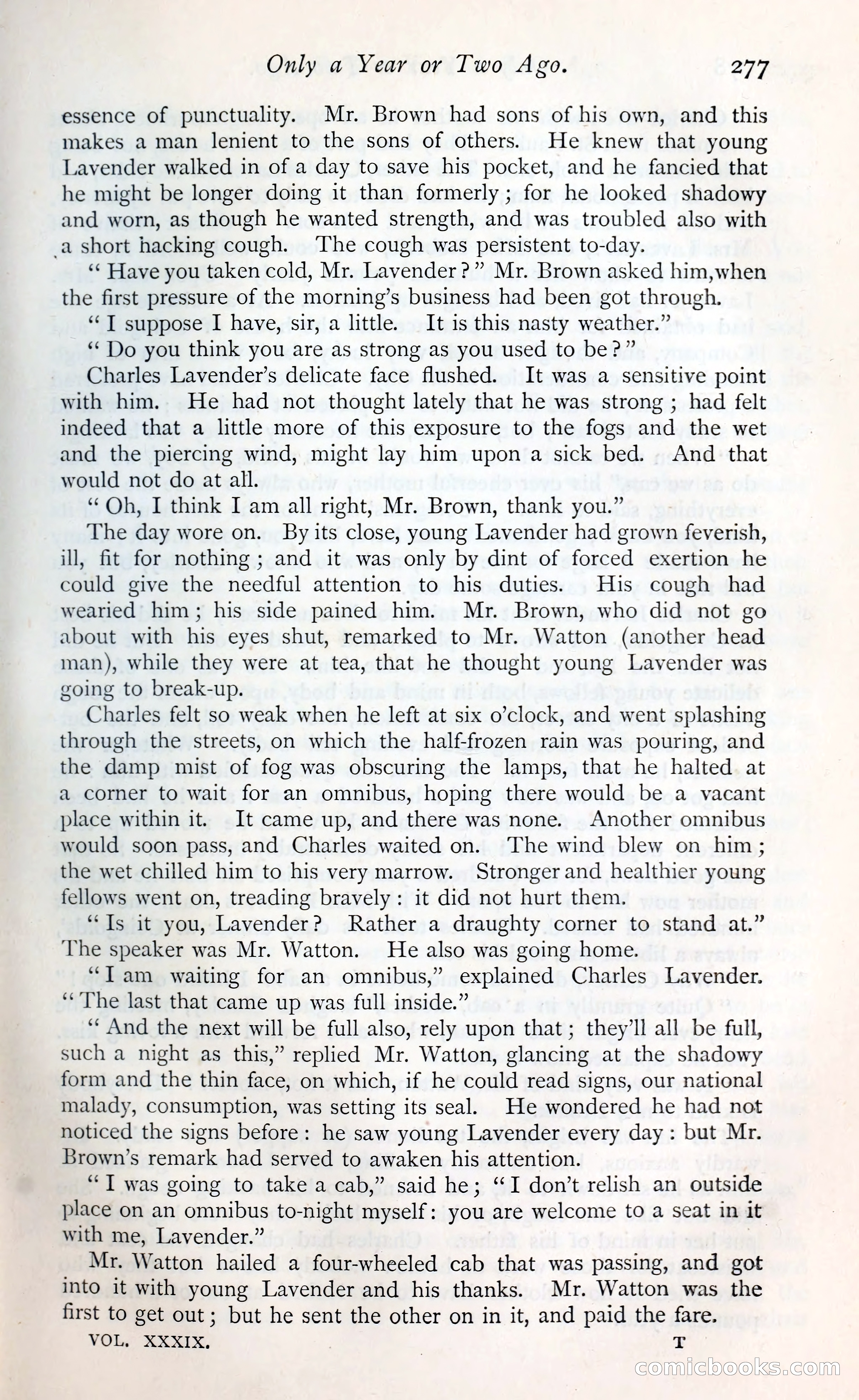
A restored page from Pulp Fiction, 1865. Page through the whole issue in the reader above.
📄 Transcribed text from this page (OCR, searchable)
Machine-transcribed from the original scan — historical spelling and the odd misread are preserved.
Only a Year or Two Ago. 277 essence of punctuality. Mr. Brown had sons of his own, and this makes a man lenient to the sons of others. He knew that young Lavender walked in of a day to save his pocket, and he fancied that he might be longer doing it than formerly ; for he looked shadowy and worn, as though he wanted strength, and was troubled also with a short hacking cough. ‘The cough was persistent to-day. ‘¢ Have you taken cold, Mr. Lavender?” Mr. Brown asked him,when the first pressure of the morning’s business had been got through. ‘‘T suppose I have, sir, a little. It is this nasty weather.” “ Do you think you are as strong as you used to be?” Charles Lavender’s delicate face flushed. It was a sensitive point with him. He had not thought lately that he was strong ; had felt indeed that a little more of this exposure to the fogs and the wet and the piercing wind, might lay him upon a sick bed. And that would not do at all. “Oh, I think I am all right, Mr. Brown, thank you.” The day wore on. By its close, young Lavender had grown feverish, ill, fit for nothing ; and it was only by dint of forced exertion he could give the needful attention to his duties. His cough had wearied him; his side pained him. Mr. Brown, who did not go about with his eyes shut, remarked to Mr. Watton (another head man), while they were at tea, that he thought young Lavender was going to break-up. Charles felt so weak when he left at six o’clock, and went splashing through the streets, on which the half-frozen rain was pouring, and the damp mist of fog was obscuring the lamps, that he halted at a corner to wait for an omnibus, hoping there would be a vacant place within it. It came up, and there was none. Another omnibus would soon pass, and Charles waited on. The wind blew on him; the wet chilled him to his very marrow. Stronger and healthier young fellows went on, treading bravely: it did not hurt them. “Is it you, Lavender? Rather a draughty corner to stand at.” The speaker was Mr. Watton. He also was going home. “Tam waiting for an omnibus,” explained Charles Lavender. “The last that came up was full inside.” “And the next will be full also, rely upon that; they’ll all be full, such a night as this,” replied Mr. Watton, glancing at the shadowy form and the thin face, on which, if he could read signs, our national malady, consumption, was setting its seal. He wondered he had not noticed the signs before: he saw young Lavender every day: but Mr. Brown’s remark had served to awaken his attention. “I was going to take a cab,” said he; “I don’t relish an outside place on an omnibus to-night myself: you are welcome to a seat in it with me, Lavender.” Mr. Watton hailed a four-wheeled cab that was passing, and got into it with young Lavender and his thanks. Mr. Watton was the first to get out; but he sent the other on in it, and paid the fare. VOL, XXXIX, | T GonmilGaooks (SO) an