
Pulp Fiction, 1865 · page 290 of 400
The Argosy — page 290: what you’re looking at
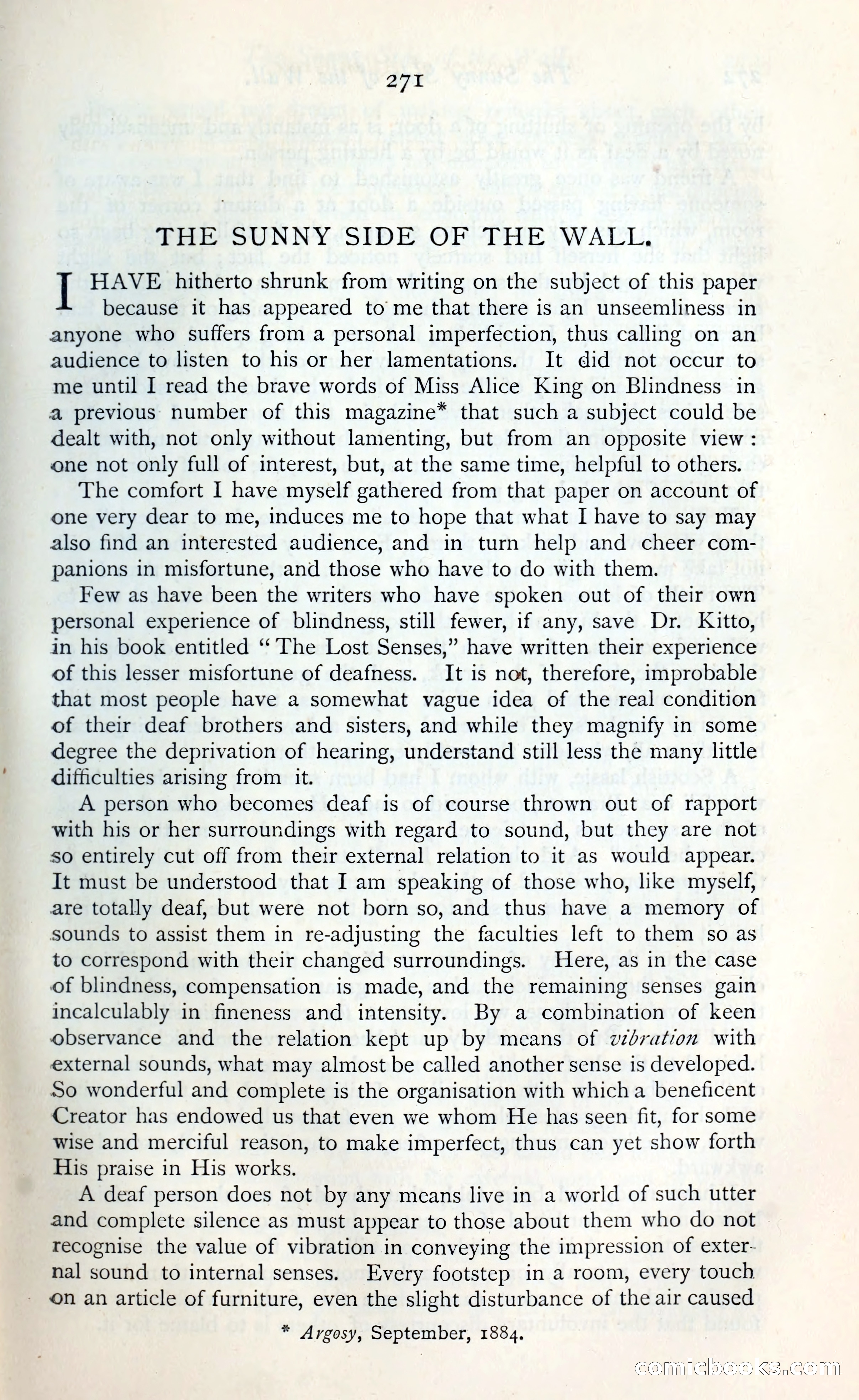
A restored page from Pulp Fiction, 1865. Page through the whole issue in the reader above.
📄 Transcribed text from this page (OCR, searchable)
Machine-transcribed from the original scan — historical spelling and the odd misread are preserved.
271 THE SUNNY SIDE OF THE WALL. I HAVE hitherto shrunk from writing on the subject of this paper because it has appeared to me that there is an unseemliness in anyone who suffers from a personal imperfection, thus calling on an audience to listen to his or her lamentations. It did not occur to me until I read the brave words of Miss Alice King on Blindness in a previous number of this magazine™ that such a subject could be dealt with, not only without lamenting, but from an opposite view: one not only full of interest, but, at the same time, helpful to others. The comfort I have myself gathered from that paper on account of one very dear to me, induces me to hope that what I have to say may also find an interested audience, and in turn help and cheer com- panions in misfortune, and those who have to do with them. Few as have been the writers who have spoken out of their own personal experience of blindness, still fewer, if any, save Dr. Kitto, in his book entitled ‘‘’ The Lost Senses,” have written their experience of this lesser misfortune of deafness. It is not, therefore, improbable that most people have a somewhat vague idea of the real condition of their deaf brothers and sisters, and while they magnify in some degree the deprivation of hearing, understand still less the many little difficulties arising from it. A person who becomes deaf is of course thrown out of rapport with his or her surroundings with regard to sound, but they are not so entirely cut off from their external relation to it as would appear. It must be understood that I am speaking of those who, like myself, are totally deaf, but were not born so, and thus have a memory of sounds to assist them in re-adjusting the faculties left to them so as to correspond with their changed surroundings. Here, as in the case of blindness, compensation is made, and the remaining senses gain incalculably in fineness and intensity. By a combination of keen observance and the relation kept up by means of wzbration with external sounds, what may almost be called another sense is developed. So wonderful and complete is the organisation with which a beneficent Creator has endowed us that even we whom He has seen fit, for some wise and merciful reason, to make imperfect, thus can yet show forth His praise in His works. A deaf person does not by any means live in a world of such utter and complete silence as must appear to those about them who do not - recognise the value of vibration in conveying the impression of exter- nal sound to internal senses. Every footstep in a room, every touch on an article of furniture, even the slight disturbance of the air caused * Argosy, September, 1884. CORNICE LOO ©) <S (CO) an