
Pulp Fiction, 1865 · page 258 of 400
The Argosy — page 258: what you’re looking at
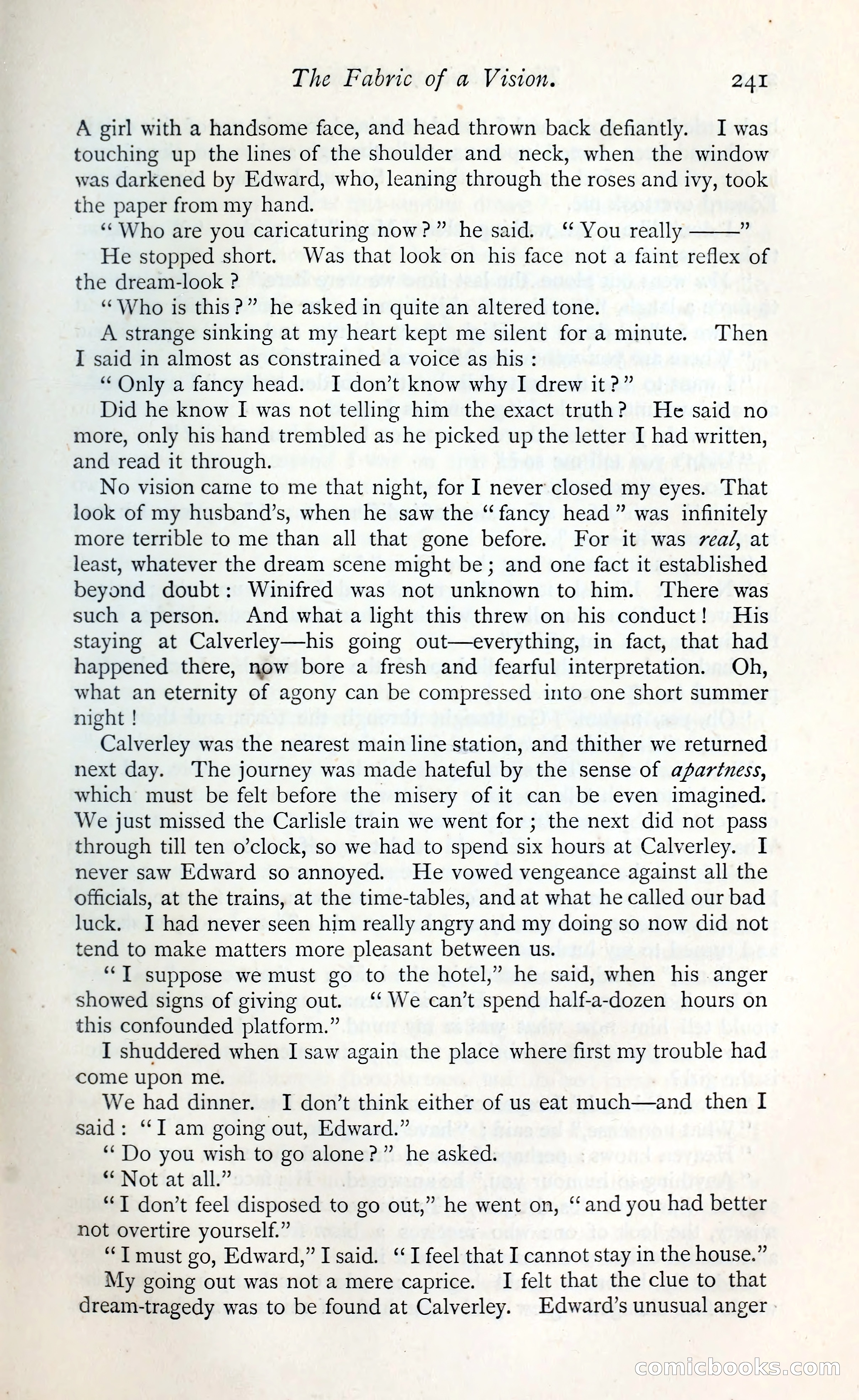
A restored page from Pulp Fiction, 1865. Page through the whole issue in the reader above.
📄 Transcribed text from this page (OCR, searchable)
Machine-transcribed from the original scan — historical spelling and the odd misread are preserved.
The Fabric of a Vision. 241 A girl with a handsome face, and head thrown back defiantly. I was touching up the lines of the shoulder and neck, when the window was darkened by Edward, who, leaning through the roses and ivy, took the paper from my hand. ‘‘ Who are you caricaturing now?” he said. ‘ You really x He stopped short. Was that look on his face not a faint reflex of the dream-look ? ‘Who is this?” he asked in quite an altered tone. A strange sinking at my heart kept me silent fora minute. Then I said in almost as constrained a voice as his : “Only a fancy head. I don’t know why I drew it?” Did he know I was not telling him the exact truth? MHe said no more, only his hand trembled as he picked up the letter I had written, and read it through. No vision came to me that night, for I never closed my eyes. That look of my husband’s, when he saw the “fancy head” was infinitely more terrible to me than all that gone before. For it was vea/, at least, whatever the dream scene might be; and one fact it established beyond doubt: Winifred was not unknown to him. ‘There was such a person. And what a light this threw on his conduct! His staying at Calverley—his going out—everything, in fact, that had happened there, now bore a fresh and fearful interpretation. Oh, what an eternity of agony can be compressed into one short summer night ! Calverley was the nearest main line station, and thither we returned next day. ‘The journey was made hateful by the sense of apartness, which must be felt before the misery of it can be even imagined. We just missed the Carlisle train we went for; the next did not pass through till ten o’clock, so we had to spend six hours at Calverley. I never saw Edward so annoyed. He vowed vengeance against all the officials, at the trains, at the time-tables, and at what he called our bad luck. JI had never seen him really angry and my doing so now did not tend to make matters more pleasant between us. “IT suppose we must go to the hotel,” he said, when his anger showed signs of giving out. ‘‘ We can’t spend half-a-dozen hours on this confounded platform.” I shuddered when I saw again the place where first my trouble had come upon me. We had dinner. I don’t think either of us eat much—and then I said: “I am going out, Edward.” ‘Do you wish to go alone?” he asked. * Not at all.” “T don’t feel disposed to go out,” he went on, ‘and you had better not overtire yourself.” | “T must go, Edward,” I said. “I feel that I cannot stay in the house.” My going out was not a mere caprice. I felt that the clue to that dream-tragedy was to be found at Calverley. Edward’s unusual anger CoOnnicloooks (SO