
Pulp Fiction, 1865 · page 257 of 400
The Argosy — page 257: what you’re looking at
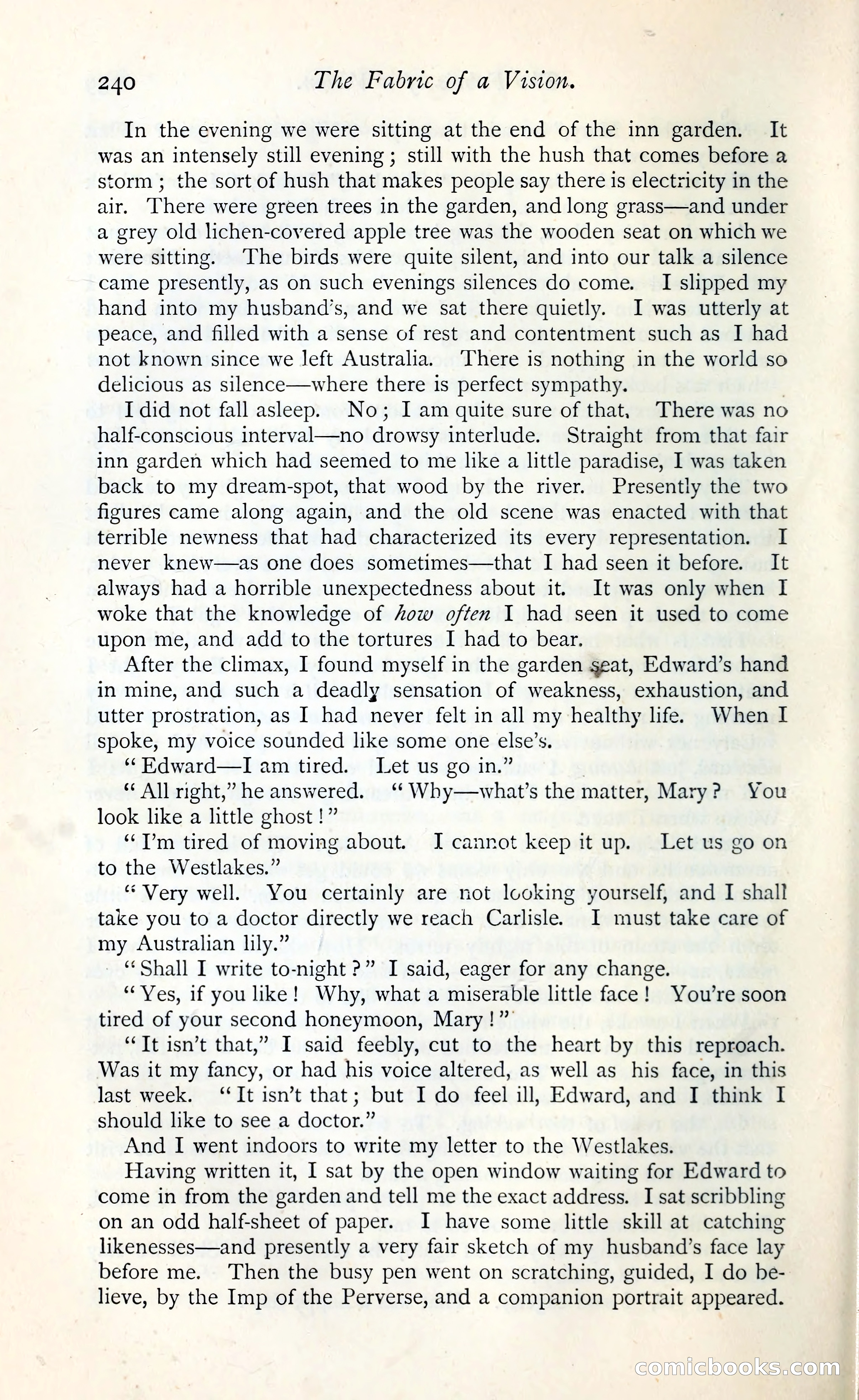
A restored page from Pulp Fiction, 1865. Page through the whole issue in the reader above.
📄 Transcribed text from this page (OCR, searchable)
Machine-transcribed from the original scan — historical spelling and the odd misread are preserved.
240 The Fabric of a Vision. In the evening we were sitting at the end of the inn garden. It was an intensely still evening; still with the hush that comes before a storm ; the sort of hush that makes people say there is electricity in the air. There were green trees in the garden, and long grass—and under a grey old lichen-covered apple tree was the wooden seat on which we were sitting. The birds were quite silent, and into our talk a silence came presently, as on such evenings silences do come. I slipped my hand into my husband’s, and we sat there quietly. I was utterly at peace, and filled with a sense of rest and contentment such as I had not known since we left Australia. ‘There is nothing in the world so delicious as silence—where there 1s perfect sympathy. : I did not fall asleep. No; I am quite sure of that, There was no half-conscious interval—no drowsy interlude. Straight from that fair inn garden which had seemed to me like a little paradise, I was taken back to my dream-spot, that wood by the river. Presently the two figures came along again, and the old scene was enacted with that terrible newness that had characterized its every representation. I never knew—as one does sometimes—that I had seen it before. It always had a horrible unexpectedness about it. It was only when I woke that the knowledge of how often I had seen it used to come upon me, and add to the tortures I had to bear. After the climax, I found myself in the garden seat, Edward’s hand in mine, and such a deadly sensation of weakness, exhaustion, and utter prostration, as I had never felt in all my healthy life. When I spoke, my voice sounded like some one else’s. “Edward—I am tired. Let us go in.” | All right,” he answered. ‘‘ Why—what’s the matter, Mary? You look like a httle ghost!” “T’m tired of moving about. J cannot keep it up. Let us go on to the Westlakes.” “Very well. You certainly are not looking yourself, and I shall take you to a doctor directly we reach Carlisle. I must take care of my Australian lily.” ‘Shall I write to-night ?” I said, eager for any change. “Yes, if you like! Why, what a miserable little face! You’re soon tired of your second honeymoon, Mary!” “Tt isn’t that,” I said feebly, cut to the heart by this reproach. Was it my fancy, or had his voice altered, as well as his face, in this last week. ‘‘It isn’t that; but I do feel ill, Edward, and I think I should like to see a doctor.” And I went indoors to write my letter to the Westlakes. Having written it, I sat by the open window waiting for Edward to come in from the garden and tell me the exact address. I sat scribbling on an odd half-sheet of paper. JI have some little skill at catching likenesses—and presently a very fair sketch of my husband’s face lay before me. Then the busy pen went on scratching, guided, I do be- lieve, by the Imp of the Perverse, and a companion portrait appeared. CORNICLOOKS (@) (EO) m