
Pulp Fiction, 1865 · page 236 of 400
The Argosy — page 236: what you’re looking at
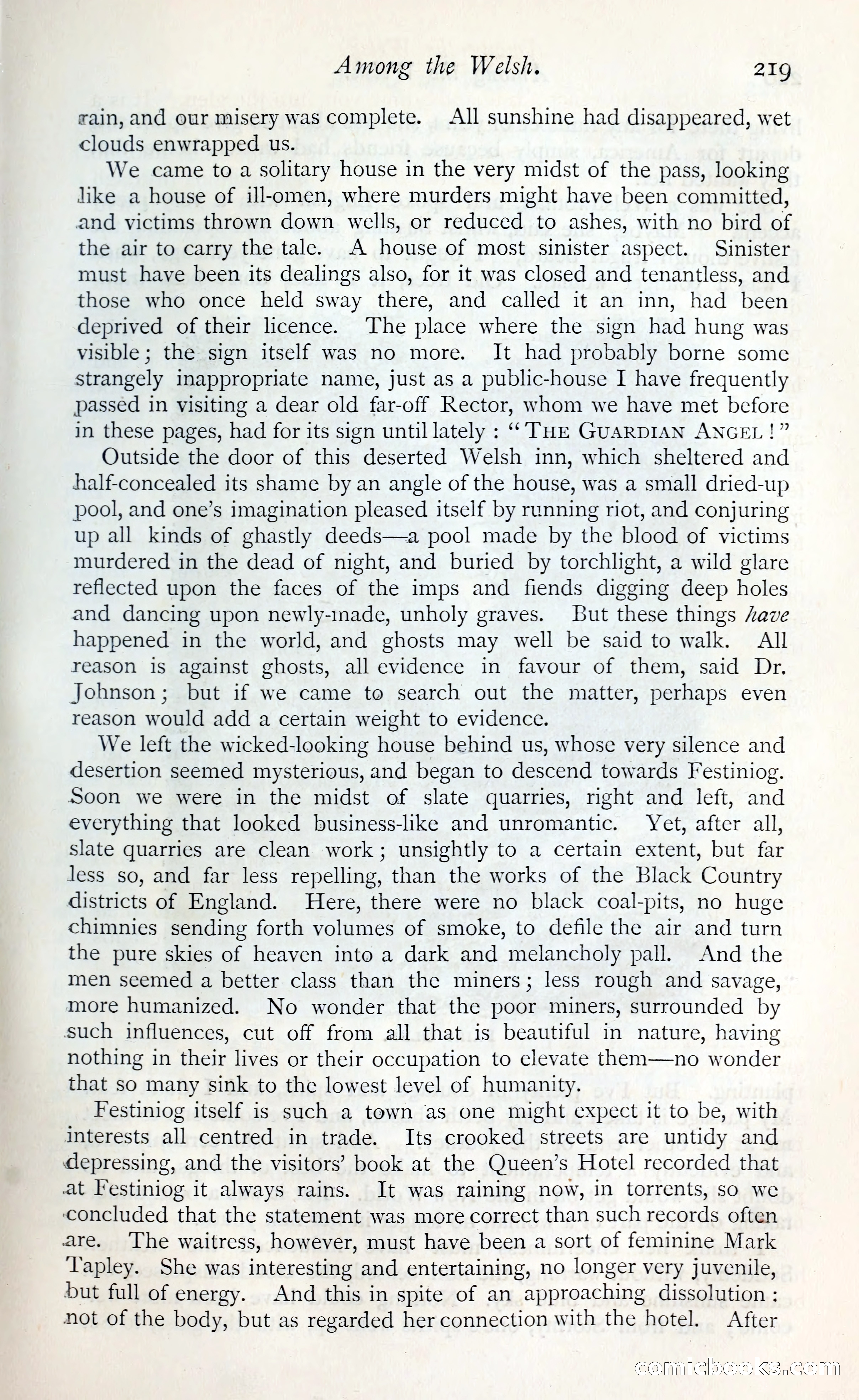
A restored page from Pulp Fiction, 1865. Page through the whole issue in the reader above.
📄 Transcribed text from this page (OCR, searchable)
Machine-transcribed from the original scan — historical spelling and the odd misread are preserved.
Among the Welsh. 219 rain, and our misery was complete. All sunshine had disappeared, wet clouds enwrapped us. We came to a solitary house in the very midst of the pass, looking like a house of ill-omen, where murders might have been committed, and victims thrown down wells, or reduced to ashes, with no bird of the air to carry the tale. A house of most sinister aspect. Sinister must have been its dealings also, for it was closed and tenantless, and those who once held sway there, and called it an inn, had been deprived of their licence. ‘The place where the sign had hung was visible; the sign itself was no more. It had probably borne some strangely inappropriate name, just as a public-house I have frequently passed in visiting a dear old far-off Rector, whom we have met before in these pages, had for its sign until lately : “ "THE GUARDIAN ANGEL!” Outside the door of this deserted Welsh inn, which sheltered and half-concealed its shame by an angle of the house, was a small dried-up pool, and one’s imagination pleased itself by running riot, and conjuring up all kinds of ghastly deeds—a pool made by the blood of victims murdered in the dead of night, and buried by torchlight, a wild glare reflected upon the faces of the imps and fiends digging deep holes and dancing upon newly-inade, unholy graves. But these things have happened in the world, and ghosts may well be said to walk. All reason 1s against ghosts, all evidence in favour of them, said Dr. Johnson; but if we came to search out the matter, perhaps even reason would add a certain weight to evidence. We left the wicked-looking house behind us, whose very silence and desertion seemed mysterious, and began to descend towards Festiniog. Soon we were in the midst of slate quarries, right and left, and everything that looked business-like and unromantic. Yet, after all, slate quarries are clean work; unsightly to a certain extent, but far less so, and far less repelling, than the works of the Black Country districts of England. Here, there were no black coal-pits, no huge chimnies sending forth volumes of smoke, to defile the air and turn the pure skies of heaven into a dark and melancholy pall. And the men seemed a better class than the miners; less rough and savage, more humanized. No wonder that the poor miners, surrounded by such influences, cut off from all that is beautiful in nature, having nothing in their lives or their occupation to elevate them—no wonder that so many sink to the lowest level of humanity. Festiniog itself is such a town as one might expect it to be, with interests all centred in trade. Its crooked streets are untidy and depressing, and the visitors’ book at the Queen’s Hotel recorded that at Festiniog it always rains. It was raining now, in torrents, so we concluded that the statement was more correct than such records often are. ‘The waitress, however, must have been a sort of feminine Mark Tapley. She was interesting and entertaining, no longer very juvenile, Dut full of energy. And this in spite of an approaching dissolution : not of the body, but as regarded her connection with the hotel. After COnNICLOOOKS (SO) am