
Pulp Fiction, 1865 · page 235 of 400
The Argosy — page 235: what you’re looking at
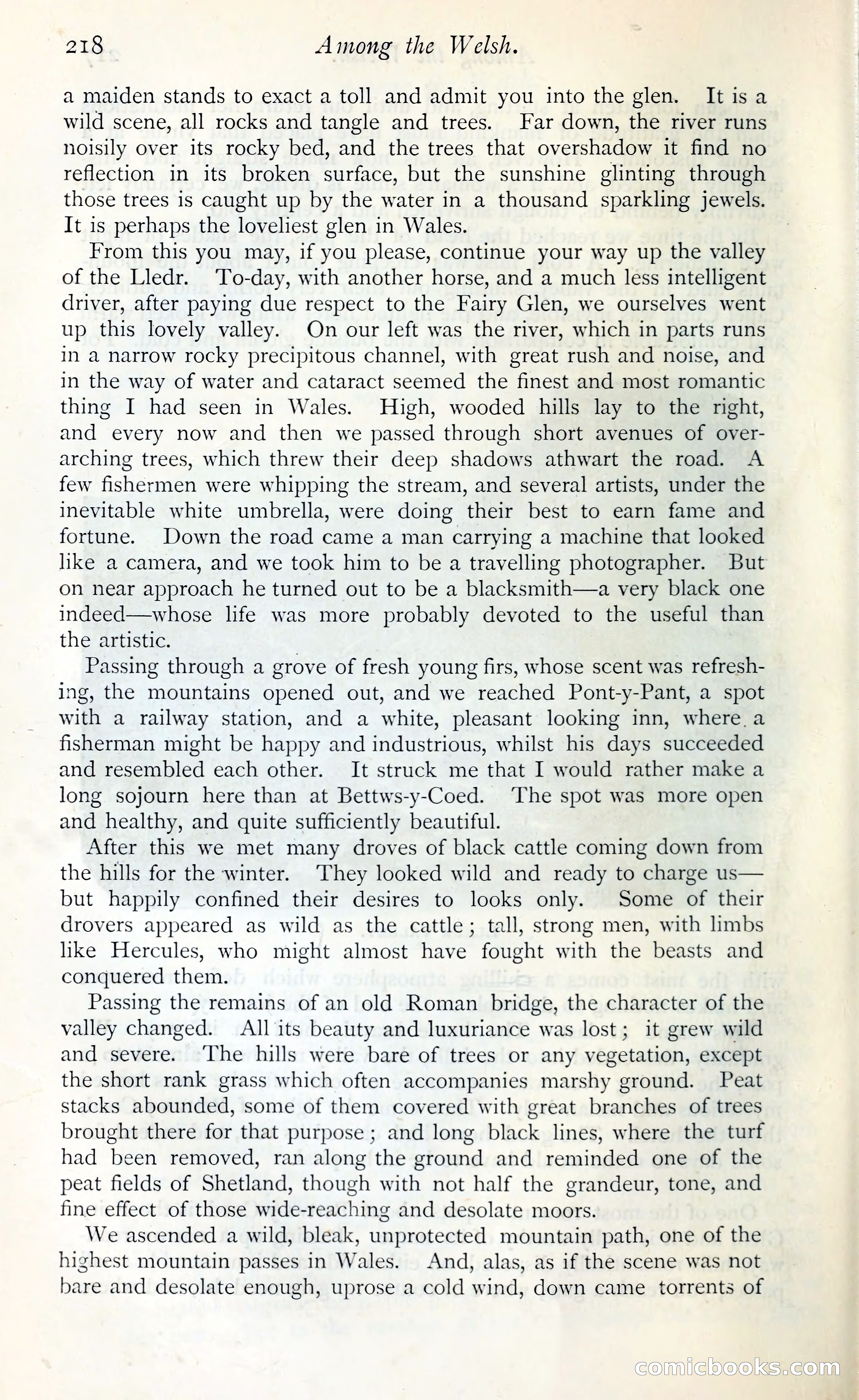
A restored page from Pulp Fiction, 1865. Page through the whole issue in the reader above.
📄 Transcribed text from this page (OCR, searchable)
Machine-transcribed from the original scan — historical spelling and the odd misread are preserved.
218 Among the Welsh. a maiden stands to exact a toll and admit you into the glen. Itisa wild scene, all rocks and tangle and trees. Far down, the river runs noisily over its rocky bed, and the trees that overshadow it find no reflection in its broken surface, but the sunshine glinting through those trees is caught up by the water in a thousand sparkling jewels. It is perhaps the loveliest glen in Wales. From this you may, if you please, continue your way up the valley of the Lledr. ‘To-day, with another horse, and a much less intelligent driver, after paying due respect to the Fairy Glen, we ourselves went up this lovely valley. On our left was the river, which in parts runs in a narrow rocky precipitous channel, with great rush and noise, and in the way of water and cataract seemed the finest and most romantic thing I had seen in Wales. High, wooded hills lay to the right, and every now and then we passed through short avenues of over- arching trees, which threw their deep shadows athwart the road. A few fishermen were whipping the stream, and several artists, under the inevitable white umbrella, were doing their best to earn fame and fortune. Down the road came a man carrying a machine that looked like a camera, and we took him to be a travelling photographer. But on near approach he turned out to be a blacksmith—a very black one indeed—whose life was more probably devoted to the useful than the artistic. Passing through a grove of fresh young firs, whose scent was refresh- ing, the mountains opened out, and we reached Pont-y-Pant, a spot with a railway station, and a white, pleasant looking inn, where. a fisherman might be happy and industrious, whilst his days succeeded and resembled each other. It struck me that I would rather make a long sojourn here than at Bettws-y-Coed. ‘The spot was more open and healthy, and quite sufficiently beautiful. After this we met many droves of black cattle coming down from the hills for the winter. They looked wild and ready to charge us— but happily confined their desires to looks only. Some of their drovers appeared as wild as the cattle; tall, strong men, with limbs like Hercules, who might almost have fought with the beasts and conquered them. Passing the remains of an old Roman bridge, the character of the valley changed. All its beauty and luxuriance was lost; it grew wild and severe. ‘The hills were bare of trees or any vegetation, except the short rank grass which often accompanies marshy ground. Peat stacks abounded, some of them covered with great branches of trees brought there for that purpose ; and long black lines, where the turf had been removed, ran along the ground and reminded one of the peat fields of Shetland, though with not half the grandeur, tone, and fine effect of those wide-reaching and desolate moors. We ascended a wild, bleak, unprotected mountain path, one of the highest mountain passes in Wales. And, alas, as if the scene was not bare and desolate enough, uprose a cold wind, down came torrents of EOMIGIOOKS (E() m